Tech+ 3.3 Lesson
Presentation
•
Information Technology (IT)
•
10th Grade
•
Practice Problem
•
Easy
Sean Carchidi
Used 1+ times
FREE Resource
16 Slides • 32 Questions
1
2
3
Multiple Choice
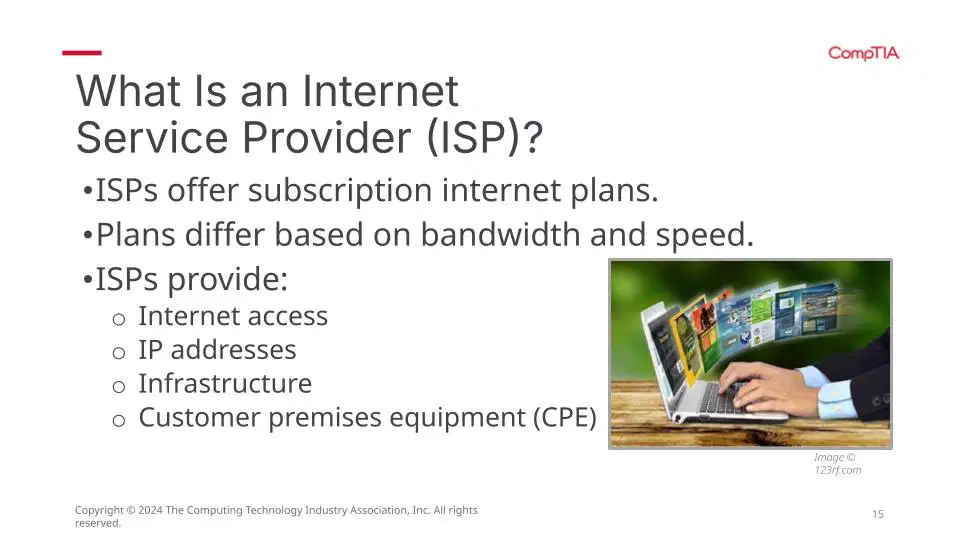
What Is an Internet Service Provider (ISP)?
4
Multiple Choice
What is a CPE?
5
Open Ended
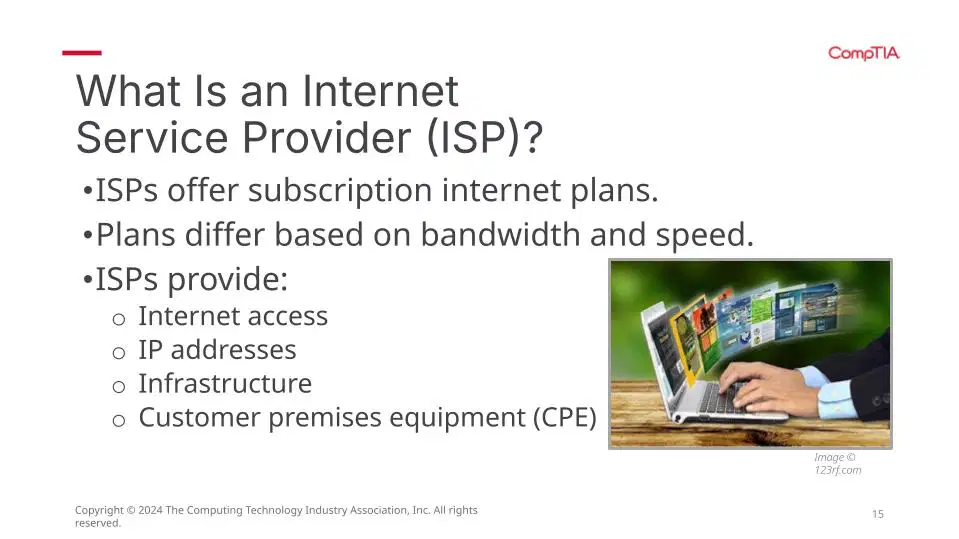
What do ISPs provide?
6
ISP plans
ISPs offer various plans with different bandwidth and speed options
Bandwidth: How much data you can transfer per second
Speed: How fast the data is transferred
Download and upload speeds can be:
Different (Asymmetrical)
The same (Symmetrical)
7
Multiple Choice
What is ISP bandwidth?
8
Multiple Choice
What does the "speed" mean from an ISP?
9
Multiple Choice
Asymmetrical speeds from an ISP mean?
10
Multiple Choice
Symmetrical speeds from an ISP mean...
11
Open Ended
What are the different types of internet connections?
12
13
Multiple Choice
What does latency mean?
14
Multiple Select
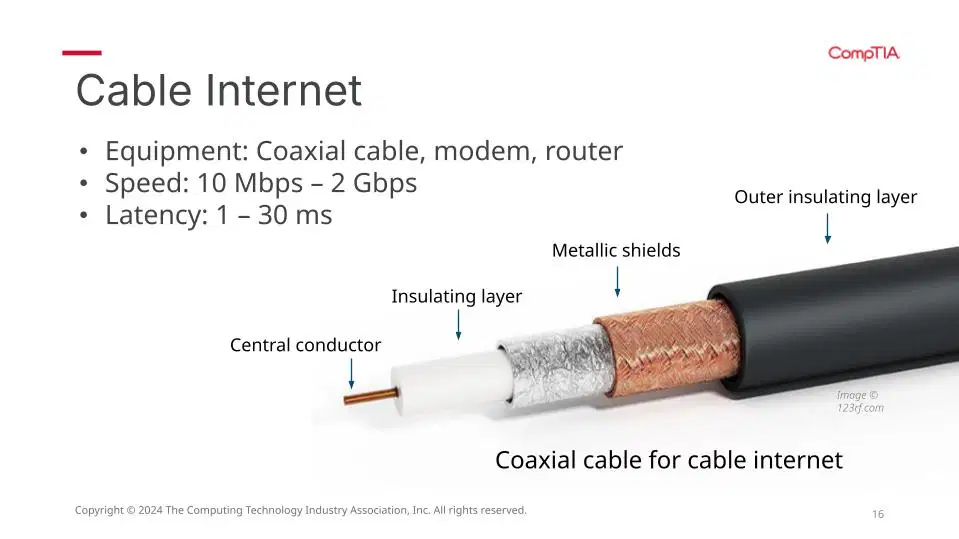
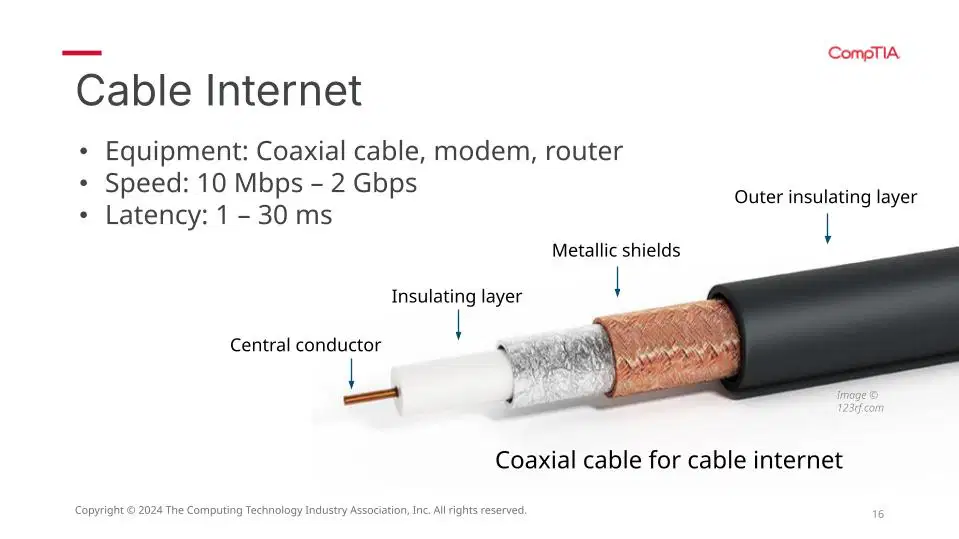
What equipment is needed for cable internet? Select more than one.
Cable modem
Coaxial cables
Router
15
Multiple Choice
When a cable modem converts digital data into an analog signal, what is it called?
16
Multiple Choice
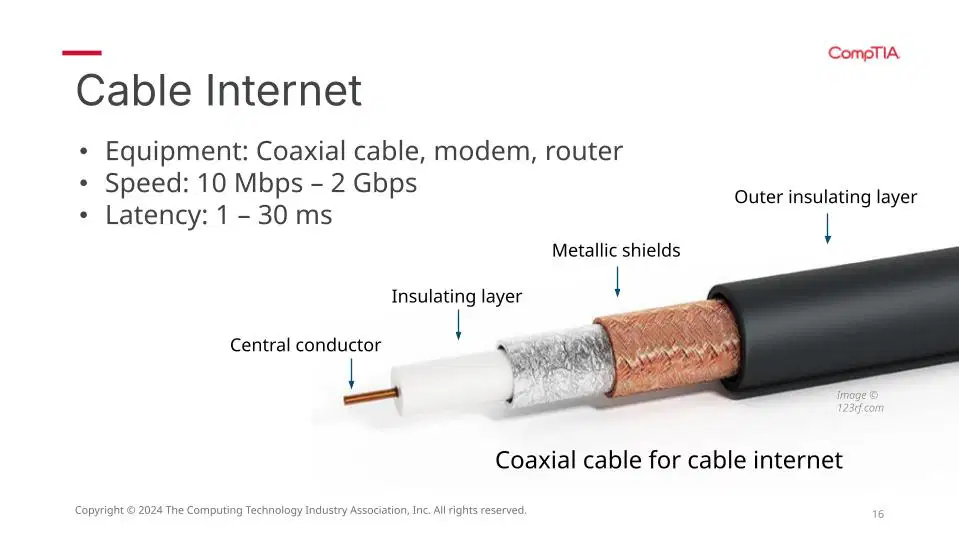
What is the FASTEST a cable modem connection can get to?
17
18
Multiple Choice
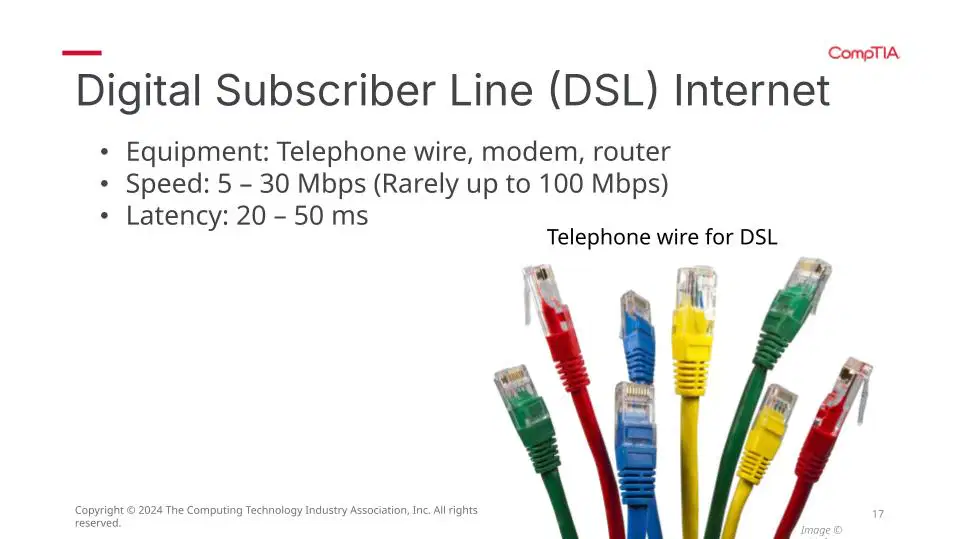
What does DSL mean?
19
Math Response
The max speed of cable internet is 2Gbps, which is about 2000Mbps. How much slower, by PERCENTAGE is DSL? (you are going to take the max speed of DSL and divide it into the max speed of cable)
20
Features of DSL
Features:
Typical speed is up to 30 Mbps (rarely up to 100 Mbps).
Latency is 20 ms up to 50 ms.
Most residential DSL is asymmetric (ADSL). That means downloading is faster than uploading.
Businesses and freelance professionals who work with large files usually prefer symmetric DSL (SDSL), so downloading and uploading are equally fast.
DSL internet speeds depend on:
The quality of the wiring
How far you are from your local phone company’s exchange or hub
21
Open Ended
According to the features, DSL internet speeds depends on...
22
23
Multiple Choice
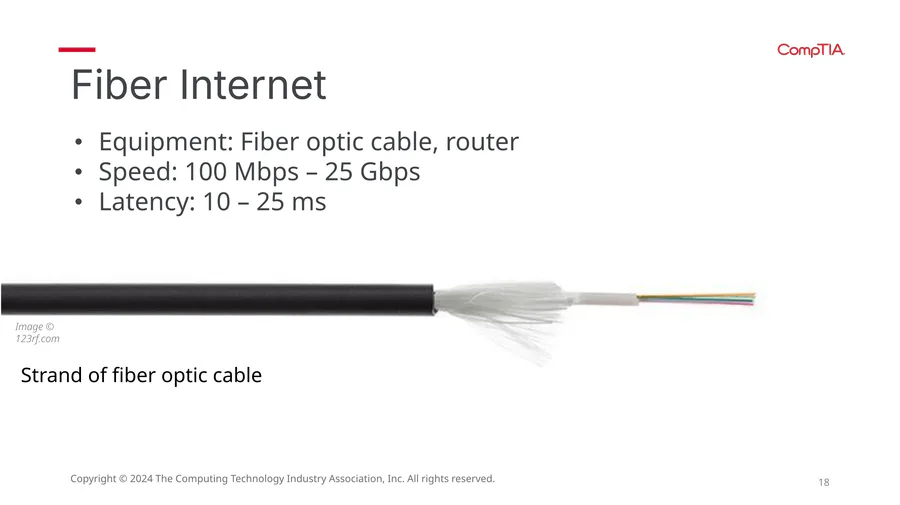
A fiber cable uses WHAT to transmit data.
24
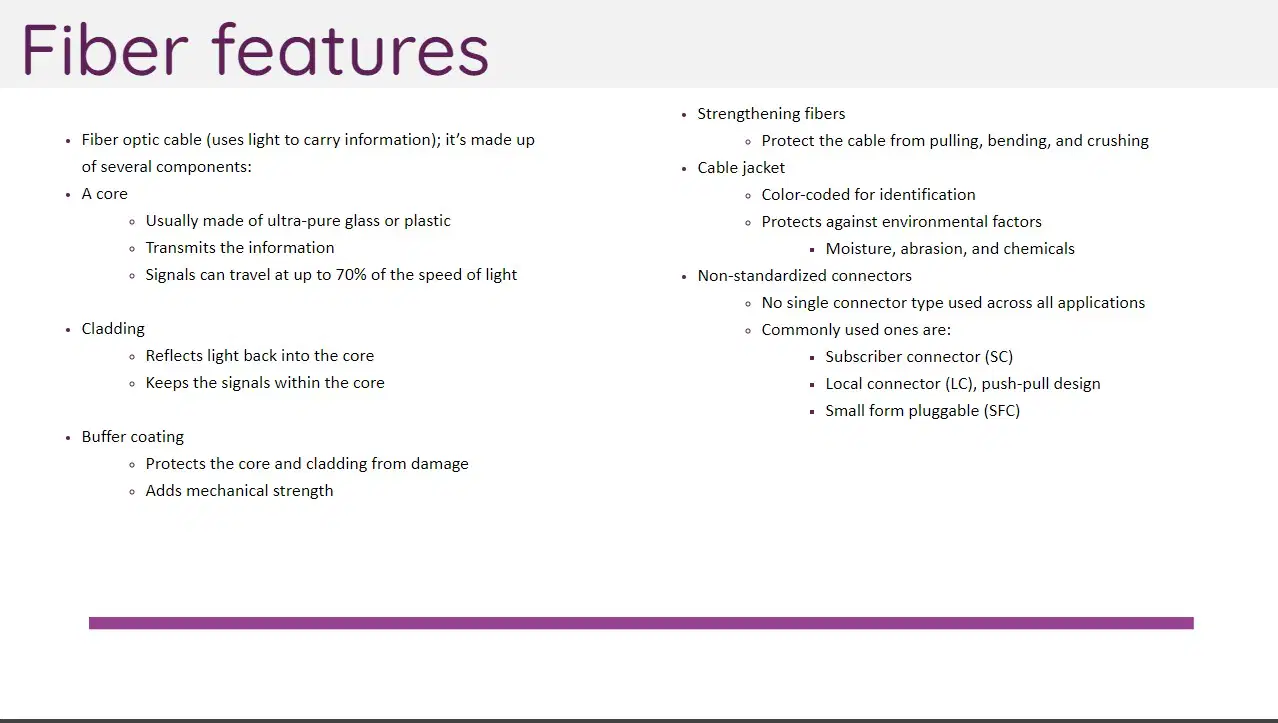
Fiber features
Fiber optic cable (uses light to carry information); it’s made up of several components:
A core
Usually made of ultra-pure glass or plastic
Transmits the information
Signals can travel at up to 70% of the speed of light
Cladding
Reflects light back into the core
Keeps the signals within the core
Buffer coating
Protects the core and cladding from damage
Adds mechanical strength
Strengthening fibers
Protect the cable from pulling, bending, and crushing
Cable jacket
Color-coded for identification
Protects against environmental factors
Moisture, abrasion, and chemicals
Non-standardized connectors
No single connector type used across all applications
Commonly used ones are:
Subscriber connector (SC)
Local connector (LC), push-pull design
Small form pluggable (SFC)
25
Multiple Select
A fiber cable is made up of these components:
copper
core
cladding
buffer coating
26
Open Ended
What are the fiber connector types?
27
Fiber features
Features:
High bandwidth
High-speed connections, up to 25 Gbps
Latency is 10 ms to 25 ms
Signals travel longer distances than other internet types.
Immunity to electromagnetic interference (EMI)
Durable, longer lifespan than wire cabling
Scalable
28
Multiple Select
What are some features of fiber connections?
high bandwidth & resistance to interference
high speed & low latency
long-distance capability
29
Multiple Choice
What is FTTC?
Fiber to the Curb(FTTC) is a broadband technology that combines fiber optic and copper cables.
30
31
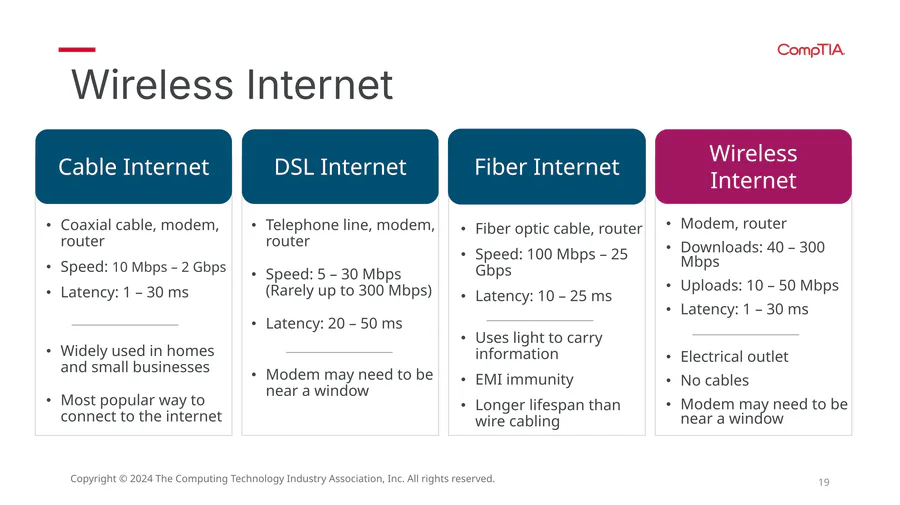
Wireless (cellular) features
Features:
Sends signals over cellular radio waves.
Enhanced speed connections with 5G:
Download speeds up to 300 Mbps
Upload speeds up to 50 Mbps
The speed is good for most of the things you do online.
Latency is 1 ms to 30 ms.
You can place your modem anywhere in your house.
No cable outlet needed.
Plug it into an electrical outlet.
If the signal is weak, you may need to place it near a window.
Widely used in homes and small businesses
32
Multiple Choice
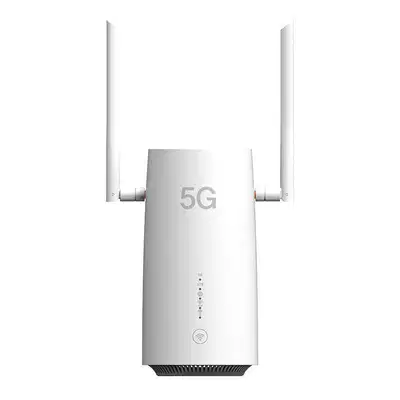
Where should you place a cellular modem?
33
Multiple Choice
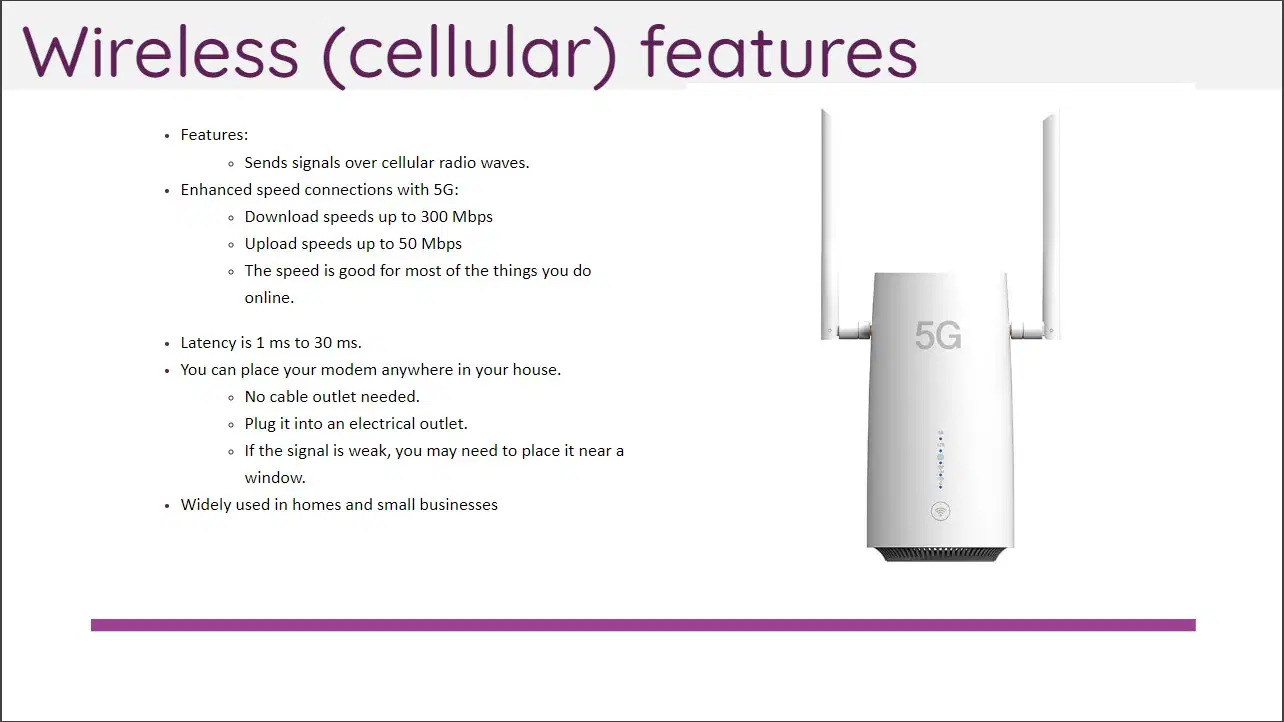
What is the max upload speed of a cellular modem?
Up to 50 Mbps
Up to 500 Mbps
Up to 10 Mbps
Up to 2 Gbps
34
35
Open Ended
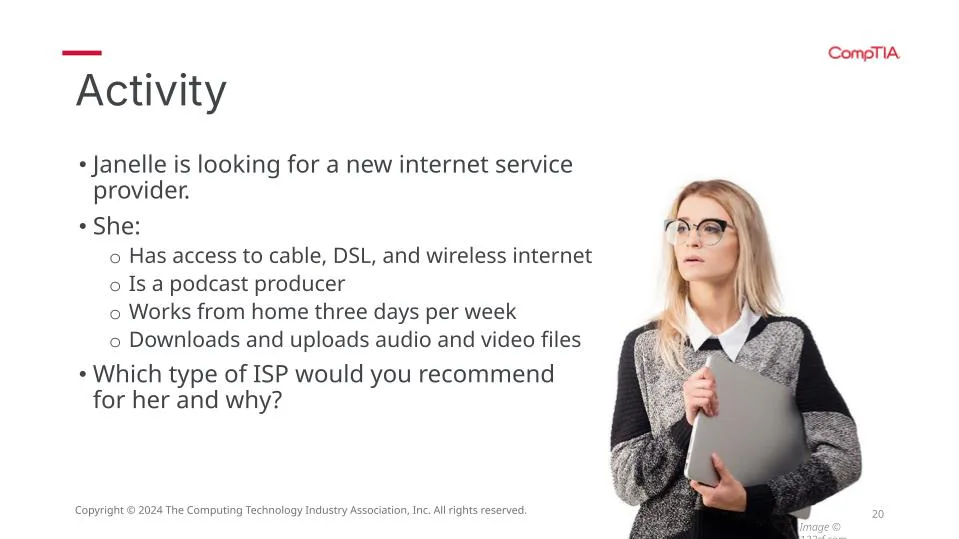
Which type of ISP would you recommend
for her and why?
36
37
Satellite features
Features:
Data is transmitted to and from a satellite orbiting earth.
Speed tends to be on the low side:
Download speeds up to 250 Mbps
Upload speeds usually 3 Mbps
Latency is usually more than 100 ms.
Relies on a satellite dish. The satellite company can help you find the best location for your dish.
Data caps may limit how much data you can use.
Bad weather can affect your signal.
38
Dropdown
Speed tends to be on the
Download speeds up to
Upload speeds usually
39
Dropdown
Relies on a satellite
Data
Bad
40
Multiple Choice
For satellite, why is the upload speed so low and the latency so high?
41
Multiple Choice
When would satellite internet be the best option?
42
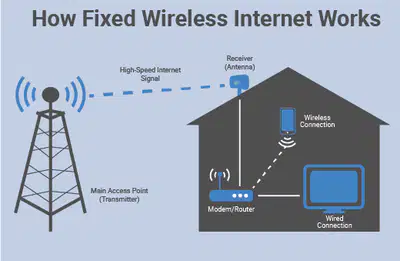
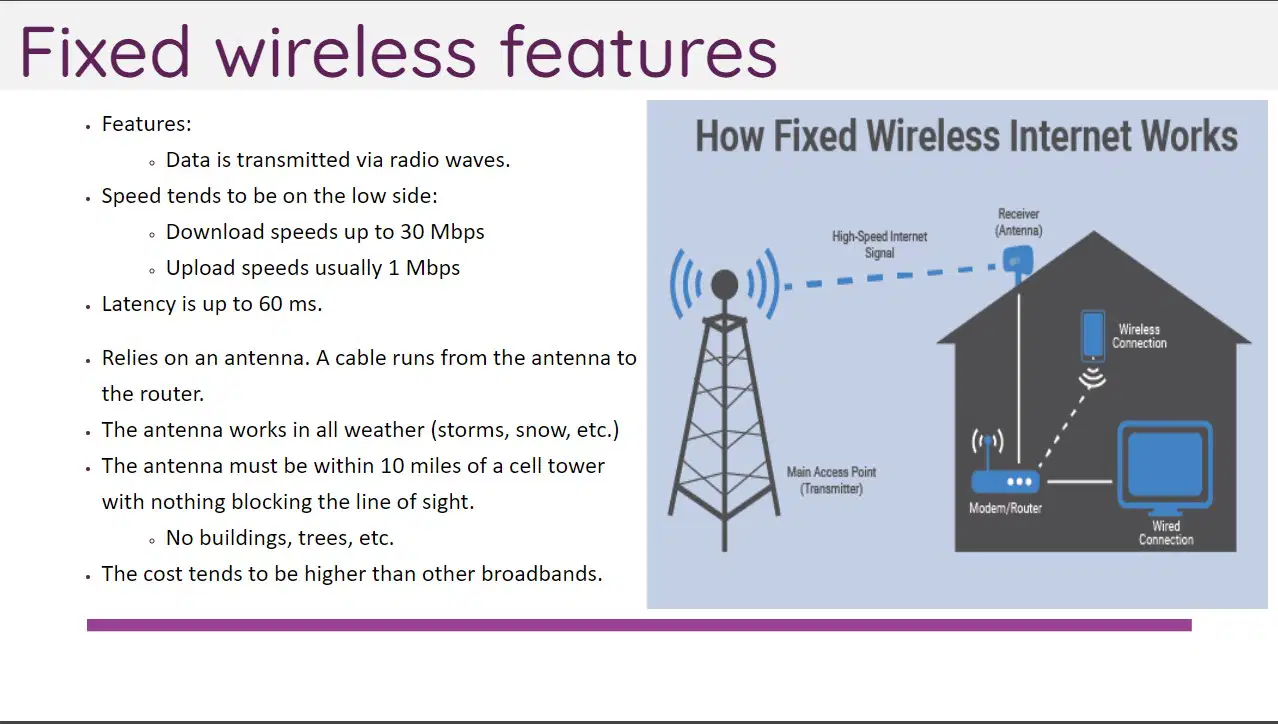
Fixed wireless features
Features:
Data is transmitted via radio waves.
Speed tends to be on the low side:
Download speeds up to 30 Mbps
Upload speeds usually 1 Mbps
Latency is up to 60 ms.
Relies on an antenna. A cable runs from the antenna to the router.
The antenna works in all weather (storms, snow, etc.)
The antenna must be within 10 miles of a cell tower with nothing blocking the line of sight.
No buildings, trees, etc.
The cost tends to be higher than other broadbands.
43
Dropdown
Speed tends to be on the
Download speeds up to
Upload speeds usually
44
Dropdown
Relies on an
The antenna must be within 10 miles of a
No buildings, trees, etc.
The cost tends to be
45
Open Ended
If someone’s only internet options are satellite and fixed wireless, what questions would you ask to help them decide between the two?
46
47
Word Cloud
What is the most important word you learned in this lesson?
48
Poll
How would you rate this lesson?
Great
Good
OK
Not a fan
Show answer
Auto Play
Slide 1 / 48
SLIDE

Similar Resources on Wayground
45 questions
PAST SIMPLE & PAST CONTINUOUS
Presentation
•
10th Grade
40 questions
Hellenims and Alexander the Great
Presentation
•
10th Grade
41 questions
End of the Year Spanish 1 Review
Presentation
•
9th - 11th Grade
40 questions
Globalization and Sustainability
Presentation
•
10th Grade
43 questions
SQL
Presentation
•
10th Grade
45 questions
Trigonometric Ratios
Presentation
•
10th Grade
44 questions
Animal Kingdom
Presentation
•
9th - 10th Grade
43 questions
Virus, plant and animal terms
Presentation
•
9th - 11th Grade
Popular Resources on Wayground
15 questions
Grade 3 Simulation Assessment 1
Quiz
•
3rd Grade
22 questions
HCS Grade 4 Simulation Assessment_1 2526sy
Quiz
•
4th Grade
16 questions
Grade 3 Simulation Assessment 2
Quiz
•
3rd Grade
19 questions
HCS Grade 5 Simulation Assessment_1 2526sy
Quiz
•
5th Grade
17 questions
HCS Grade 4 Simulation Assessment_2 2526sy
Quiz
•
4th Grade
20 questions
Equivalent Fractions
Quiz
•
3rd Grade
24 questions
HCS Grade 5 Simulation Assessment_2 2526sy
Quiz
•
5th Grade
20 questions
Math Review
Quiz
•
3rd Grade
Discover more resources for Information Technology (IT)
20 questions
Figurative Language Review
Quiz
•
10th Grade
20 questions
Earth Day Trivia
Quiz
•
9th - 12th Grade
10 questions
Earth Day Awareness and Impact
Interactive video
•
6th - 12th Grade
10 questions
Earth Day and Plastic Alternatives
Interactive video
•
5th - 10th Grade
5 questions
A.F/ST Quizizz Day 1
Quiz
•
9th - 12th Grade
100 questions
Biology EOC Review
Quiz
•
9th - 12th Grade
20 questions
Earth Day
Quiz
•
3rd - 12th Grade
16 questions
AP Biology: Unit 1 Review (CED)
Quiz
•
9th - 12th Grade