

Unit 3 Lesson 1: Newton's Laws

Presentation
•
Physics
•
9th - 12th Grade
•
Easy

Kaye Pickett
Used 2+ times
FREE Resource
19 Slides • 33 Questions
1

NEWTON'S LAWS
Chapter 5
1
2

FORCE
A force is a push or a pull.
A force is an action that has the ability to change
motion.
Forces do not always create a change of motion,
but they could.
2
3

INERTIA: NEWTON’S FIRST LAW
Newton’s First Law: An object will move at a
constant velocity until a force acts upon it.
In other words, an object will keep doing what it’s
doing until forced to change.
3
4

INERTIA: WHATCAUSESIT?
Inertia is an object’s ability to RESIST a change
of motion.
The word “inertia” comes from the Latin word for
lazy.
How easy/difficult is it to change what an object
is doing?
Easy ➔ Low inertia
Difficult ➔ High inertia
4
5
6

INERTIAVS. MASS
Inertia is a physical property of MASS.
What is MASS? Mass is the amount of matter in
an object. It does not reflect the amount of space
it takes up.
Mass doesn’t change from position or speed or
acceleration*
*at non-relativistic speeds, that is
5
7

EVERYDAYEXAMPLEOF INERTIA
If you are in a car without a seatbelt that is
traveling down the road, and the car suddenly
brakes, you will fly forward.
Since you are a separate object from the car and
you are traveling at a velocity, you will want to
continue traveling at that velocity. When the car
stops, you will keep going until forced to stop by
the road or the windshield.
Seat belts make us a “part of the car,” so when
the car stops, so do we.
6
8

MAGICOR PHYSICS?
A magician pull a tablecloth out from a perfelcty
set table. The dishes remain in place.
7
The dishes have inertia, which mean
that they won’t want to move
sideways. When the tablecloth is
pulled very rapidly and doesn’t have
time to react with the dishes, they
stay put.
9
Multiple Choice
When an object does not want to change motion, it is called ________________.
inertia
motion
10
Multiple Choice
Kicking a ball is an example of ________________.
force
speed
11
Multiple Choice
A force is a _________________.
push or pull
speed
12
Multiple Choice
Newton's first law states that an object in motion stays in motion and an object at rest stays at rest unless acted on by ______________________________.
a balanced force
an unbalanced force
13
Multiple Choice
Which has more Inertia?
a skateboard
a truck
14
Multiple Choice
What kind of objects have inertia?
all objects with mass
only objects in motion
15
Multiple Choice
Which type of force will cause an object to change motion?
balanced force
unbalanced force
16
Multiple Choice
What can a force do?
start a motion
stop a motion
change the direction of the motion
all of the above
17
Multiple Choice
The amount of matter in an object is called ________________.
weight
mass
18
Multiple Choice
Objects with greater ________________ have more inertia.
mass
speed
19
Multiple Choice
Newton's first law is also called the law of __________________
motion
inertia
20
Multiple Choice
According to Newton's first law of motion, if you were riding in a car and hit another car in front of you without wearing a seatbelt, you would _______________.
fall forward because your body keeps moving in that direction
fall back because of force
21
Multiple Choice
A book will not move by itself because it has ________________.
gravity
inertia
22
Multiple Choice
When a car stops suddenly, your body tends to keep moving ______________________.
backwards
forward
23
Multiple Choice
Balanced forces cause ________________________.
no motion
motion
24

NEWTON’S SECOND LAW: F=MA
Newton’s second law states that the acceleration
of an object is directly proportional to the applied
force and indirectly proportional to its mass.
8
ma
F =ma
25

UNITSOF FORCE
The equation symbol for force is F.
The SI unit of force is the Newton (N).
Definition: 1 Newton the amount of force
required to accelerate 1kg by 1m/s2.
Therefore, the Newton is a derived unit and
9
1 N =
1 kg m
s2
26


QUICK EXAMPLE
Caleb pushes Chris with a force of 56N. If Chris’
mass is 82kg, what is his acceleration?
10
27

SOLUTION: SET UP
Knowns and Unknowns:
F = 56N; m = 82kg; a = ???
Equation:
Isolate the variable.
11
ma
F =
a =
F
m
28
Math Response
Caleb pushes Chris with a force of 56N. If Chris’ mass is 82kg, what is his acceleration in m/s2?
29


SOLUTION
Plug in numbers
12
2
68
.0
82
56
=
=
=
30

ANOTHER EXAMPLE
Eric pushes Ariel with a force of 97N and she
accelerates at 2.1m/s2. What is her mass?
13
31
Math Response
Eric pushes Ariel with a force of 97N and she accelerates at 2.1m/s2. What is her mass in kg?
32
Multiple Choice

33
Multiple Choice
34
Multiple Choice
35
Multiple Choice
36
Multiple Choice
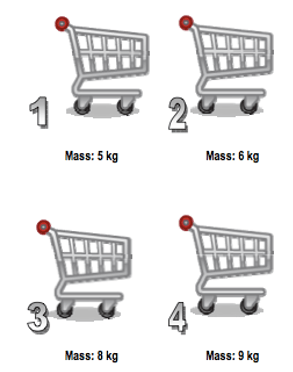
37
Multiple Choice
A ball has an acceleration of 8 m/s2. If the force is tripled, the ball's new acceleration will be:
24 m/s2
11 m/s2
unchanged
2.67 m/s2
38
Multiple Choice
An object is moving with an acceleration of 6 m/s2. If the force is doubled and the mass is cut by one-third, the new acceleration will be:
4 m/s2
1 m/s2
36 m/s2
unchanged
39
Multiple Choice

These two force arrows are acting on an object. The net force (in N) acting on this object is:
16
12
28
4.0
40
Multiple Choice
41
Multiple Choice
A 20 kg bike accelerates at 10 m/s2. what was the force?
F = m x a
25 Newtons
20 Newtons
200 Newtons
10 Newtons
42
Multiple Choice
I the mass of an object is 10 kg. And the acceleration is 10 m/s2, what is the force on the object?
1000 N
20 N
10 N
100 N
43
Multiple Choice
If the mass of an object is 5 kg, and the acceleration is 2 m/s2. What is the force?
10 N
7 N
3 N
12 N
44

NEWTON’S THIRD LAW
Action and Reaction
14
45

THIRD LAW
Newton’s third law states that for every action
there is an equal and opposite reaction.
If you push it, it pushes back!!
The action/reaction forces are acting on different
objects.
You push on the wall, the wall pushes on you.
You stand on the floor, the floor holds you up.
The hammer hits the nail, the nail pushes back on
the hammer.
15
46
Multiple Choice
A baseball player hits a ball with 400 N of force. How much force does the ball exert on the bat?
300
400
500
Not enough info to tell
47
Multiple Choice
Your friend pushes you for making fun of him/her. What is the reaction force?
You pushing back on your friend
You pushing on the ground
There is no reaction force
Your friend pushing on the ground
48
Multiple Choice
When you jump up, you push the earth downwards. Why can't you tell that the earth has moved?
The force of you jumping up doesn't actually push the earth down.
The earth has much more mass so it doesn't move at all
The earth is firmly rooted
The earth has much more mass so you can't tell that it moved
49
Multiple Choice
When you hit a tennis ball with a racket...
The ball exerts more force on the racket
The ball and racket exert the same force on each other
The racket exerts more force on the ball
It depends on how hard you hit it
50

NORMAL FORCE
The normal force, FN, is the force of the surface
pushing back on the object.
It is the reaction to the action.
For example, if you push on a wall, the force with
which the wall pushes back on you is the normal
force.
16
Fapp
FN
Normal force is ALWAYS
perpendicular to the
surface
Normal force only
occurs with
contact forces
51


USING NEWTON’S THIRD LAW
When you walk forward, you push against the
ground. You push the ground backward slightly,
while the ground pushes you forward.
A jet engine pushes massive amounts of air
behind it, which propels the plane forward
Space shuttle launch
17
52


CONSIDERTHEFOLLOWING:
If everyone on Earth gathered in a straight line
around the equator and began walking in the
same direction, could we affect the rotation of the
Earth?
18
NEWTON'S LAWS
Chapter 5
1
Show answer
Auto Play
Slide 1 / 52
SLIDE
Similar Resources on Wayground

44 questions
Properties of Water
Presentation
•
9th - 12th Grade
47 questions
LAB SAFETY - SPRING 2022
Presentation
•
9th - 12th Grade
49 questions
Pedigrees
Presentation
•
9th - 12th Grade
48 questions
Biogeochemical Cycles: Nutrient Cycles
Presentation
•
9th - 12th Grade
46 questions
Biomolecule terms - photosynthesis and respiration
Presentation
•
9th - 12th Grade
46 questions
Simple Harmonic Motion & Spring Pendulum Notes
Presentation
•
9th - 11th Grade
46 questions
Newton's Three Laws of Motion Class Lesson
Presentation
•
9th - 12th Grade
44 questions
Irregular Present Tense Verbs
Presentation
•
9th - 12th Grade
Popular Resources on Wayground
10 questions
How much do you know about our Portrait of an Eagle?

Quiz
•
10th Grade
10 questions
Fast Food Slogans
Quiz
•
6th - 8th Grade
21 questions
Continents and Oceans
Quiz
•
6th Grade
20 questions
Parts of Speech
Quiz
•
5th Grade
16 questions
Subject & Predicate
Quiz
•
5th Grade
25 questions
Multiplication Facts
Quiz
•
5th Grade
12 questions
Map Skills
Quiz
•
3rd Grade
22 questions
Continents and Oceans
Quiz
•
5th Grade
Discover more resources for Physics
20 questions
Position vs. Time Graphs
Quiz
•
9th Grade
20 questions
Calculating Net Force
Quiz
•
6th - 9th Grade
18 questions
Interpreting Motion Graphs
Presentation
•
9th - 12th Grade
10 questions
Exit Check 4.1 - Destructive Processes
Quiz
•
9th Grade
21 questions
Distance/Time Graphs
Quiz
•
9th Grade
20 questions
Unit 2 - Waves Test - 2026
Quiz
•
9th - 12th Grade
10 questions
Exit Check 4.2 - Constructive Forces
Quiz
•
9th Grade
10 questions
Exit Check 4.3 - Conservation of Momentum
Quiz
•
9th Grade