Search Header Logo
Chapter 5 Lecture Slides Quizizz

Chapter 5 Lecture Slides Quizizz

Assessment

Presentation

Chemistry

9th - 12th Grade

Easy

Created by

NICOLE MILLER

Used 1+ times

FREE Resource

66 Slides • 34 Questions

1

media

2

media

3

media

4

media

5

media

6

media

7

media

8

Multiple Choice

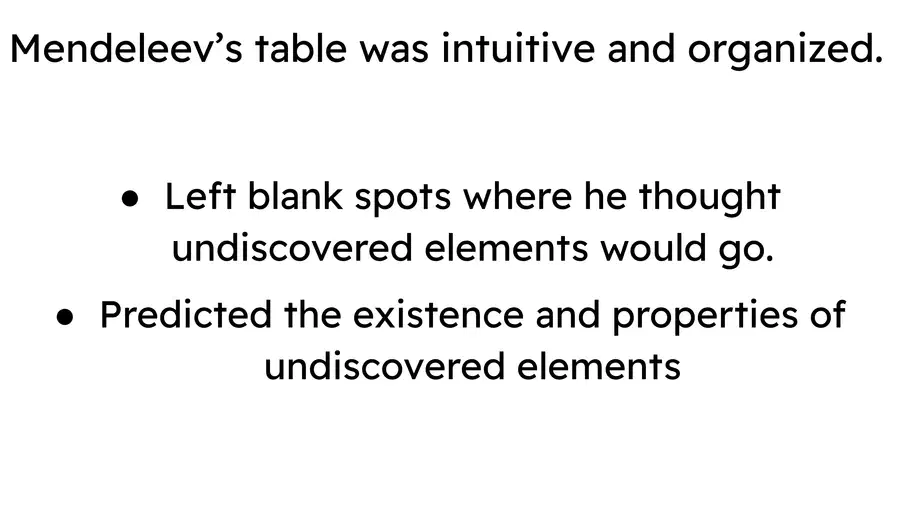
What was a notable feature of Mendeleev's periodic table?
1
It arranged elements in alphabetical order.
2
It included all known elements at the time.
3
It left gaps for undiscovered elements and predicted their properties.
4
It was based solely on the atomic number of elements.

9

media

10

media

11

media

12

media

13

media

14

media

15

media

16

media

17

media

18

media

19

media

20

media

21

Multiple Choice

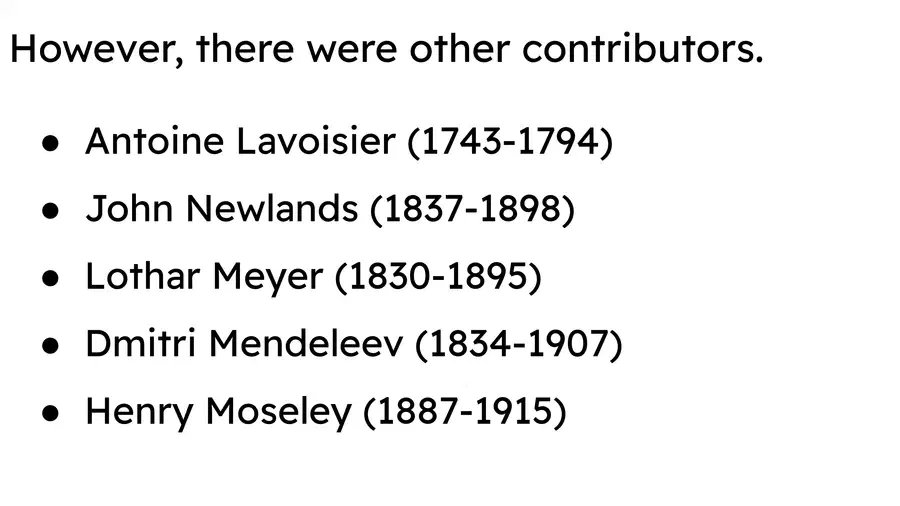
What discovery did Henry Moseley make in 1913 that changed the periodic table?
1
He discovered the neutron.
2
He discovered the atomic number.
3
He discovered the electron.
4
He discovered isotopes.

22

media

23

media

24

media

25

Multiple Choice

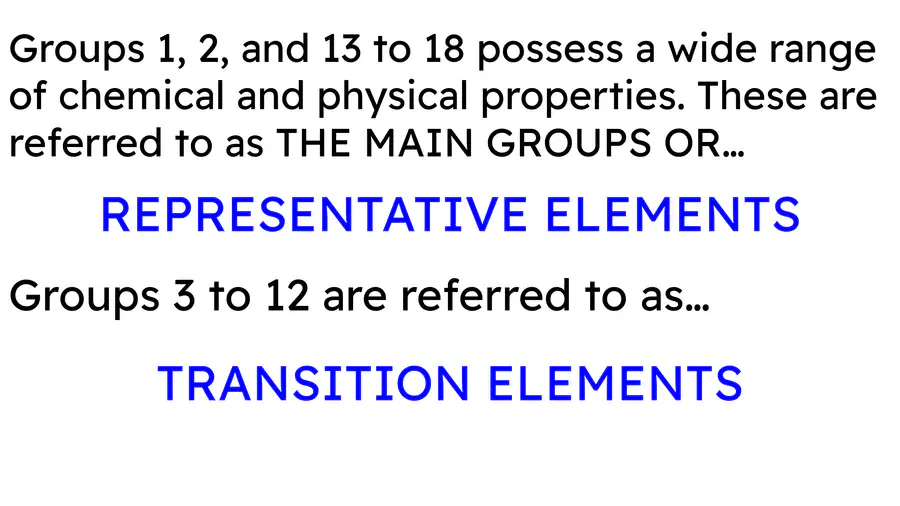
What organizational structure does the periodic table use?
1
Random arrangement.
2
Both periods and groups.
3
Only periods.
4
Only groups.

26

Multiple Choice

The vertical columns on the periodic are called _______________.

1

Rows

2

Periods

3

Groups

4

Valence

27

Multiple Choice

The horizontal rows of the Periodic Table are called ______________.

1

Periods

2

Groups

3

Families

4

Halogens

28

media

29

media

30

media

31

media

32

media

33

Hotspot

Which group is the Alkali Metals?

34

media

35

Hotspot

Which group is the Alkaline Earth Metals?

36

media

37

media

38

media

39

media

40

Hotspot

Which group is the Halogens?

41

Hotspot

Which group is the Noble Gases?

42

media

43

Drag and Drop

The ​
boarder the staircase & have properties of both metals and nonmetals. They are ​
, ​
, and ​
.
Drag these tiles and drop them in the correct blank above
metalloids
shiny
brittle
semi-conductors
transition metals
dull
strong
good conductors
bad conductors
man-made

44

Hotspot

Which side of the periodic table are the nonmetals located?

45

Hotspot

Which side of the periodic table are the metals located?

46

Categorize

Options (10)

copper

potassium

strontium

magnesium

carbon

chlorine

nitrogen

argon

helium

silver

Categorize the options into the right categories

Metals
Nonmetals

47

media

48

media

49

media

50

media

51

media

52

media

53

media

54

media

55

media

56

media

57

media

58

Multiple Choice

Identify the Electron Configuration for Aluminum (Al)

1

1s2 2s2 2p6 3s2 3p1

2

1s2 2s2 2p6 3s2 3p3

3

1s2 2s2 2p6 3s2 4p1

59

Match

Question image

Match the parts of the electron configuration to what it represents.

1

s

2

period

block

element

60

Match

Match the group to the configuration that it ends with.

s1

s2

p5

p6

alkali metals

alkaline earth metals

halogens

noble gases

61

Multiple Choice

What are the missing pieces?

1s2 2s2 2p6 ___ 3p6 4s2 ___ 4p2

1

3s2 , 4d10

2

2p4 , 3d10

3

3p6 , 3d10

4

3s2 , 3d10

62

Match

Match the element to it's noble gas notation:

krypton

silicon

strontium

copper

[Kr]

[Ne] 3s2 3p2

[Kr] 5s2

[Ar] 4s2 3d9

63

media

64

media

65

media

66

media

67

media

68

media

69

media

70

media

71

media

72

Multiple Choice

Which of the following will have a larger radius than Zinc?
1
Gallium
2
Aluminum
3
Magnesium
4
Strontium

73

Multiple Choice

Which atom has the largest atomic radius?
1
potassium
2
rubidium 
3
francium
4
cesium

74

media

75

media

76

media

77

Multiple Choice

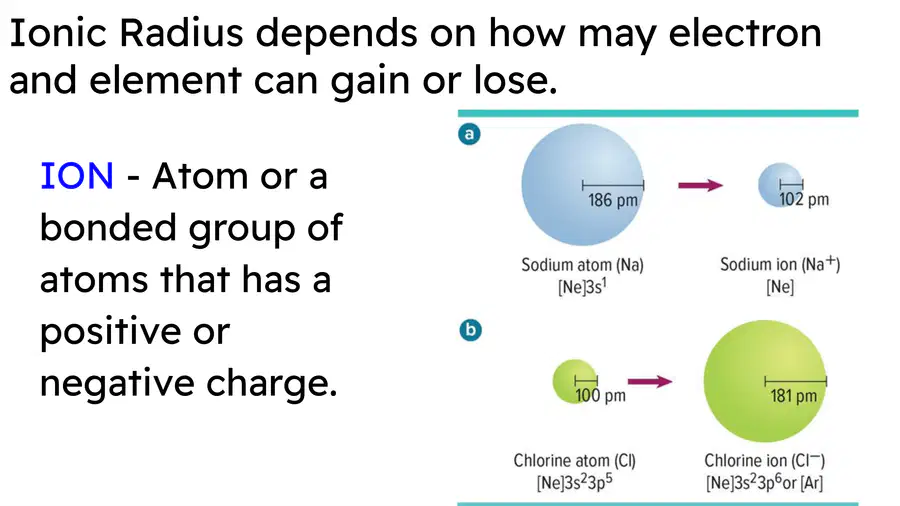
Which types of elements from cations?

1

metals

2

nonmetals

3

metalloids

4

noble gases

78

Multiple Choice

Which types of elements from anions?

1

metals

2

nonmetals

3

metalloids

4

noble gases

79

Multiple Choice

What is the ion formed from Sulfur?

1

S+2

2

S-2

3

S+6

4

S-6

80

Multiple Choice

Atomic radius generally increases as we move __________.  
1
down a group and from right to left across a period 
2
up a group and from left to right across a period 
3
down a group and from left to right across a period 
4
up a group and from right to left across a period 

81

media

82

media

83

media

84

media

85

Multiple Choice

Which ion has the smaller radius?

1

P3-

2

Cl-

86

Multiple Choice

Which species has the larger radius?

1

Na

2

Na+

87

Multiple Choice

Which species has the larger radius?

1

I

2

I-

88

media

89

media

90

media

91

media

92

Multiple Choice

Which of the following will have a lower ionization energy than Scandium (Sc)?
1
Helium (He)
2
Titanium (Ti)
3
Calcium (Ca)
4
Magnesium (Mg)

93

Multiple Choice

Ionization energy is...
1
the energy required to add an electron to a specific atom
2
how much energy it takes to remove an electron from an atom
3
the energy required to shield the outer electrons from the nucleus
4
a measure of the ability of an atom to attract electrons

94

media

95

media

96

Multiple Choice

Which has the greater EN: 
Cl or Al?
1
Cl
2
Al

97

Multiple Choice

Which has the greater EN: 
H or F?
1
H
2
F

98

Multiple Choice

Which of the following will have a higher electronegativity than arsenic (As)?
1
Carbon (C)
2
Neon (Ne)
3
Antimony (Sb)
4
Germanium (Ge)

99

Multiple Choice

Electronegativity is...
1
how good an atom is at attracting electrons
2
the ability of an atom to lose electrons
3
the energy required to remove an electron from a specific atom
4
how easy it is to make friends. 

100

Multiple Choice

Electronegativity __________ from left to right within a period and __________ from top to bottom within a group.
1
decreases, increases 
2
increases, increases
3
increases, decreases 
4
stays the same, increases
media

Show answer

Auto Play

Slide 1 / 100

SLIDE