

People in Science

Presentation
•
Science
•
5th Grade
•
Practice Problem
•
Medium
+16
Standards-aligned

Michael Stephens
Used 4+ times
FREE Resource
28 Slides • 8 Questions
1

TEKS 5.8.A - Energy Transformations
2

Marshall Watson, PhD is a petroleum engineer. Petroleum engineers find ways to extract petroleum, including oil and gas, from different sources.
Marshall Watson
3
Petroleum engineers must be knowledgeable in many fields of science, and experts in properties of matter, properties of rock, as well as energy transformations.
Marshall Watson
4
To successfully extract oil, petroleum engineers know that oil has a different relative density than water, so it floats. They know that liquids can move between layers of rocks also.
Marshall Watson
5
This knowledge is used to design and improve technology to find fossil fuels.
Marshall Watson
6
Watson began his career in 1981 as a reservoir engineering expert. Reservoir engineering is the part of petroleum engineering that focuses on how to extract the petroleum without losing any to the surrounding rocks.
Marshall Watson
7

Watson’s work took him all over the United States planning new extraction sites and improving efficiencies at existing locations.
Marshall Watson
8

After a 30-year career in the field, Watson returned to college. He received his doctorate in petroleum engineering from Texas Tech in 2008.
Marshall Watson
9

Now, Watson uses his extensive knowledge to help other petroleum engineers. He holds two patents for inventions that help drill new sources of natural gas.
Marshall Watson
10
His horizontal drilling invention uses high-powered water jets and allows petroleum companies to reach sources of energy that a traditional vertical drilling method alone cannot.
Marshall Watson
11
His hydraulic fracturing invention also uses water. The water breaks up underground rock so that the petroleum can be reached.
Marshall Watson
12
Each of these inventions built upon previous scientific work to reach deeper and more challenging pockets of petroleum.
Marshall Watson
13

Since 2013, Watson has been a professor at Texas Tech. He is the chair of the Bob L. Herd Department of Petroleum Engineering. He is the past president of the Society of Petroleum Evaluation Engineers where he mentored others.
Marshall Watson
14

Under Watson’s leadership, the Texas Tech’s East Campus Oilfield Technology Center has grown to the premier petroleum research location in the country.
Marshall Watson
15
In 2023, they expanded their facility to include a complete working oil rig that students can use to learn. Students are able to model changes to the systems to make it more efficient and potentially cheaper too.
Marshall Watson
16
Multiple Choice
Since 2013, Watson has been a professor at _____.
Texas Christian University
Texas Tech
The University of Texas
17
Drag and Drop
18
Multiple Select
Petroleum engineers must be knowledgeable in many fields of science, and experts in properties of matter, properties of rock, as well as energy transformations. (Choose all that apply.)
properties of matter
shark anatomy
energy transformations
properties of rock
19
Drag and Drop
20
Multiple Select
What kinds of things would a petroleum engineer study? (Choose all that apply.)
ways to make steel stronger for building
ways to reach a natural gas reserve deep underground
the best location for an oil platform in the ocean
the best location to search for fossils in the desert
21

Steven Chu, PhD is a physicist. A physicist is a scientist who studies matter, energy, and motion. Physicists also study how these forces can be used to support the things we do and need in everyday life, such as energy.
Steven Chu
22
Physicists analyze and collect data, perform studies, and run simulations to better understand how things in life work.
Steven Chu
23
Chu received his doctorate in physics from the University of California–Berkeley in 1976. Chu and his colleagues studied how tiny particles can be cooled and trapped with lasers. He won the Nobel Prize in Physics in 1997 for this discovery.
Steven Chu
24
Chu served as the 12th United States Secretary of Energy from 2009 to 2013. Chu was the first Asian American to hold this position. The U.S. Secretary of Energy is the head of the Department of Energy for the country.
Steven Chu
25
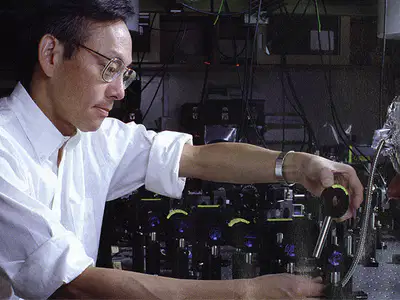
Chu wants to see more research on science that our rapidly changing society can benefit from, such as renewable energy, nuclear power, and even alternative building materials.
Steven Chu
26
Energy storage costs and development are very high, so research and investment are needed to make renewable or nuclear energy sources more affordable for all countries.
Steven Chu
27
He advocates for smart building solutions, like using more wood in structures. Buildings made from wood are strong and safe, and wood is quicker to be replenished than traditional building materials.
Steven Chu
28

Chu uses the example of improvements of batteries over time. Have you ever tried to use a very old battery in a portable gaming device?
Steven Chu
29
Chances are it only worked for a few minutes before the screen turned off! Batteries from even 10 years ago are not able to power an advanced electronic toy from today for very long.
Steven Chu
30

The earlier batteries used less efficient materials and were more expensive to make. Scientists made incremental improvements, testing new materials, such as lithium, building upon the research of others.
Steven Chu
31
Now, batteries are more reliable and cheaper for everyone.
Steven Chu
32
Drag and Drop
33
Multiple Select
What kinds of things would a physicist study? (Choose all that apply.)
energy transformations at an amusement park
weather patterns in Utah
a comet in the solar system
the tiniest particles of matter
34
Open Ended
How do scientific discoveries, such as improvements in energy technology, impact science? Provide evidence in your answer.
35

Go back and review your ideas about the Guiding Question from the start of this lesson. Now, use what you have learned to answer the question.
Can You Explain It?
36

TEKS 5.8.A - Energy Transformations
Show answer
Auto Play
Slide 1 / 36
SLIDE
Similar Resources on Wayground

29 questions
Lab Safety Is Common Sense
Presentation
•
KG
34 questions
Simple Machines
Presentation
•
5th - 6th Grade
34 questions
Physical Properties of Matter Review
Presentation
•
5th Grade
32 questions
Gravity
Presentation
•
5th - 6th Grade
26 questions
Science STAAR TEKS
Presentation
•
5th Grade
26 questions
Classifying Animals
Presentation
•
5th Grade
29 questions
Science - Unit 2A - Light Energy - Lesson 1
Presentation
•
5th Grade
31 questions
Practice Test for PAT SIE (Grade 5)
Presentation
•
5th Grade
Popular Resources on Wayground
10 questions
How much do you know about our Portrait of an Eagle?

Quiz
•
10th Grade
10 questions
Fast Food Slogans
Quiz
•
6th - 8th Grade
21 questions
Continents and Oceans
Quiz
•
6th Grade
20 questions
Parts of Speech
Quiz
•
5th Grade
16 questions
Subject & Predicate
Quiz
•
5th Grade
25 questions
Multiplication Facts
Quiz
•
5th Grade
12 questions
Map Skills
Quiz
•
3rd Grade
22 questions
Continents and Oceans
Quiz
•
5th Grade
Discover more resources for Science
9 questions
Properties of matter and Mixtures
Quiz
•
5th Grade
20 questions
Mixtures and Solutions Practice
Quiz
•
5th Grade
20 questions
Food Chains and Food Webs Review
Quiz
•
5th Grade
11 questions
Understanding Light Review 4
Quiz
•
5th Grade
15 questions
Force and Motion
Presentation
•
5th Grade
20 questions
Food Chains & Food Webs
Quiz
•
5th - 7th Grade
20 questions
Weathering, Erosion, & Deposition
Quiz
•
5th Grade
16 questions
Mixture or Solution?
Quiz
•
5th Grade