

Lesson 1. 1. 2 States of Matter

Presentation
•
Science
•
5th Grade
•
Practice Problem
•
Easy
+12
Standards-aligned

Sabrina Wagner
Used 5+ times
FREE Resource
8 Slides • 4 Questions
1


Science
Today we will:
• Identify the particles
in solids, liquids,
and gasses
Today we need:
• Knowledge Check
• Science Book page 1
2

Science
Positive Thinking
Affirmation
Say it like you mean it!
Show us your positive
body language!
3,2,1 GO!
I am ready to learn.
3
4
Categorize


Identify solids, liquids and gases.
5
Match
Match the vocabulary word to definition.
particles
volume
mass
the tiny building blocks that make up ma
the amount of space in an object
the quantity of matter in an object
the tiny building blocks that make up ma
the amount of space in an object
the quantity of matter in an object
6
7
Multiple Select
Which state of matter can you move through
solid
liquid
gas
none
8


A solid is matter that has a definite size and shape. Solids can only change shape if
they are broken or cut.
The volume of a solid stays the same no matter how you move or turn it.
The particles in a solid are packed together tightly.
They do not move, and they keep their shape.
While particles in solids do not move from their spots, they still have some energy that
makes them vibrate.
When solids get warmer, they vibrate more. Some solids expand when they vibrate.
Solids
9


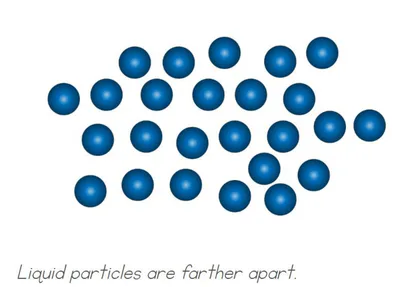
Liquids
A liquid is matter that has a definite size but no definite shape.
Liquids change shape each time they move.
They take the shape of their container but have no fixed volume.
Water, juice, milk, and oil are examples of liquids.
The particles in a liquid are farther away from each
other than the particles in a solid.
This means there is more space between the particles in a
liquid.
The extra space allows the particles to slide around and take
different shapes.
10


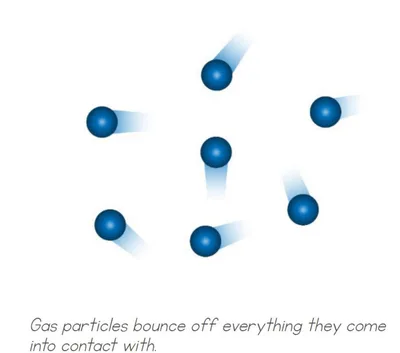
Gases
A gas is matter that has no definite size or shape.
Gases do not have a fixed volume, so they will spread out to fill any
space they are in.
Unlike solids and liquids, most gases cannot be seen.
Unlike the particles in solids and liquids, gas particles are very
far apart and move freely.
Gas particles are very small. They are much tinier than even the
smallest things you can see.
They are constantly moving because of the space between
each particle.
11
Match
Match the image of the particles to the state of matter.
solid
liquid
gas
solid
liquid
gas
12


Tomorrow we will complete a graded science assignment. Here is what you will need.
If you are unable to have these materials, you are welcome to follow along as I perform the activities instead.
Science
Today we will:
• Identify the particles
in solids, liquids,
and gasses
Today we need:
• Knowledge Check
• Science Book page 1
Show answer
Auto Play
Slide 1 / 12
SLIDE
Similar Resources on Wayground

11 questions
Force and Motion Review 1
Presentation
•
5th Grade
11 questions
Saturn
Presentation
•
5th Grade
7 questions
Volume 5th Grade
Presentation
•
5th Grade
9 questions
LIVING THINGS
Presentation
•
5th Grade
9 questions
Mixtures and Solutions
Presentation
•
5th Grade
10 questions
states of matter
Presentation
•
4th - 5th Grade
9 questions
Science Unit 2 Lesson 1
Presentation
•
5th Grade
9 questions
Parts of an Atom
Presentation
•
6th Grade
Popular Resources on Wayground
21 questions
Continents and Oceans

Quiz
•
6th Grade
20 questions
Parts of Speech
Quiz
•
5th Grade
16 questions
Subject & Predicate
Quiz
•
5th Grade
25 questions
Multiplication Facts
Quiz
•
5th Grade
12 questions
Map Skills
Quiz
•
3rd Grade
22 questions
Continents and Oceans
Quiz
•
5th Grade
15 questions
Rounding Decimals
Quiz
•
5th Grade
20 questions
Brand Labels
Quiz
•
5th - 12th Grade
Discover more resources for Science
16 questions
Fast Focus Science - Standard 5.8.A
Quiz
•
5th Grade
20 questions
Mixtures and Solutions Practice
Quiz
•
5th Grade
20 questions
Force and Motion Task Cards
Quiz
•
5th Grade
20 questions
Food Chains and Food Webs Review
Quiz
•
5th Grade
15 questions
Force and Motion
Presentation
•
5th Grade
10 questions
Law of Conservation of Mass
Quiz
•
5th Grade
25 questions
Chemical and Physical Changes in Matter
Quiz
•
5th Grade
20 questions
Food Webs
Quiz
•
5th Grade