Search Header Logo
Algebra 2024 3.7 Lesson

Algebra 2024 3.7 Lesson

Assessment

Presentation

Mathematics

9th Grade

Medium

CCSS
HSA.REI.D.10, HSF.BF.B.3, HSF.IF.B.4

+6

Standards-aligned

Created by

Oscar Hidalgo

Used 2+ times

FREE Resource

11 Slides • 26 Questions

1
media

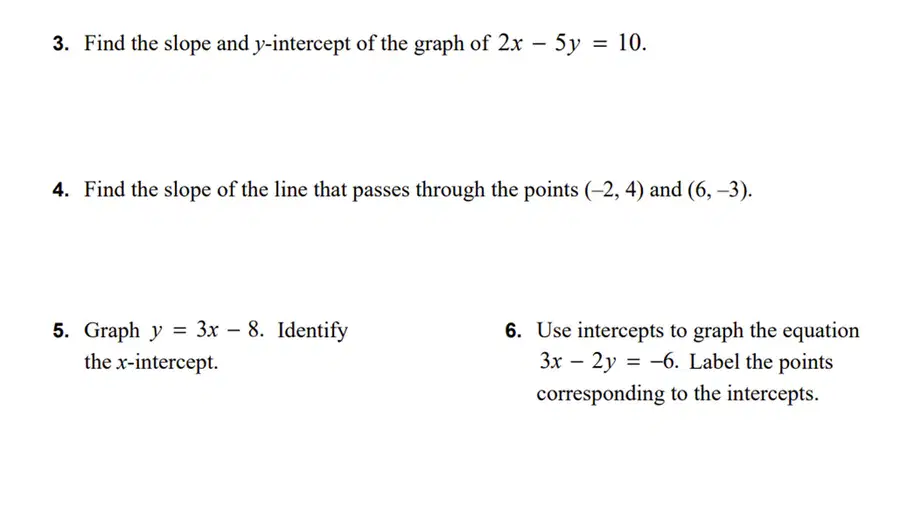
​Bellwork

2

media

3

media

4

Multiple Choice

Question image
Which parent function matches the graph?
1
y = |x|
2
y = ∛(x)
3
y = x2
4
y = a⋅bx

5

Multiple Choice

Question image
What type of function is shown?
1
linear
2
quadratic
3
square root
4
absolute value

6

Multiple Choice

Question image
What type of function is shown?
1
Exponential 
2
square root
3
quadratic
4
cube root

7

Multiple Choice

Question image
Which parent function matches the graph?
1
f(x) = √(x)
2
f(x) = ∛(x)
3
f(x) = |x|
4
f(x) = a⋅bx

8

Multiple Choice

Question image
What type of function is shown?
1
exponential
2
linear
3
quadratic
4
square root

9

Multiple Choice

Question image
Which parent function matches the graph? 
1
f(x) = x
2
f(x) = x2
3
f(x) =√(x)
4
f(x) =∛(x)

10

Multiple Choice

Question image
Which parent function matches the graph? 
1
f(x) = a⋅bx
2
f(x) = ∛(x)
3
f(x) = √(x)
4
f(x) = x2

11

Multiple Choice

Which of the following parent functions does not have a Domain of all Real numbers?

1
2
3
4

12

media

13

Multiple Choice

For y=a(x  h)n+ky=a\left(x\ -\ h\right)^n+k , how does adding a constant (k) transform the parent function?

1

Horizontal shift

2

Vertical Shift

3

Reflection over the x-axis

4

Reflection over the y-axis

14

Multiple Choice

For y=a(x  h)n+ky=a\left(x\ -\ h\right)^n+k , how does adding or subtracting an (h) value from x transform the parent function?

1

Horizontal shift

2

Vertical Shift

3

Reflection over the x-axis

4

Reflection over the y-axis

15

Multiple Choice

For y=a(x  h)n+ky=a\left(x\ -\ h\right)^n+k , What transformation happens when the a becomes negative?

1

Horizontal shift

2

Vertical Shift

3

Reflection over the x-axis

4

Reflection over the y-axis

16

Multiple Choice

For y=a(x  h)n+ky=a\left(x\ -\ h\right)^n+k , What transformation happens when the a is between 0 and 1

1

Vertical stretch

2

Vertical compression

3

Reflection over the x-axis

4

Reflection over the y-axis

17

Multiple Choice

For y=a(x  h)n+ky=a\left(x\ -\ h\right)^n+k , What transformation happens when the a is greater than 1

1

Vertical stretch

2

Vertical compression

3

Reflection over the x-axis

4

Reflection over the y-axis

18

media

19

media

20

Multiple Choice

Question image
If the blue function is f(x)=x2, then the red function must be
1
g(x)=x2-5
2
g(x)=x2+5
3
g(x)=(x-5)2
4
g(x)=(x+5)2

21

Multiple Choice

Question image
  The blue function is the parent function f(x) = x3.  Which of the following is the correct equation for the red function, g(x)?
1
g(x)=x3+1
2
g(x)=x3-1
3
g(x)=(x-1)3
4
g(x)=(x+1)3

22

Multiple Choice

Question image
What is the equation of the graph below?
1
f(x) = I x + 2 I 
2
f(x) = I x + 2 I +2
3
f(x) = I x - 2 I +2
4
f(x) = I x - 2 I 

23

Multiple Choice

Question image
Which of the following is the correct equation for the given graph?
1
f(x) = (x - 2)2 - 1
2
f(x) = (x + 2)2 - 1
3
f(x) = -(x + 2)2 - 1
4
f(x) = -(x - 2)2 - 1

24

media

25

media

26

Multiple Choice

Question image
Match the equation to its description.
1
Right 2 and up 2
2
Left 2 and up 2
3
Right 2 and down 2
4
Left 2 and down 2

27

Multiple Choice

g(x)=f(x-1)-5
Describe the transformation to f(x) that results in g(x).
1
f(x) has been translated to the left one and down five.
2
f(x) has been translated to the right one and down five.
3
f(x) has been translated to the left one and up five.
4
f(x) has been translated to the right one and up five.

28

Multiple Choice

Describe the transformations that maps
y = g(x) to y = - g(x + 6) - 10
1
Reflect over y-axis
Shifted down 10 units
Shifted left 6 units
2
Reflect over x-axis
Shifted up 10 units
Shifted left 6 units
3
Reflect over y-axis
Shifted up 10 units
Shifted right 6 units
4
Reflect over x-axis
Shifted down 10 units
Shifted left 6 units

29

media

30

Multiple Select

Question image

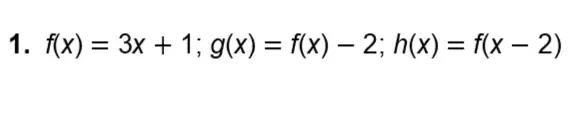
Describe the transformations from the graph of f to the graphs of g and h.

1

The graph of g is a vertical translation 2 units down of the graph of f

2

The graph of h is a horizontal translation 2 units right of the graph of f.

3

The graph of g is a vertical translation 2 units up of the graph of f

4

The graph of h is a horizontal translation 2 units left of the graph of f.

5

The graph of g is a horizontal translation 2 units left of the graph of f

31

Multiple Select

Question image

Describe the transformations from the graph of f to the graphs of g and h.

1

The graph of g is a vertical translation 1 unit up of the graph of f.

2

The graph of h is a horizontal translation 1 unit left of the graph of f.

3

The graph of g is a vertical translation 1 unit down of the graph of f.

4

The graph of h is a horizontal translation 1 unit right of the graph of f.

5

The graph of h is a vertical translation 1 unit down of the graph of f.

32

media

33

Multiple Choice

Question image

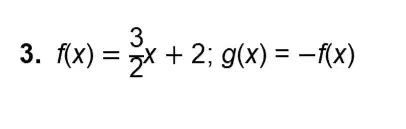
Describe the transformations from the graph of f to the graphs of g

1

The graph of g is a reflection in the x-axis of the graph of f

2

The graph of g is a reflection in the y-axis of the graph of f

34

Multiple Choice

Question image

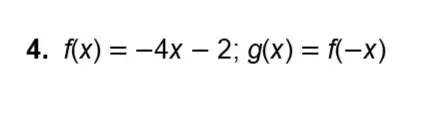
Describe the transformations from the graph of f to the graphs of g

1

The graph of g is a reflection in the x-axis of the graph of f

2

The graph of g is a reflection in the y-axis of the graph of f

35

media

36

Multiple Choice

Question image

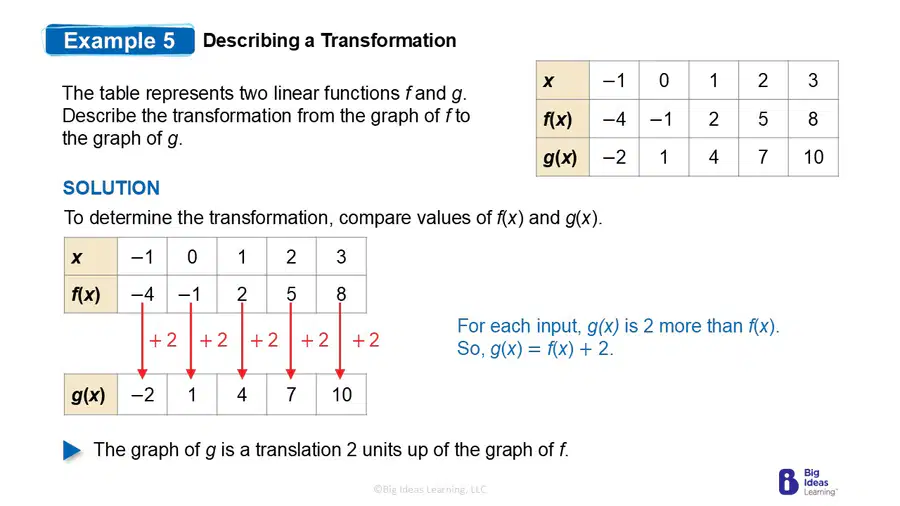
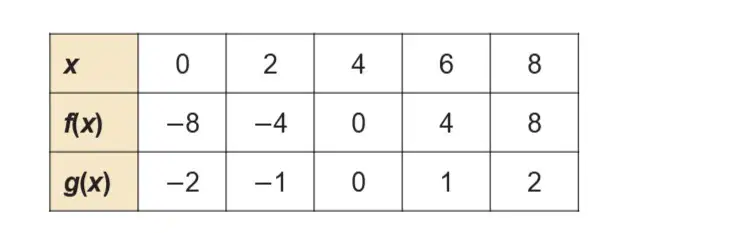
The table represents two linear functions f and g. Describe the transformation from the graph of f to the graph of g.

1

The graph of g is a horizontal shift 4 units left of the graph of f

2
The graph of g is a reflection of the graph of f across the x-axis.
3

The graph of g is a vertical shift 4 units up of the graph of f.

4

The graph of g is a vertical shrink of the graph of f by a factor of 1/4

37

Multiple Choice

Question image

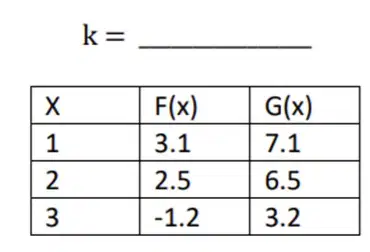
1.    Considering the table below, describe the transformation in order to determine the value of the real number, 𝑘, that defines the transformation from 𝑓(𝑥) to 𝑔(𝑥).

1

k = 4

2

k = -4

3

k = 1/4

4

k = -1/4

media

​Bellwork

Show answer

Auto Play

Slide 1 / 37

SLIDE