

Westward Expansion

Presentation
•
History
•
6th - 8th Grade
•
Medium

Thurston Stewart
Used 5+ times
FREE Resource
28 Slides • 18 Questions
1

Manifest Destiny
1803-1853
The United States Expanded from the Atlantic to the Pacific in 50 years.
2
Fill in the Blanks
The belief that it was fate, or destined, for the United States to expand westward, from the Atlantic Ocean to the Pacific Ocean is known as
Type answer...
3


Manifest Destiny
•
A belief shared by many
Americans in the mid 1800s
that the United States should
expand across the continent
to the Pacific Ocean.
•
President Polk believed it was
our manifest destiny, or
“obvious fate” to settle land
all the way to the Pacific
Ocean in order to spread
democracy.
4
Open Ended
"The American claim is by right of our manifest destiny to
overspread to possess the whole of the continent which
Providence has given us for the development of the great
experiment of liberty and our democratic government
entrusted to us. It is a right such as that of the tree to the space
of air and earth suitable for the full expansion of its principle
and destiny of growth. It is in our future far more than in our
past...that our true title is found." -John O'Sullivan - reporter
for the Morning News
What is O'Sullivan saying is the purpose and goal of Manifest Destiny?
5


7th Grade Unit 3: Policy
Expansion and Conflict
6


Louisiana Purchase:
1803
•
Thomas Jefferson bought the
Louisiana Territory from France
for $15 million.
•
Jefferson wanted to make sure
the U.S. had control of the Port of
New Orleans and the
Mississippi River.
•
The Louisiana Purchase doubled
the size of the United States.
7
Multiple Choice

What motivated America to want to purchase the Louisiana colony?
America wanted to have control of the diverse population there
America wanted control of the Mississippi River
America despised France and wanted to show Napoleon Bonaparte that France could not keep the territory
America did not want Louisiana, they just took it to keep it from the British
8
Multiple Choice

How did the Louisiana Purchase impact the United States of America?
it nearly doubled the size of the land that the country possessed
it made the United States more susceptible for invasion from France
it made the United States and Spain have a better international relationship
it made the people of America feel upset about having foreign citizens in their country
9


Florida: 1819
•The U.S. wanted to take Florida from
Spain because of attacks by
Seminole Indians and runaway
slaves in Georgia.
•In 1819, President Monroe sent
General Andrew Jackson to Florida
to help protect the U.S. border.
•Jackson invaded Florida and
overthrew the governor of Florida.
He had no direct orders from
President Monroe.
•Spain gave Florida to the U.S. in
exchange for $5 million and control
of Texas.
10

11


Texas: 1830s
•
In 1821, Texas was a part of Mexico.
•Stephen Austin brought the first 300
families to Texas - known as the Old
Three Hundred.
•By 1830, 25,000 Americans were
living in Texas. They were required to
become Mexican citizens and
become Catholic.
•The Americans had to follow Mexican
law.
•When Americans complained, Mexico
closed Texas to further American
immigration.
Stephen Austin
12


Texas Revolution: 1835-36
•
March 2, 1836 Texas succeeded from
Mexico
•Mexican General Santa Anna tried to
suppress the Texans but was eventually
defeated by Sam Houston and the Texans.
•After the Alamo and Goliad, Sam Houston
surprise attacked Santa Anna at the Battle of San Jacinto.“Remember the Alamo! Remember Goliad!”
•Texas won its independence and named itself the Lone Star Republic in 1836.
Antonio Lopez
de Santa Anna
13


Texas Statehood: 1845
•
Santa Anna was captured and forced to sign
a treaty giving Texas its independence.
•
Texas became an independent nation in
1836 called the Lone Star Republic.
•
Sam Houston became President.
•
Annexation of Texas was delayed:
•
Worry that adding Texas as a slave state
would upset the balance between free
and slave states
Fear that annexing Texas would lead to war with Mexico
•
Texas joined the U.S. and became the 28th
state in 1845.
Sam Houston
14


Oregon Country: 1846
•
In 1820, both the U.S. and Britain
claimed to own Oregon Country.
•In the 1830s and 1840s, thousands of
American pioneers were going west to settle in Oregon Country.
•President Polk wanted all of Oregon to
the fifty-four fifty parallel. The American
people cried, “Fifty-four forty or fight.”
• Neither Polk nor Britain wanted war.
• Britain and the U.S. compromised.
They split Oregon in half at the 49th
parallel. The U.S. got the southern half.
15
Oregon Country: 1846

16
Multiple Select
Which two countries agreed to a compromise of the 49th Pararral as becoming the border?
United States
Mexico
France
Great Britian
17
Multiple Choice
The US President James K. Polk used the slogan "Fifty-four Forty or Fight!"
in order to:
intimidate the British to give up Oregon
provoke Mexico into war
ask for the release of 54 prisoners
offer $54.40 to buy Oregon
18

19


Donner Party: 1846
•
Settlers bound for California took a southern route known as the California Trail. This path went through the Sierra Nevada mountain range. Settlers tried to cross the
mountains before the first snow.
•Guidebooks helped pioneers find their way.
•Lansford Hastings wrote the “Emigrants
Guide to Oregon and California.” Hastings’
guide advertised a new shortcut that would save 300-400 miles. Hastings had never traveled the route himself.
•Following Hastings’ guide and shortcut, The Donner Party left the California trail and got lost. They were trapped in the Sierra Nevada in winter. They were stuck without food and resorted to eating the dead to
survive. 42 of 87 died.
20
Poll
Was Hasting's Travel guide of California and Oregon "shortcut" helpful for travelers?
YES
NO
21

22

23

24

25
26


Mexican American War:
1846-48
•
President Polk wanted to expand the U.S. territory
clear to the Pacific Ocean.
•
After the U.S. annexed Texas in 1845, Mexico
and the U.S. disagreed on the Texas border
•
The U.S. claimed the Rio Grande River.
•
Mexico claimed the Nueces River.
•
The U.S. sent troops to patrol the border and they were fired on by Mexican troops. This was
followed by a declaration of war.
•
This led to the Treaty of Guadalupe Hidalgo,
which ended the war.
27
Multiple Choice
28


Mexican Cession: 1848
•In the Treaty of Guadalupe Hidalgo,
Mexico gave the U.S. the territories of
California, Nevada and Utah, most of
Arizona and New Mexico, and parts of
Colorado and Wyoming.
•
The US also claimed Texas north of
the Rio Grande
•The U.S. paid $15 million for the
territory
•Today this is the American southwest.
•Mexican Cession increased the size of
the US by 25%
29
Multiple Choice
30
Multiple Choice
How much money the the U.S. pay for the land to Mexico
10 million
150 million
15 million
5 million
31
Open Ended
What impact did the Mexican Cession of 1848 have on the size of the United States?
32


Bear Flag Revolt:
1846
•
Small group of American settlers seized the town of Sonoma.
•
Americans declared California an
independent nation and made a grizzly bear flag.
•
John C. Fremont was leading a mapping
expedition in the Sierra Nevadas. He joined
the American settlers in their revolt against
the Californios.
•
Shortly after, U.S. naval forces came ashore in California and raised the stars and stripes. They claimed California for the
United States.
33

34


Gadsden Purchase:
1853
•
After the war with Mexico,
Americans wanted to guarantee that any southern railroad to California would be built completely on American soil.
•
US paid $10 million for the
southern parts of Arizona and New Mexico.
•The existing boundary between the U.S. and Mexico was fixed.
35
Multiple Choice
Why did the United States value the land bought in the Gadsden Purchase?
Flat land perfect for a railroad
It's mountains were perfect to build forts
It was coastal land perfect for farming cotton.
It was known as a dangerous place filled with poisonous animals and plants.
36
Multiple Choice
What two current states include the land bought in the Gadsden Purchase?
Texas and Oklahoma
Arizona and New Mexico
California and Nevada
Utah and Colorado
37


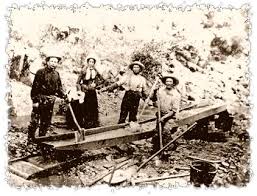
California Gold Rush:
1849
•Gold was found in Sutter’s Mill in
1848.
•In 1849, about 80,000 gold seekers,
known as forty-niners, came to
California hoping to strike it rich.
•Panning for gold was the simplest method.
•A miner fills a pan with dirt. He
then puts the pan under water
and shakes it until any gold
settles on the bottom.
Sutter’s Mill
38
Multiple Choice
Which city became one of the U.S's largest almost overnight due to the Gold Rush?
Los Angeles
Sacramento
San Francisco
Sonoma
39

40
Multiple Choice
41


California Gold Rush:
1849
•
Mining camps sprung up whenever enough people gathered to look for gold.
•At the mining camps, many people prospected (searched for gold).
Others ran businesses that catered to the miners - laundry, food,
innkeepers, legal services, supplies
Famine and economic hardship
in China brought many Chinese to
California. However, they faced discrimination and a high tax on foreign miners.
42
Multiple Choice

Some store owners became rich selling gold prospectors their supplies.
True
False
43


Impact of Gold Rush
•
The arrival of 49ers created a
population boom. Immigration
increased diversity of
population.
•California became a state in 1 year
•Growth of new businesses and
industry transformed California’s
economy
• Gold mining was important, but farming and ranching grew.
44
Multiple Choice
45


7th Grade Unit 3: Policy
Expansion and Conflict
46
Open Ended
Describe one cause and effect of Manifest Destiny?
Manifest Destiny
1803-1853
The United States Expanded from the Atlantic to the Pacific in 50 years.
Show answer
Auto Play
Slide 1 / 46
SLIDE
Similar Resources on Wayground

44 questions
Understanding The Constitution
Presentation
•
7th - 8th Grade
40 questions
Mexican-American War
Presentation
•
6th - 9th Grade
40 questions
Phases of the Moon
Presentation
•
6th - 8th Grade
42 questions
Ch 13 Lesson 3 - A Christian Europe
Presentation
•
6th - 8th Grade
43 questions
Whiskey Rebellion
Presentation
•
6th - 9th Grade
40 questions
Concordância verbal
Presentation
•
KG
43 questions
Canadian Confederation
Presentation
•
7th Grade
40 questions
Continental Drift and Layers of the Earth
Presentation
•
6th - 8th Grade
Popular Resources on Wayground
6 questions
PRIDE Always and Everywhere
Presentation
•
12th Grade
20 questions
Lab Safety Quiz

Quiz
•
6th Grade
26 questions
KOR Review Kahoot Questions
Quiz
•
8th Grade
21 questions
Continents and Oceans
Quiz
•
6th Grade
12 questions
Unit Zero lesson 2 cafeteria
Presentation
•
9th - 12th Grade
20 questions
Parts of Speech
Quiz
•
5th Grade
10 questions
Riddles Riddles fun Riddles
Quiz
•
6th - 12th Grade
16 questions
Subject & Predicate
Quiz
•
5th Grade
Discover more resources for History
15 questions
SS8G1 Georgia Geography
Quiz
•
8th Grade
37 questions
GA Settlement & Trustee Colony
Quiz
•
8th Grade
20 questions
13 Colonies
Quiz
•
5th - 6th Grade
12 questions
SS8H1 European Exploration
Quiz
•
8th Grade
20 questions
Exploration and Colonization
Quiz
•
8th Grade
10 questions
Exploring the Journey of Early Humans

Interactive video
•
6th - 10th Grade
22 questions
Exploration & Colonization
Quiz
•
8th Grade
5 questions
THE 5 THEMES OF GEOGRAPHY
Interactive video
•
6th Grade