Thermal Energy and Transfer
Presentation
•
Science
•
7th Grade
•
Practice Problem
•
Easy
+15
Standards-aligned
Ms. Lamphear
Used 3+ times
FREE Resource
8 Slides • 27 Questions
1
Multiple Choice
What happens to the temperature of a substance when kinetic energy decreases?
The temperature decreases.
The temperature is not related to kinetic energy.
The temperature increases.
The temperature stays constant.
2
The transfer of energy from one particle of matter to another particle of matter.
Conduction
The transfer of thermal energy by the movement of a fluid (a gas or a liquid).
Convection
The transfer of energy by electromagnetic waves (light energy waves).
Radiation
3
Conduction
Energy transfer between particles of matter that touch directly.
As heat is added to a material, the particles begin to vibrate more which means kinetic energy increases.
Conduction happens through direct touch/contact between objects.
4
Multiple Choice
Which of the following is an example of conduction?
Making pancakes on a stove.
Microwaving your left overs.
Water at a rolling boil.
Heat coming from the sun.
5
Convection
Heat transfer through movement of fluids.
Fluids are materials that can flow, like liquids and gases.
The particles at the bottom heat up and become less dense. This causes them to rise and push the colder and denser molecules down.
This movement is called a Convection Current
6
Multiple Choice
Which of the following is an example of convection?
Making pancakes on a stove.
Microwaving your left overs.
Water at a rolling boil.
Heat coming from the sun.
7
Multiple Choice
What causes a convection current and keeps it going?
Hot particles sink, causing the cold particles to rise.
Cold particles steal the heat from the hot particles.
Hot particles rise, pushing the cold particles down toward the heat source.
Convection currents do not move at all.
8
Radiation
Heat transfer by electromagnetic waves.
The only form of heat transfer that does not require matter.
Heat you can feel but do not always see.
This is how we receive heat from the sun since it is able to pass through the vacuum of space where there is not matter present for it to travel through.
9
Multiple Choice
Which of the following is an example of radiation?
Making pancakes on a stove.
Microwaving your left overs.
Water at a rolling boil.
Cloud formation
10
Multiple Choice
True or False: Radiation can travel through a the vacuum of space.
True
False
11
Open Ended
Why does hot air rise and cold air sink?
12
Multiple Choice
Which of the following is not a method of heat transfer?
Radiation
Insulation
Convection
Conduction
13
Multiple Choice
In which of the following are the particles the closest together?
Solid
Liquid
Gas
Fluid
14
Multiple Choice
How does heat reach the Earth from the Sun?
Conduction
Convection
Radiation
Insulation
15
Draw
Write the number of the match in the box next to the definition.
16
17
Multiple Choice
Heat ALWAYS Travels from
Higher temperature to lower temperature
Lower temperature to higher temperature
18
Multiple Choice
What happens to particles as they heat up?
They slow down
Nothing
They don't move
They speed up
19
Multiple Choice
What happens when the coffee and the cup are in thermal equilibrium?
The temperature of the cup is increasing
The temperature of the coffee is decreasing
There is no longer heat being transferred because they are both the same temperature
20
Multiple Choice
Two objects with different temperatures will reach thermal equilibrium when.....
both object becomes hotter
both objects become colder
both object reach the same final temperature
21
Multiple Choice
In what direction do hot liquids and gasses move?
Side to Side
Down
Up
Back and Forth
22
Multiple Choice
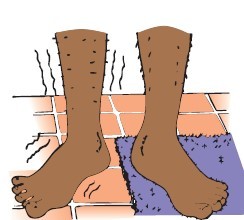
After taking a hot shower, James steps out of the shower onto the tile floor. The tile felt cold to his feet. Which explanation below best describes James' experience?
Heat from his feet is transferred to the tile floor
Cold from the tile floor is transferred to his feet
Cold from his feet is transferred to the tile floor
23
Multiple Choice
The condition where two substances in physical contact with each other no longer exchange heat energy. They are the same temperature. THis is called.....
Thermal Energy
Cooler to Warmer
Thermal Equilibrium
24
25
26
Multiple Choice
I wear a large winter coat to keep my body warm. The coat is a ....
conductor
insulator
27
Open Ended
Type two different conductors
28
Open Ended
Type THREE different INSULATORS
29
Multiple Choice
A cook will use an oven mitt to pick up a hot pan because cloth is a(n) ________ and keeps the heat from their hand.
Conductor
Insulator
Light Transfer
Heat transfer
30
Match
Match the following vocabulary terms to the definition
Thermal Energy
Conductor
Insulator
Heat
Allows thermal energy to pass through (GO)
DOES NOT allow thermal energy to pass (STOP)
Heat
Allows thermal energy to pass through (GO)
DOES NOT allow thermal energy to pass (STOP)
31
Multiple Choice
What is the difference between a conductor and an insulator?
An insulator allows thermal energyto flow through it easily and a conductor does not
A conductor allows thermal energy to flow through it easily and an insulator does not.
An insulator is magnetic and a conductor is not
A conductor is magnetic and an insulator is not
Show
32
Multiple Choice
Which one is NOT an Insulator?
33
Multiple Choice
The foam cup and cardboard sleeve act as ______ for the hot coffee.
Insulator
Conductor
Electricty
Light
34
35
Multiple Choice
Which spoon handle would be the hottest?
What happens to the temperature of a substance when kinetic energy decreases?
The temperature decreases.
The temperature is not related to kinetic energy.
The temperature increases.
The temperature stays constant.
Show answer
Auto Play
Slide 1 / 35
MULTIPLE CHOICE

Similar Resources on Wayground
27 questions
Chemical and Physical Change
Presentation
•
7th Grade
30 questions
Organisms and their Environment Review
Presentation
•
7th Grade
32 questions
Digestive System
Presentation
•
7th Grade
29 questions
Air Pollution
Presentation
•
7th Grade
25 questions
7th Science- Energy Transfer in Ecosystems
Presentation
•
7th Grade
27 questions
Atoms, Elements, Molecules, & Compounds
Presentation
•
7th - 8th Grade
29 questions
Limiting Factors and Carrying Capacity
Presentation
•
7th Grade
27 questions
Describing Phase Change at Two Scales
Presentation
•
7th Grade
Popular Resources on Wayground
20 questions
STAAR Review Quiz #3
Quiz
•
8th Grade
20 questions
Equivalent Fractions
Quiz
•
3rd Grade
6 questions
Marshmallow Farm Quiz
Quiz
•
2nd - 5th Grade
20 questions
Main Idea and Details
Quiz
•
5th Grade
20 questions
Context Clues
Quiz
•
6th Grade
20 questions
Inferences
Quiz
•
4th Grade
19 questions
Classifying Quadrilaterals
Quiz
•
3rd Grade
12 questions
What makes Nebraska's government unique?
Quiz
•
4th - 5th Grade
Discover more resources for Science
19 questions
Introduction to Properties of Waves
Presentation
•
6th - 8th Grade
16 questions
Interactions within Ecosystems
Presentation
•
6th - 8th Grade
45 questions
Food Webs
Quiz
•
6th - 8th Grade
16 questions
Photosynthesis and Cellular Respiration Review
Quiz
•
7th Grade
20 questions
Abiotic & Biotic Factors
Quiz
•
7th Grade
20 questions
Asexual/Sexual Reproduction
Quiz
•
7th Grade
20 questions
Energy Transformations
Quiz
•
6th - 8th Grade
20 questions
Food Webs + Energy Pyramids
Quiz
•
7th Grade