Ecology and the Food Web
Presentation
•
Science
•
7th - 8th Grade
•
Medium
Standards-aligned
Jessica McGregor
Used 3+ times
FREE Resource
23 Slides • 18 Questions
1
Ecology and the Food Web
The relationship between living organisms and their environment.
2
Multiple Choice
A system comprising all the biotic and abiotic factors in an area and all the interacts among them
Ecosystem
Community
Population
3
All energy on Earth comes from the Sun.
So how do we get that energy?
4
Food Chain
5
6
7
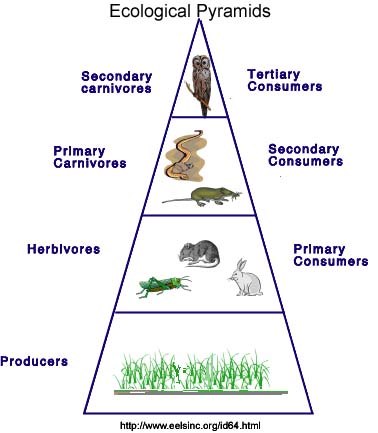
What do you notice about this pyramid?
Trophic Levels
8
9
10
11
Stop and Think:
Why are decomposers important?
12
Multiple Choice
13
Multiple Choice
Which type of consumer is always a primary consumer?
Herbivore
Omnivore
Carnivore
14
Multiple Choice
Where does the energy start in this food chain?
Plant
Sun
Deer
Wolf
15
Multiple Choice
16
Multiple Choice
17
Multiple Choice
18
Multiple Choice
19
An organism that makes its own food is called a producer, or an autotroph.
An organism that cannot make its own food is called a consumer, or a heterotroph.
Produces and Consumers
20
Multiple Choice
21
Multiple Choice
What is a lily pad?
autotroph
heterotroph
22
Open Ended
What is the difference between heterotroph and autotroph?
23
Multiple Choice
24
Multiple Choice
What is algae?
autotroph
heterotroph
25
Multiple Choice
What is an insect?
autotroph
heterotroph
26
Multiple Choice
Which category of organism cannot make its own food?
Autotroph
Heterotroph
27
Symbiotic Relationships
* any close relationship between two different species
28
Symbiotic Relationships
29
Mutualism
a relationship where both organisms benefit
30
Example of Mutualism
Lichen and Fungus
Lichen provides energy to fungus, while fungus gives the lichen a place to grow.
31
Examples of Mutualism
32
Commensalism
33
Example of Commensalism
Banrnacles, small crestaceans, attach themselves to larger organisms, such as a whale, to be transported to new food sources.
34
Example of Commensalism
As Caribou migrate, the arctic fox follows throughout its journey in order to hunt the small animals that have become exposed by the caribou.
35
Parasitism
36
Parasitism
The organism that is being benefitted is called the Parasite
The organism that is being harmed is called the Host
37
Example of Parasitism
A roundworm attaches itself inside the intestine of a puppy to feed on the nutrients in the puppy's blood.
The puppy is hurt by the parasite and looses blood.
The roundworm benefits by receiving food.
38
Example of Parasitism
The fungus (parasite) gets nutrients by breaking down the tree (host). As a result, the tree decays, gets weak, and becomes very vulnerable to the weather.
39
Multiple Choice
40
Multiple Choice
What type of relationship is this?
parasitism
mutualism
commensalism
competition
41
Multiple Choice
symbiotic relationship in which both organisms benefit
competition
mutualism
commensalism
Ecology and the Food Web
The relationship between living organisms and their environment.
Show answer
Auto Play
Slide 1 / 41
SLIDE

Similar Resources on Wayground
37 questions
Ohm's Law
Presentation
•
7th Grade
34 questions
Biodiversity Intro
Presentation
•
7th Grade
34 questions
Terrestrial Biomes Review
Presentation
•
7th Grade
33 questions
Electromagnets!
Presentation
•
6th - 8th Grade
39 questions
LIght technology
Presentation
•
8th Grade
33 questions
Watersheds
Presentation
•
7th Grade
36 questions
What is Matter?
Presentation
•
7th - 8th Grade
36 questions
Biotic and Abiotic Factors
Presentation
•
7th Grade
Popular Resources on Wayground
10 questions
HCS SCI 03 Summer School Assessment 1
Quiz
•
3rd Grade
15 questions
HCS SCI 05 Summer School Assessment 1 Review
Quiz
•
5th Grade
22 questions
Day 9 Equations and Inequalities Review
Quiz
•
9th Grade
10 questions
Writing and Identifying Ratios Practice
Quiz
•
5th - 6th Grade
7 questions
PYRAMID PERSPECTIVES part 1
Presentation
•
9th - 12th Grade
12 questions
Understanding the Fourth of July
Quiz
•
9th Grade
15 questions
Soccer World Cup Quiz Questions
Quiz
•
7th Grade