

IGCSE ACIDS AND BASES

Presentation
•
Chemistry
•
11th Grade
•
Easy
Standards-aligned

Alshia Lugo
Used 1+ times
FREE Resource
29 Slides • 8 Questions
1
ACIDS BASES SALTS
2

2 ORGANISATION OF THE ORGANISM
YOUR NOTES
8 ACIDS, BASES & SALTS
savemyexams.co.uk
Page 1
© copyright Save My Exams
CIE IGCSE Chemistry Revision Notes
CIE IGCSE Chemistry Resources
REVISION NOTES TOPIC QUESTIONS PAST PAPERS
CONTENTS:
8.1 ACIDS, BASES & OXIDES
8.1.1
THE CHARACTERISTIC PROPERTIES OF ACIDS & BASES
8.1.2
TYPES OF OXIDES
VIEW EXAM QUESTIONS
8.2 SALTS & CHEMICAL ANALYSIS
8.2.1
PREPARATION OF SALTS
8.2.2
IDENTIFICATION OF IONS & GASES
VIEW EXAM QUESTIONS
8.1 ACIDS, BASES & OXIDES
8.1.1 THE CHARACTERISTIC PROPERTIES OF ACIDS & BASES
Properties of Acids
Properties of acids
• Acids have pH values of below 7, have a sour taste and are corrosive
• In acidic conditions, blue litmus paper turns red and methyl orange indicator turns red
• Acids are substances that can neutralise a base, forming a salt and water
• When acids react, they will lose electrons to form positively charged hydrogenions (H+)
• The presence of H+ ions is what makes a solution acidic
Example: Hydrochloric Acid
HCl (aq) → H+ (aq) + Cl- (aq)
Typical reactions of acids
Acids and metals
• Only metals abovehydrogen in the reactivity series will react with dilute acids
• When acids react with metals they form a salt and hydrogen gas:
Acid + Metal → Salt + Hydrogen
Examples of Reaction Between Acids and Metals:
3
4
5
6
Multiple Choice
Which of the following statements is true concerning acids and bases?
acids and bases don't react with each other
acids mixed with bases neutralize each other
acids mixed with bases make stronger bases
acids mixed with bases make stronger acids
7
Multiple Choice
Neutral solutions have a pH of:
0
1
7
14
8
Multiple Choice
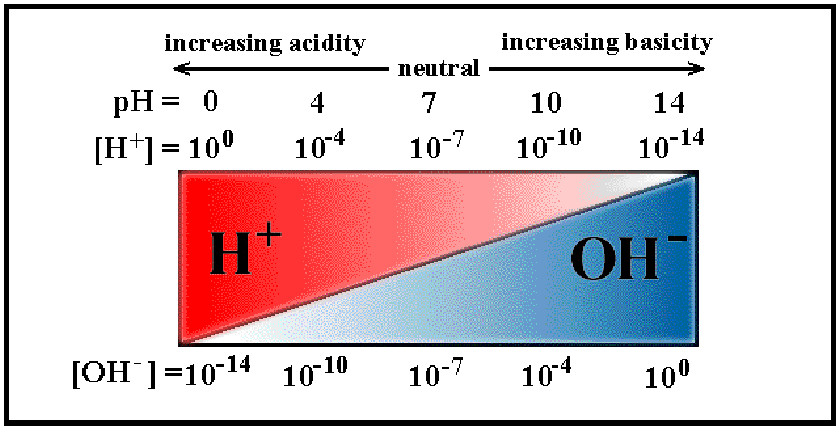
True or false: a neutral solution has equal amounts of H+ and OH-.
True
False
9
Multiple Choice

A
B
C
D
10
Multiple Choice

pH 0
pH 6
pH 7
pH 10
pH 14
11
Multiple Choice

pH 1
pH 5
pH 7
pH 12
12
Drag and Drop

13
Multiple Choice

A
B
C
D
14

2 ORGANISATION OF THE ORGANISM
YOUR NOTES
8 ACIDS, BASES & SALTS
savemyexams.co.uk
Page 3
© copyright Save My Exams
CIE IGCSE Chemistry Revision Notes
CIE IGCSE Chemistry Resources
REVISION NOTES TOPIC QUESTIONS PAST PAPERS
Properties of Bases
Properties of bases
• Bases have pH values of above 7
• A base which is water soluble is referred to as an alkali
• In basic (alkaline) conditions red litmus paper turns blue and methyl orange indicator turns
In basic (alkaline) conditions red litmus paper turns blue and methyl orange indicator turns
yellow
• Bases are substances which can neutralise an acid, forming a salt and water
• Bases are usually oxides or hydroxides of metals
• When alkalis react, they gain electrons to form negative hydroxide ions (OH–)
• The presence of the OH– ions is what makes the aqueous solution an alkali
Example: Sodium Hydroxide
NaOH (s) → Na+ (aq) + OH- (aq)
Typical reactions of bases
Bases and acids
• When they react with an acid, a neutralisation reaction occurs
• Acids and bases react together in a neutralisation reaction and produce a salt and water:
Acid + Base → Salt + Water
Examples of Reaction Between Bases and Acids:
•
Alkalis and ammonium salts
• Ammonium salts undergo decomposition when warmed with an alkali
• Even though ammonia is itself a weak base, it is very volatile and can easily by displaced
from the salt by another alkali
• A salt, water and ammonia are produced
Example:
NH4Cl + NaOH → NaCl + H2O + NH3
8.1.1 THE CHARACTERISTIC PROPERTIES OF ACIDS & BASES cont...

15


8 ACIDS, BASES & SALTS
YOUR NOTES
savemyexams.co.uk
Page 4
© copyright Save My Exams
CIE IGCSE Chemistry Revision Notes
CIE IGCSE Chemistry Resources
REVISION NOTES TOPIC QUESTIONS PAST PAPERS
8.1.1 THE CHARACTERISTIC PROPERTIES OF ACIDS & BASES cont...
• This reaction is used as a chemical test to confirm the presence of the ammonium ion
(NH4
+)
• Alkali is added to the substance with gentle warming followed by the test for ammonia
gas using damp red litmus paper
• The litmus paper will turn from red to blue if ammonia is present.
Neutrality & Relative Acidity & Alkalinity
The pH scale
• The pH scale is a numerical scale which is used to show how acidic or alkaline a solution
is
• It goes from 1 – 14 (extremely acidic substances can have values of below 1)
• All acids have pH values of below 7, all alkalis have pH values of above 7
• The lower the pH then the more acidic the solution is
• The higher the pH then the more alkaline the solution is
• A solution of pH 7 is described as being neutral e.g. water
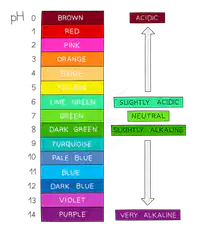
The pH scale showing acidity, neutrality and alkalinity
Universal indicator
• Universal indicator is a mixture of different indicators which is used to measure the pH
• A drop is added to the solution and the colour is matched with a colour chart which
indicates the pH which matches specific colours.
16

2 ORGANISATION OF THE ORGANISM
YOUR NOTES
8 ACIDS, BASES & SALTS
savemyexams.co.uk
Page 5
© copyright Save My Exams
CIE IGCSE Chemistry Revision Notes
CIE IGCSE Chemistry Resources
REVISION NOTES TOPIC QUESTIONS PAST PAPERS
8.1.1 THE CHARACTERISTIC PROPERTIES OF ACIDS & BASES cont...
The pH scale with the Universal Indicator colours which can be used to determine
the pH of a solution
The importance of pH and soil acidity
• Soil pH is analysed to indicate the acidity or alkalinity of soil
• Most plants favour a pH value of between 5.5 and 8
• Changes in soil which cause a pH to be outside this range adversely affect plant processes
resulting in reduced growth and cropyield
• Soils may become acid from acidrain, overuse of fertilisers which contain ammonium
salts or by the excessive breakdown of organic matter by bacteria
• Crushed or powdered limestone (calcium carbonate) or lime (calcium oxide) or slaked lime
(calcium hydroxide) is added to neutralise the excess acidity in the soil
• The addition process must be carefully monitored though, as if added in excess, further
damage could be done if the pH goes too high
17


8 ACIDS, BASES & SALTS
YOUR NOTES
savemyexams.co.uk
Page 6
© copyright Save My Exams
CIE IGCSE Chemistry Revision Notes
CIE IGCSE Chemistry Resources
REVISION NOTES TOPIC QUESTIONS PAST PAPERS
8.1.1 THE CHARACTERISTIC PROPERTIES OF ACIDS & BASES cont...
EXTENDED ONLY
Proton Transfer & Weak & Strong Acids & Bases
Proton transfer in acids and bases (Alkalis)
Proton transfer
• The earlier definition of an acid and a base can be extended
• In terms of proton transfer, we can further define each substance in how they
interact with protons
Acids
• Acids are proton donors as they ionize in solution producing protons, H+ ions
• These H+ ions make the aqueous solution acidic
Bases (Alkalis)
• Bases (alkalis) are protonacceptors as they ionize in solution producing OH– ions
which can accept protons
• These OH– ions make the aqueous solution alkaline
Diagram Showing the Role of Acids and Bases in the Transfer of Protons
Strong acids and bases
• Acids and alkalis can be either strong or weak, depending on how many ions they
produce when dissolved in water
• Strong acids and bases ionizecompletely in water, producing solutions of very low
pH for an acid or veryhigh pH for a base
• Strong acids include HCl and H2SO4 and strong bases include the Group I
hydroxides
18

2 ORGANISATION OF THE ORGANISM
YOUR NOTES
8 ACIDS, BASES & SALTS
savemyexams.co.uk
Page 7
© copyright Save My Exams
CIE IGCSE Chemistry Revision Notes
CIE IGCSE Chemistry Resources
REVISION NOTES TOPIC QUESTIONS PAST PAPERS
8.1.1 THE CHARACTERISTIC PROPERTIES OF ACIDS & BASES cont...
EXTENDED ONLY
Proton Transfer & Weak & Strong Acids & Bases
• Weak acids and bases
• Weak acids and bases partially ionize in water and produce pH values which are
closer to the middle of the pH scale
• Weak acids include organic acids such as ethanoic acid, CH3COOH and weak
bases include aqueous ammonia
• For both weak acids and bases, there is usually an equilibrium set-up between the
molecules and their ions once they have been added to water
• Example of a weak acid: propanoic acid
CH3CH2COOH ⇌ H+ + CH3CH2COO-
• Example for a weak base: aqueous ammonia
NH3 + H2O ⇌ NH4
+ + OH-
• In both cases the equilibrium lies to the left, indicating a high concentration of intact
acid / base molecules, with a low concentration of ions in solution
Effect of concentration on strong and weak acids and alkalis
• A concentrated solution of either an acid or a base is one that contains a high
number of acid or base molecules per dm3 of solution
• It does not necessarily mean that the acid or base is strong though, as it may be
made from a weak acid or base which does not dissociate
• For example a dilute solution of HCl will be more acidic than a concentrated solution
of ethanoic acid, since most of the HCl molecules dissociate but very few of the
CH3COOH do.
EXAM TIP
In acid-base chemistry, the terms strong and weak refer to the ability to dissociate and
produce H+/OH– ions.
If referring to concentration when answering a question, then the words concentrated or
dilute should be used.
19

8 ACIDS, BASES & SALTS
YOUR NOTES
savemyexams.co.uk
Page 8
© copyright Save My Exams
CIE IGCSE Chemistry Revision Notes
CIE IGCSE Chemistry Resources
REVISION NOTES TOPIC QUESTIONS PAST PAPERS
8.1.2 TYPES OF OXIDES
Classifying Oxides
Types of oxide
Acid and basic oxides
• Acidic and basic oxides have different properties and values of pH
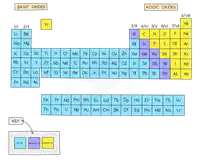
• The difference in their pH stems from whether they are bonded to a metal or a nonmetal
element
• The metallic character of the element influences the acidic or alkaline behaviour of the
molecule
Metals form basic oxides and hydroxides while nonmetals form acidic oxides
Acidic oxides
• Acidic oxides are formed when a nonmetal element combines with oxygen
• They react with bases to form a salt and water
• When dissolved in water they produce an acidic solution with a low pH
• Common examples include SO2 and SiO2
Basic oxides
• Basic oxides are formed when a metal element combines with oxygen
• They react with acids to form a salt and water
• When dissolved in water they produce a basic solution with a high pH
• Common examples include NaOH, KOH and Ca(OH)2
20

2 ORGANISATION OF THE ORGANISM
YOUR NOTES
8 ACIDS, BASES & SALTS
savemyexams.co.uk
Page 9
© copyright Save My Exams
CIE IGCSE Chemistry Revision Notes
CIE IGCSE Chemistry Resources
REVISION NOTES TOPIC QUESTIONS PAST PAPERS
8.1.2 TYPES OF OXIDES cont...
EXTENDED ONLY
Neutral & Amphoteric Oxides
Neutral oxides
• Some oxides do not react with either acids or bases and thus are said to be neutral
• Examples include N2O, NO and CO
Amphoteric oxides
• Amphoteric oxides are a curious group of oxides that can behave as bothacidic and
basic, depending on whether the other reactant is an acid or a base
• In both cases a salt and water is formed
• Two most common amphoteric oxides are zinc oxide and aluminum oxide
• The hydroxides of both of these elements also behave amphoterically
• Example of aluminium oxide behaving as a base:
Al2O3 + 6HCl → 2AlCl3 + 3H2O
• Example for an aluminium oxide behaving as an acid:
Al2O3 + 2NaOH → 2NaAlO2 + H2O
> NOW TRY SOME EXAM QUESTIONS
21

8 ACIDS, BASES & SALTS
YOUR NOTES
savemyexams.co.uk
Page 10
© copyright Save My Exams
CIE IGCSE Chemistry Revision Notes
CIE IGCSE Chemistry Resources
REVISION NOTES TOPIC QUESTIONS PAST PAPERS
QUESTION 1
QUESTION 2
?
A student is provided with an unmarked beaker containing a colourless
solution and asked to identify it. The student decides to perform a series of
reactions with the solution and record the observations.
Which of these observations is not indicative of an acid?
A The solution causes blue litmus to turn red.
B On heating and the addition of copper oxide, the solution turns blue.
C On the addition of ammonium carbonate, a colourless, pungent gas is
released.
D On the addition of a piece of magnesium, effervescence was produced
and the magnesium piece ‘disappeared’ after a few minutes.
Which of the following statements is not correct?
A Ammonia is released when a base reacts with an ammonium salt.
B Neutralisation occurs when an acid and an alkali react together.
C Carbon dioxide is released when an acid and a carbonate react together.
D The higher the pH of a solution, the higher its acidity.
EXAM QUESTIONS
22

2 ORGANISATION OF THE ORGANISM
YOUR NOTES
8 ACIDS, BASES & SALTS
savemyexams.co.uk
Page 11
© copyright Save My Exams
CIE IGCSE Chemistry Revision Notes
CIE IGCSE Chemistry Resources
REVISION NOTES TOPIC QUESTIONS PAST PAPERS
EXAM QUESTIONS
QUESTION 3
?
Which of the following properties is not indicative of a base?
A Carbon dioxide is released when it reacts with a carbonate.
B A salt is formed on reaction with an acid.
C Ammonia is released on reaction with an ammonium salt.
D Universal indicator paper turns blue when placed in an alkaline solution.
23

8 ACIDS, BASES & SALTS
YOUR NOTES
savemyexams.co.uk
Page 12
© copyright Save My Exams
CIE IGCSE Chemistry Revision Notes
CIE IGCSE Chemistry Resources
REVISION NOTES TOPIC QUESTIONS PAST PAPERS
8.2 SALTS & CHEMICAL ANALYSIS
8.2.1 PREPARATION OF SALTS
Preparation, Separation & Purification of Salts
Salts
• A salt is a compound that is formed when the hydrogenatom in an acid is replaced by a
metal
• For example if we replace the H in HCl with a potassium atom, then the salt potassium
chloride is formed, KCl
• Salts are an important branch of chemistry due to the varied and important uses of this
class of compounds
• These uses include fertilisers, batteries, cleaning products, healthcare products and
fungicides
Naming salts
• The name of a salt has two parts
• The first part comes from the metal, metal oxide or metal carbonate used in the reaction
• The second part comes from the acid
• The name of the salt can be determined by looking at the reactants
• For example hydrochloric acid always produces salts that end in chloride and contain the
chloride ion, Cl–
• Other examples:
• Sodium hydroxide reacts with hydrochloric acid to produce sodium chloride
• Zinc oxide reacts with sulfuric acid to produce zincsulfate
Preparing salts
• Some salts can be extracted by mining but others need to be prepared in the laboratory
• There are two key ideas to consider when preparing salts:
• Is the salt being formed soluble or insoluble in water?
• Is there water of crystallisation present in the salt crystals?
24


2 ORGANISATION OF THE ORGANISM
YOUR NOTES
8 ACIDS, BASES & SALTS
savemyexams.co.uk
Page 13
© copyright Save My Exams
CIE IGCSE Chemistry Revision Notes
CIE IGCSE Chemistry Resources
REVISION NOTES TOPIC QUESTIONS PAST PAPERS
8.2.1 PREPARATION OF SALTS cont...
Solubility of the common salts
SALTS
SOLUBLE
INSOLUBLE
SODIUM,
POTASSIUM AND
AMMONIUM
ALL
NONE
NITRATES
ALL
NONE
ETHANOATES
ALL
NONE
CHLORIDES
MOST ARE SOLUBLE
SILVER AND
LEAD (II)
SULFATES
MOST ARE SOLUBLE
BARIUM,
CALCIUM AND
LEAD (II)
CARBONATES
CARBONATES OF SODIUM,
POTASSIUM AND AMMONIUM
MOST ARE INSOLUBLE
HYDROXIDES
HYDROXIDES OF SODIUM,
POTASSIUM AND CALCIUM
(CALCIUM HYDROXIDE IS SLIGHTLY
SOLUBLE)
MOST ARE INSOLUBLE
25


8 ACIDS, BASES & SALTS
YOUR NOTES
savemyexams.co.uk
Page 14
© copyright Save My Exams
CIE IGCSE Chemistry Revision Notes
CIE IGCSE Chemistry Resources
REVISION NOTES TOPIC QUESTIONS PAST PAPERS
8.2.1 PREPARATION OF SALTS cont...
Preparing soluble salts
Method A: adding acid to a solid metal, base or carbonate
Diagram showing the preparation of soluble salts
26

2 ORGANISATION OF THE ORGANISM
YOUR NOTES
8 ACIDS, BASES & SALTS
savemyexams.co.uk
Page 15
© copyright Save My Exams
CIE IGCSE Chemistry Revision Notes
CIE IGCSE Chemistry Resources
REVISION NOTES TOPIC QUESTIONS PAST PAPERS
8.2.1 PREPARATION OF SALTS cont...
Method:
• Add dilute acid into a beaker and heat using a bunsen burner flame
• Add the insoluble metal, base or carbonate, a little at a time, to the warm dilute acid and
stir until the base is in excess (i.e. until the base stops disappearing and a suspension of
the base forms in the acid)
• Filter the mixture into an evaporating basin to remove the excess base
• Heat the solution to evaporate water and to make the solution saturated
• Check the solution is saturated by dipping a cold, glass rod into the solution and seeing if
crystals form on the end
• Leave the filtrate in a warm place to dry and crystallize
• Decant excess solution and allow crystals to dry
Preparation of Pure, Hydrated Copper (II) Sulfate Crystals using Method A
Acid = Dilute Sulfuric Acid InsolubleBase = Copper (II) Oxide
Method:
• Add dilute sulfuric acid into a beaker and heat using a bunsen burner flame
• Add copper (II) oxide (insoluble base), a little at a time to the warm dilute sulfuric acid and
stir until the copper (II) oxide is in excess (stops disappearing)
• Filter the mixture into an evaporating basin to remove the excess copper (II) oxide
• Leave the filtrate in a warm place to dry and crystallize
• Decant excess solution
• Blot crystals dry
Equation Of Reaction:
Copper (II) Oxide + Dilute Sulfuric Acid
→Copper (II) Sulphate + Water
CuO (s) H2SO4 (aq)
CuSO4 (s) H2O (l)
27

8 ACIDS, BASES & SALTS
YOUR NOTES
savemyexams.co.uk
Page 16
© copyright Save My Exams
CIE IGCSE Chemistry Revision Notes
CIE IGCSE Chemistry Resources
REVISION NOTES TOPIC QUESTIONS PAST PAPERS
8.2.1 PREPARATION OF SALTS cont...
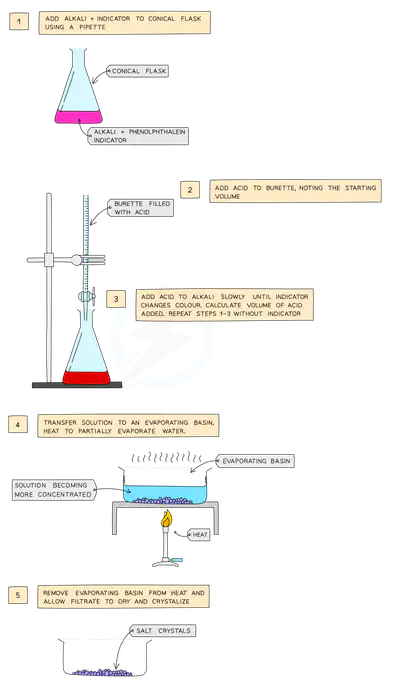
Method B: reacting a dilute acid & alkali
Diagram showing the apparatus needed to prepare a salt by titration
28

2 ORGANISATION OF THE ORGANISM
YOUR NOTES
8 ACIDS, BASES & SALTS
savemyexams.co.uk
Page 17
© copyright Save My Exams
CIE IGCSE Chemistry Revision Notes
CIE IGCSE Chemistry Resources
REVISION NOTES TOPIC QUESTIONS PAST PAPERS
8.2.1 PREPARATION OF SALTS cont...
Method:
• Use a pipette to measure the alkali into a conical flask and add a few drops of indicator
(phenolphthalein or methyl orange)
• Add the acid into the burette and note the starting volume
• Add the acid very slowly from the burette to the conical flask until the indicator changes to
appropriate colour
• Note and record the final volume of acid in burette and calculate the volume of acid added
(starting volume of acid – final volume of acid)
• Add this same volume of acid into the same volume of alkali without the indicator
• Heat to partially evaporate, leaving a saturated solution
• Leave to crystallise decant excess solution and allow crystals to dry
EXTENDED ONLY
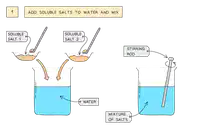
Preparing Insoluble Salts
• Insoluble salts can be prepared using a precipitationreaction
• The solid salt obtained is the precipitate, thus in order to successfully use this method the
solid salt being formed must be insoluble in water
Using Two Soluble Reactants
29

8 ACIDS, BASES & SALTS
YOUR NOTES
savemyexams.co.uk
Page 18
© copyright Save My Exams
CIE IGCSE Chemistry Revision Notes
CIE IGCSE Chemistry Resources
REVISION NOTES TOPIC QUESTIONS PAST PAPERS
8.2.1 PREPARATION OF SALTS cont...
EXTENDED ONLY
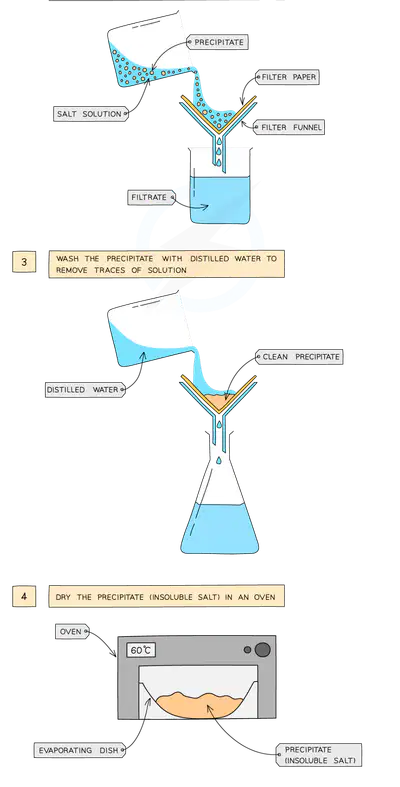
Diagram showing the use of titration to prepare a salt
30

2 ORGANISATION OF THE ORGANISM
YOUR NOTES
8 ACIDS, BASES & SALTS
savemyexams.co.uk
Page 19
© copyright Save My Exams
CIE IGCSE Chemistry Revision Notes
CIE IGCSE Chemistry Resources
REVISION NOTES TOPIC QUESTIONS PAST PAPERS
EXTENDED ONLY cont...
8.2.1 PREPARATION OF SALTS cont...
Method:
• Dissolve soluble salts in water and mix together using a stirring rod in a beaker
• Filter to remove precipitate from mixture
• Wash filtrate with water to remove traces of other solutions
• Leave in an oven to dry
Preparation Of Pure, Dry Lead (II) Sulfate Crystals using a precipitation reaction
• Soluble Salt 1 = Lead (II) Nitrate Soluble Salt 2 = Potassium Sulfate
Method:
• Dissolve Lead (II) Nitrate and Potassium Sulfate in water and mix together using a
stirring rod in a beaker
• Filter to remove precipitate from mixture
• Wash filtrate with water to remove traces of potassium nitrate solution
• Leave in an oven to dry
Equation of Reaction:
Lead (II) Nitrate + Potassium Sulfate → Lead (II) Sulfate + Potassium Nitrate
Pb(NO3)2 (s)
K2SO4 (s)
PbSO4 (s)
2KNO3 (s)
Selecting a Method of Preparation
• When deciding the method of preparation, if is important to first know whether the
salt being produced is soluble or insoluble
• If it is soluble than it can be prepared using either method (A or B) for preparing a
soluble salt
• If it is insoluble then it must be prepared using by precipitation
31

8 ACIDS, BASES & SALTS
YOUR NOTES
savemyexams.co.uk
Page 20
© copyright Save My Exams
CIE IGCSE Chemistry Revision Notes
CIE IGCSE Chemistry Resources
REVISION NOTES TOPIC QUESTIONS PAST PAPERS
8.2.2 IDENTIFICATION OF IONS & GASES
Identification of Cations
Test for aqueous cations
• Metal cations in aqueous solution can be identified by the colour of the precipitate they
form on addition of sodium hydroxide and ammonia
• If only a small amount of NaOH is used then normally the metalhydroxide precipitates
• In excess NaOH some of the precipitates may dissolve
• A few drops of NaOH is added at first and any colour changes or precipitates formed are
noted
• Then the NaOH is added in excess and the reaction is observed again
• The steps are repeated for the test using ammonia solution
Analysing results
• The table below contains the results for each of the cations included in the syllabus
• If a precipitate is formed from either NaOH or aqueous ammonia then the hydroxide is
insoluble in water
• Zinc for example reacts as such:
ZnCl2(aq) + 2NaOH(aq) → Zn(OH)2 + H2O(l)
• Ca2+ ions can be distinguished from Zn2+ and Al3+ as CaOH calcium hydroxide precipitate
does not dissolve in excess NaOH but both zinc hydroxide and aluminium hydroxide do
• Zn2+ ions can be distinguished from Al3+ ions as ZnOH dissolves in excess aqueous
ammonia but Al(OH)3doesnot
• Most transition metals produce hydroxides with distinctive colours
EXAM TIP
The ammonia or sodium hydroxide solution must be added very slowly.
If it is added too quickly, and the precipitate is soluble in excess, then you run the risk of
missing the formation of the initial precipitate, which dissolves as quickly as it it forms if
excess solution is added.
32


2 ORGANISATION OF THE ORGANISM
YOUR NOTES
8 ACIDS, BASES & SALTS
savemyexams.co.uk
Page 21
© copyright Save My Exams
CIE IGCSE Chemistry Revision Notes
CIE IGCSE Chemistry Resources
REVISION NOTES TOPIC QUESTIONS PAST PAPERS
8.2.2 IDENTIFICATION OF IONS & GASES cont...
METAL
CATION
EFFECT OF ADDING
NaOH
EFFECT OF ADDING
AMMONIA SOLUTION
ALUMINIUM
(Al3+)
WHITE PRECIPITATE, DISSOLVES
IN EXCESS NaOH TO FORM A
COLOURLESS SOLUTION
WHITE PRECIPITATE, INSOLUBLE
IN EXCESS AMMONIA, WHITE
PRECIPITATE REMAINS
AMMONIUM
(NH4+)
AMMONIA PRODUCED
IF WARMED
-
CALCIUM
(Ca2+)
WHITE PRECIPITATE, INSOLUBLE SO
REMAINS IN EXCESS NaOH
VERY FAINTLY VISIBLE WHITE
PRECIPITATE
CHROMIUM (III)
(Cr3+)
GREEN PRECIPITATE WHICH FORMS
A GREEN SOLUTION IN EXCESS
GREY-GREEN PRECIPITATE,
INSOLUBLE IN EXCESS
COPPER (II)
(Cu2)
LIGHT BLUE PRECIPITATE,
INSOLUBLE IN EXCESS
LIGHT BLUE PRECIPITATE,
SOLUBLE IN EXCESS TO FORM
DARK BLUE COLOUR
IRON (II)
(Fe2+)
GREEN PRECIPITATE, INSOLUBLE IN
EXCESS
GREEN PRECIPITATE, INSOLUBLE
IN EXCESS
IRON (III)
(Fe3+)
RED-BROWN PRECIPITATE,
INSOLUBLE IN EXCESS
RED-BROWN PRECIPITATE,
INSOLUBLE IN EXCESS
ZINC
(Zn2+)
WHITE PRECIPITATE, DISSOLVES
IN EXCESS TO FORM COLOURLESS
SOLUTION
WHITE PRECIPITATE,
DISSOLVES IN EXCESS TO FORM
COLOURLESS SOLUTION
EXAM TIP
Be sure to distinguish between the term “colourless” and “clear”.
A solution that loses its colour has become colourless.
A clear solution is one that you can see through such as water.
Solutions can be clear and have colour e.g. dilute copper sulphate.
33



8 ACIDS, BASES & SALTS
YOUR NOTES
savemyexams.co.uk
Page 22
© copyright Save My Exams
CIE IGCSE Chemistry Revision Notes
CIE IGCSE Chemistry Resources
REVISION NOTES TOPIC QUESTIONS PAST PAPERS
8.2.2 IDENTIFICATION OF IONS & GASES cont...
Tests for cations
• The flame test
• is used to identify the metal cations by the colour of the flame they produce
• A small sample of the compound is placed on an unreactive metal wire such as nichrome
or platinum
• The colour of the flame is observed and used to identify the metal
The different coloured flames produced by metal cations during flame tests
CATION
COLOUR OF FLAME
Li+
RED
Na+
YELLOW
K+
LILAC
Ca2+
ORANGE-RED
Cu2+
BLUE-GREEN
34


2 ORGANISATION OF THE ORGANISM
YOUR NOTES
8 ACIDS, BASES & SALTS
savemyexams.co.uk
Page 23
© copyright Save My Exams
CIE IGCSE Chemistry Revision Notes
CIE IGCSE Chemistry Resources
REVISION NOTES TOPIC QUESTIONS PAST PAPERS
8.2.2 IDENTIFICATION OF IONS & GASES cont...
Identification of Aqueous Anions
ANION
TEST
RESULT
CARBONATE
(CO3
2-)
ADD DILUTE ACID AND TEST THE
GAS RELEASED
EFFERVESCENCE, GAS
PRODUCED IS CO2 WHICH TURNS
LIMEWATER MILKY
CHLORIDE
(Cl-)
ACIDIFY WITH DILUTE NITRIC ACID
AND ADD AQUEOUS SILVER NITRATE
WHITE PRECIPITATE FORMED
BROMIDE
(Br-)
ACIDIFY WITH DILUTE NITRIC ACID
AND ADD AQUEOUS SILVER NITRATE
CREAM PRECIPITATE FORMED
IODIDE
(I-)
ACIDIFY WITH DILUTE NITRIC ACID
AND ADD AQUEOUS SILVER NITRATE
YELLOW PRECIPITATE FORMED
NITRATE
(NO3
2-)
ADD AQUEOUS NaOH AND ALUMINIUM
FOIL, WARM GENTLY AND TEST THE
GAS RELEASED
GAS GIVEN OFF IS AMMONIA, HAS
A PUNGENT SMELL AND TURNS
MOIST RED LITMUS PAPER BLUE
SULFATE
(SO4
2-)
ACIDIFY WITH DILUTE NITRIC ACID
AND ADD AQUEOUS BARIUM NITRATE
WHITE PRECIPITATE FORMED
SULFITE
(SO32-)
ADD DILUTE ACID, WARM GENTLY
AND TEST THE GAS RELEASED
GAS DECOLOURISES PURPLE
ACIDIFIED AQUEOUS POTASSIUM
MANGANATE(VII) SOLUTION
EXAM TIP
When it comes to qualitative inorganic analysis, always remember that there will be:
• a test for the metal cation part of the molecule
• and another test for the anion part.
35


8 ACIDS, BASES & SALTS
YOUR NOTES
savemyexams.co.uk
Page 24
© copyright Save My Exams
CIE IGCSE Chemistry Revision Notes
CIE IGCSE Chemistry Resources
REVISION NOTES TOPIC QUESTIONS PAST PAPERS
8.2.2 IDENTIFICATION OF IONS & GASES cont...
Identification of Gases
Tests for gases
• Several tests for anions and cations produce gases which then need to be tested
• The table below indicates the tests for the gases included in the syllabus
GAS
APPEARANCE OF TEST
TEST
RESULT
AMMONIA
(NH3)
COLOURLESS, PUNGENT
SMELL
DAMP RED LITMUS
PAPER
TURNS BLUE
CARBON DIOXIDE
(CO2)
COLOURLESS AND
ODOURLESS
BUBBLE THROUGH
LIMEWATER
LIMEWATER
TURNS MILKY/
CLOUDY
CHLORINE
(Cl2)
PALE GREEN, CHOKING
SMELL
DAMP BLUE LITMUS
PAPER
TURNS RED
HYDROGEN
(H2)
COLOURLESS AND
ODOURLESS
HOLD A LIGHTED
SPLINT IN MOUTH
OF TEST TUBE
BURNS WITH
A “SQUEAKY
POP” SOUND
OXYGEN
(O2)
COLOURLESS AND
ODOURLESS
HOLD A GLOWING
SPLINT
SPLINT
RELIGHTS
SULFUR DIOXIDE
(SO2)
COLOURLESS, PUNGENT
CHOKING SMELL
ADD TO ACIDIFIED
AQUEOUS
POTASSIUM
MANGANATE(VII)
TURNS FROM
PURPLE TO
COLOURLESS
EXAM TIP
It is easy to confuse the tests for hydrogen and oxygen. Try to remember that:
• a ligHted splint has an H for Hydrogen, while a glOwing splint has an O for
Oxygen.
> NOW TRY SOME EXAM QUESTIONS
36

2 ORGANISATION OF THE ORGANISM
YOUR NOTES
8 ACIDS, BASES & SALTS
savemyexams.co.uk
Page 25
© copyright Save My Exams
CIE IGCSE Chemistry Revision Notes
CIE IGCSE Chemistry Resources
REVISION NOTES TOPIC QUESTIONS PAST PAPERS
QUESTION 1
?
QUESTION 2
?
A student wanted to prepare copper(II) sulfate crystals by reacting solid
copper(II) oxide to a solution of hot sulfuric acid.
An extract from the method section of the experimental handout is shown
below:
Add the copper(II) oxide in small amounts to the hot acid in the reaction flask
and stir until it is …..1….. When the reaction has gone to completion the
copper(II) oxide will no longer …..2….., …..3….. and …..4….. the solution to
obtain the copper(II) sulfate crystals.
1
2
3
4
Ain excess
precipitate
cool
dissolve
Bin excess
dissolve
filter
cool
C
reacting
dissolve
cool
filter
D
reacting
precipitate
filter
cool
Which of the following methods to prepare a salt can be achieved using a
burette and a pipette?
A Nitric acid and calcium carbonate to prepare calcium nitrate.
B Sulfuric acid and copper(II) oxide to prepare copper(II) sulfate.
C Hydrochloric acid and zinc to prepare zinc chloride.
D Hydrochloric acid and potassium hydroxide to prepare potassium chloride.
EXAM QUESTIONS
37

8 ACIDS, BASES & SALTS
YOUR NOTES
savemyexams.co.uk
Page 26
© copyright Save My Exams
CIE IGCSE Chemistry Revision Notes
CIE IGCSE Chemistry Resources
REVISION NOTES TOPIC QUESTIONS PAST PAPERS
EXAM QUESTIONS
QUESTION 3
?
Copper(II) sulfate can be prepared by reacting solid copper(II) carbonate with
hot sulfuric acid. The alkali solid is always added in excess.
Why is the solid reactant added in excess?
A To ensure all of the acid reacts.
B To make the reaction go faster.
C To ensure all of the solid reactant has reacted.
D To increase the product yield.
> CHECK YOUR ANSWERS AT SAVEMYEXAMS.CO.UK
Head to savemyexams.co.uk
for more questions and revision notes
ACIDS BASES SALTS
Show answer
Auto Play
Slide 1 / 37
SLIDE
Similar Resources on Wayground

28 questions
Chemical Nomenclature Lessons
Presentation
•
10th Grade
28 questions
Chemical Nomenclature
Presentation
•
10th Grade
33 questions
Acids, Bases, and Covalent Compound Names
Presentation
•
11th Grade
31 questions
G11 IELTS Lesson 38 Reading
Presentation
•
11th Grade
32 questions
Prepositions of place and giving directions
Presentation
•
KG
32 questions
English for Communication: Revision
Presentation
•
11th Grade
34 questions
Phy vs Chem depth
Presentation
•
11th Grade
32 questions
Introduction to Limits In Calculus
Presentation
•
11th - 12th Grade
Popular Resources on Wayground
5 questions
A Home on the Shore

Quiz
•
3rd Grade
28 questions
US History Regents Review
Quiz
•
11th Grade
6 questions
A Horse Tale
Quiz
•
3rd Grade
20 questions
Math Review
Quiz
•
3rd Grade
10 questions
Juneteenth History and Significance

Interactive video
•
5th - 8th Grade
20 questions
Dividing Fractions
Quiz
•
5th Grade
55 questions
A Long Walk to Water Final Review
Quiz
•
6th - 8th Grade
10 questions
Equation Word Problems
Quiz
•
7th Grade
Discover more resources for Chemistry
28 questions
US History Regents Review
Quiz
•
11th Grade
20 questions
Insurance
Quiz
•
9th - 12th Grade
10 questions
Juneteenth: History and Significance
Interactive video
•
7th - 12th Grade
10 questions
7.3-7.4 Quiz
Quiz
•
11th Grade
6 questions
Mayan Mathematics part 1
Presentation
•
9th - 12th Grade
40 questions
Flags of the World
Quiz
•
KG - Professional Dev...
10 questions
Unit 9 Quiz
Quiz
•
9th - 12th Grade
50 questions
US History Regents Practice Exam
Quiz
•
11th Grade