

The Renaissance and Architecture

Presentation
•
Social Studies
•
9th - 12th Grade
•
Easy

Arianna Carter
Used 2+ times
FREE Resource
6 Slides • 6 Questions
1

2

3
Open Ended
What is the Renaissance? Briefly describe it.
4

5
Multiple Select
What does the term "Renaissance" mean, and how does it reflect the changes in European society during this period? SELECT TWO.
Age of Awakening/ Born Anew
Writers, artists, and architects left previous eras of art, literature, and building styles behind
Art and the humanities stayed stuck in the past
6
Multiple Choice
What specific features of Classical Greece and Rome influenced Renaissance architecture?
7

8
Open Ended
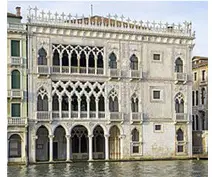
The image shows an example of architecture seen during the Renaissance period. What influenced Renaissance architecture?
9
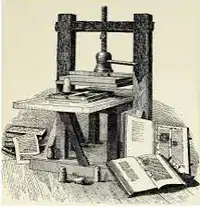
Johannes Gutenberg was a German craftsman who invented the printing press, a device that mass printed writings/books faster and cheaper than other forms of printing. Elements of his invention are thought to have included a metal alloy that could melt readily and cool quickly to form durable reusable type, an oil-based ink that could be made sufficiently thick to adhere well to metal type and transfer to vellum or paper, and a new press; likely adapted from those used in producing wine, oil, or paper, for applying firm even pressure to printing surfaces. None of these features existed in the European technique used up to that time for stamping letters on various surfaces or in woodblock printing. Gutenberg’s printing press was considered a history-changing invention, making books widely accessible and ushering in an “information revolution.”
Johannes Gutenberg and the Printing Press
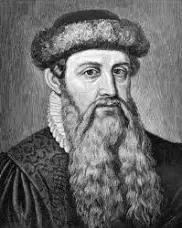
Johannes Gutenberg
10
Fill in the Blanks
The printing press is a device that _____ writing or books in a faster and cheaper way. It led to greater access of different ____ about religious and nonreligious matters, allowed _____ to store more information at lower costs, and allowed knowledge to be _____ and preserved.
Type answer...
11
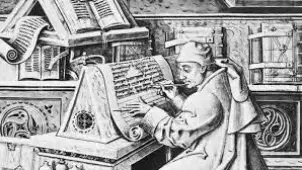
The immediate effect of the printing press was the increased output and reduced costs of books. The printing press made information available to a larger segment of the population who were, of course, eager for information of any variety. In particular, citizens of European countries gained access to a wider range of viewpoints about religious and non-religious matters. Libraries could also store greater quantities of information at a much lower cost. Printing also facilitated the dissemination and preservation of knowledge in standardized form -- this was most important in the advance of science, technology and scholarship. The printing press certainly initiated an "information revolution" on par with the Internet today. Printing could and did spread new ideas quickly and with greater impact.
How the Printing Press Changed Society
12
Open Ended
The printing press has been compared to the arrival of the internet. How are they similar? How are they different?
Show answer
Auto Play
Slide 1 / 12
SLIDE
Similar Resources on Wayground

8 questions
Mayan Civilization
Presentation
•
9th - 12th Grade
10 questions
Rise of the Roman Republic
Presentation
•
9th - 12th Grade
10 questions
Function Notation Lesson
Presentation
•
9th - 12th Grade
10 questions
Topic 14, United Kingdom
Presentation
•
9th - 12th Grade
8 questions
Unit 1 Day 3
Presentation
•
9th - 12th Grade
9 questions
Constitution and Bill of Rights Lesson
Presentation
•
9th - 12th Grade
10 questions
Puns and Oxymorons
Presentation
•
9th - 12th Grade
10 questions
Writing Equations for Exponential Functions
Presentation
•
9th - 12th Grade
Popular Resources on Wayground
10 questions
Safety Day 2026 – Student Review

Quiz
•
9th Grade
21 questions
Continents and Oceans
Quiz
•
6th Grade
20 questions
Parts of Speech
Quiz
•
5th Grade
16 questions
Subject & Predicate
Quiz
•
5th Grade
25 questions
Multiplication Facts
Quiz
•
5th Grade
12 questions
Map Skills
Quiz
•
3rd Grade
22 questions
Continents and Oceans
Quiz
•
5th Grade
15 questions
Rounding Decimals
Quiz
•
5th Grade
Discover more resources for Social Studies
10 questions
Exploring the Age of Exploration: Key Events and Figures

Interactive video
•
6th - 10th Grade
9 questions
Exploring Ancient Mesopotamia and Its Civilizations
Interactive video
•
10th Grade
20 questions
Chapter 8 Test "Types of Business Organizations"
Quiz
•
12th Grade
39 questions
Unit 7 Key Terms
Quiz
•
11th Grade - University
10 questions
Debating the Legacy of Christopher Columbus
Interactive video
•
6th - 10th Grade
38 questions
Unit 6 Key Terms
Quiz
•
11th Grade - University
27 questions
World Geography - Q1 9week Test
Quiz
•
9th Grade
22 questions
U3T2 Vocab FAC: Domestic Policy
Quiz
•
10th Grade