Search Header Logo
11/13 Types of Forces -on your own

11/13 Types of Forces -on your own

Assessment

Presentation

Science

6th - 8th Grade

Practice Problem

Easy

NGSS
MS-PS2-5, MS-PS2-4, MS-ESS1-2

+11

Standards-aligned

Created by

Ms. Baumann

Used 8+ times

FREE Resource

8 Slides • 33 Questions

1
media
media

Copyright © Savvas Learning Company LLC. All Rights Reserved. Savvas is not responsible for any modifications made by end users to the content posted in its original format.

What is friction? continued

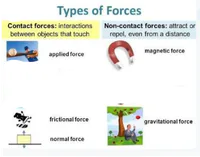
A force is a push or a pull.

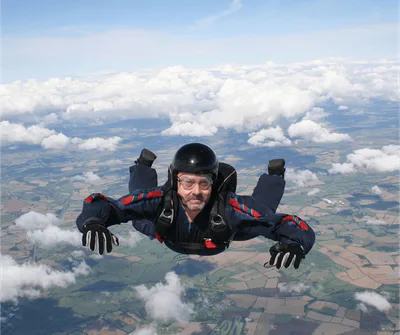
Contact forces require
that objects be in direct
contact with each other.

Non-contact forces do
not require objects to be in
direct contact.

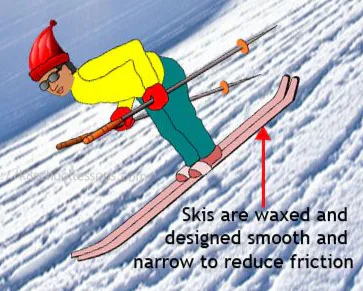
Friction is a contact force
between two surfaces
when they push or rub
against each other. It is
parallel to the surfaces and
opposes their motion.

Photo credit: Joggie Botma/Alamy Stock Photo

2

Match

Match the word with the definition.

Force

Contact forces

Non-contact forces

Friction

a push or a pull.

require
that objects be
touching

do
not require objects to be touching

is a contact force
between two surfaces

parallel lines

3

Categorize

Options (14)

touching

not touching

Question image
Question image
Question image
Question image

pushing a door

pulling a doorknob

holding something

leaning on a wall

stack of books

pressing against something

gravity
magnetism

LISTEN to the audio to drag these options into the right categories.

objects in contact
objects in non-contact

4

Dropdown

A ​
is a push or pull, described by its strength and the direction in which it acts, such as pulling a window open or pushing a door closed.

The strength and direction of a force can be represented as an arrow. The ​
of an arrow indicates the force’s strength (with longer arrows showing greater strength). The direction the ​
points indicates the direction in which the force is applied.

Some forces occur when objects are in direct contact with each other, such as when you pull open a door. These are known as ​
. Some forces do not require that objects be in direct contact with each other. These are known as ​

5

Reorder

Reorder the following from least to most FRICTION

ice

wood floor

rough concrete gravel driveway

1
2
3

6

Categorize

Options (18)
Question image
Question image
Question image

slippery surfaces

ice
wet floors
oily surfaces
smooth tiles
waxed surfaces
polished wood
rough surfaces

shaggy long carpet

sandpaper

bumpy asphalt

rubber mats

textured tiles

Question image

rough surface

Question image

Listen to the audio to drag these options into the right categories.

More friction
Less friction

7

Dropdown

Friction is a contact force that two surfaces exert on each other when they push or rub against each other. It is ​
to the surfaces and opposes their motion.

Friction is affected by two factors: the types of surfaces involved and how hard the surfaces are pushed together. In general, smooth surfaces produce less friction than ​
surfaces.

Common types of friction include sliding friction, fluid friction, and rolling friction.​
friction occurs when two surfaces slide on or past each other. Fluid friction occurs when a solid object moves through a fluid like ​
friction occurs when an object rolls across a surface.Example:  A skydiver’s body and the air particles are coming into contact. The skydiver’s body is pushing against the air particles as he falls. It is an example of fluid friction.

8

Multiple Select

Question image

Friction is a force between things that are parallel and touching.

Which 3 contain lines that are parallel?

1
2
3
4

9

media
media
media

Copyright © Savvas Learning Company LLC. All Rights Reserved. Savvas is not responsible for any modifications made by end users to the content posted in its original format.

What is gravity? continued

Gravity is a non-contact force that pulls objects with mass
toward each other. Gravitational force is affected by the mass
of the objects and the distance between them. The greater an
object’s mass, the greater the gravitational force between it
and other objects. Gravitational force decreases as the
distance between two objects increases.

Photo credit: Evgenii Baranov/Alamy Stock Photo

10

Dropdown

Question image
is a ​
force that pulls objects with mass toward each other. Gravitational force is affected by the ​
of the objects and the distance between them.


The greater an object’s mass, the greater the ​
between it and other objects.


Gravitational force decreases as the

between two objects increases.

11

Multiple Choice

Which has the

GREATEST

gravitational force?

1

more mass, less distance

2

less mass, most distance

3

more mass, more distance

12

Multiple Choice

WHich has the

LEAST

gravitational force?

1

more mass, less distance

2

less mass, most distance

3

more mass, more distance

13

Categorize

Options (10)

things closer together

things further apart

less mass

planets with larger mass
distant celestial bodies

more massive objects

Question image

tiny grains of sand

specks of dust

greater distances

LISTEN TO THE AUDIO to drag and drop these options into the right categories.

More gravity
Less gravity

14

Dropdown


Gravity is a ​
that pulls objects toward each other as a result of their masses. Gravitational force, for example, pulls objects on or near Earth toward Earth, and it also keeps ​
around the sun and the moon in orbit around Earth. 

Gravitational force depends on two factors: the ​
of the objects and the distance between them. 

Gravitational force increases as mass increases, and it decreases as the ​
between the objects ​


Example: Between which pair of objects is the gravitational force stronger: two tennis balls have less gravitational pull than two bowling balls because their mass is greater than the mass of the tennis balls.  Two soccer balls a few meters apart has more gravitational mass than two soccer balls on either end of a soccer field because gravitational force decreases as the distance increases

15

Fill in the Blanks

media image

16

media
media

Copyright © Savvas Learning Company LLC. All Rights Reserved. Savvas is not responsible for any modifications made by end users to the content posted in its original format.

What is magnetism? continued

Magnetism is the attractive or repulsive force exerted by
magnetic materials. It is a non-contact force. The
magnitude, or strength, of magnetic force decreases as
the distance between the objects increases.

17

Fill in the Blanks

media image

18

Fill in the Blanks

media image

19

Match

Question image

Match the following

magnetism

magnitude

distance

non-contact forces

attractive or repulsive force

means strength

decreases magnetic force

magnet attracting paper clips

do not touch

20

21

Multiple Select

Like poles repel each other. (Like poles are the same .)

Which 2 pair of magnets will repel each other?

1
2
3
4

22

Multiple Select

Opposite poles attract each other.

Which 2 pair of magnets will attract each other?

1
2
3
4

23

Dropdown

(like) poles repel each other.

means push ​
.

Magnets that are ​
together will repel each other with a ​
force.

24

Dropdown

poles attract.

Magnets ​
together ​
each other with ​
force

than the magnets that are ​
apart. 

25

Multiple Choice

Which pair of magnets will

ATTRACT each other

the MOST?

1

same poles, far

2

opposite poles, far

3

same poles close

4

opposite poles, close

26

Multiple Choice

Which pair of magnets will

REPEL each other

the MOST

1

same poles, far

2

opposite poles, far

3

same poles close

4

opposite poles, close

27

Match

Match the following

not touching

move together

push away

amount of stuff in something

non-contact

attract

repulsive

or repel

mass

perpendicular

28

media
media

Copyright © Savvas Learning Company LLC. All Rights Reserved. Savvas is not responsible for any modifications made by end users to the content posted in its original format.

What are normal forces? continued

An applied force is a force applied to an object by another object,
such as pushing or pulling a door. Normal force is any force that is
applied perpendicularly to a surface.

Photo credit: Red Che/Shutterstock

29

Match

Match the following. 


non-contact force that pulls objects with mass toward each other 

attractive or repulsive force exerted by magnetic materials 

the strength of a force

force exerted on an object that is applied perpendicularly to the surface

gravity

magnetism

magnitude

normal force

NOT perpendicular

30

Fill in the Blanks

media image

31

Dropdown

Question image
An ​
force is a force applied to an object by ​
,
such as pushing or pulling a door. ​
force is any force that is
applied ​
to a ​

32

Multiple Select

Question image

Which show perpendicular lines?

1
2
3
4

33

Dropdown

Forces can be applied by ​
action. The active push or pull that we exert on objects are ​
forces. The force we use to push a desk across a room is an example.

People and objects can apply forces even when they don’t seem to be actively pushing or pulling. For example, just by ​
on the floor, you are applying force by ​
down on the floor. The floor also applies force by pushing ​
on you.

34

Dropdown

is a force exerted perpendicularly to a surface; two lines that cross each other but are ​
to each other, at a 90° or a ​
.

A force is said to be normal to a surface when it is applied “head-on,” or ​
to the surface. For example, when we want to push open a heavy (hinged) door, we apply a normal force to it so that all our effort goes into opening the door. Some of our force is wasted if we push at an ​
.

35

Dropdown

Any object placed on a ​
surface, such as a floor or a table, is exerting a normal force on that surface. What makes this force “normal” is simply that it points ​
on a surface that happens to be horizontal, so the force is perpendicular to the surface. 

The upward forces exerted by the floor on objects, such as the soles of our feet, are also normal forces because they are ​
to the surfaces to which they are applied.

When we stand on a ramp or some other ​
surface, gravity still pulls us directly down, so we are still applying a downward push on the surface. But since the ramp is not horizontal, the push we exert on the ramp is ​
to the ramp (it is not “perpendicular” to it).

36

Fill in the Blanks

media image

37

Open Ended

Question image

Give YOUR OWN example of a normal force

38

Categorize

Options (4)

friction

gravity

magnetism

normal force

LISTEN to the audio to drag these options into the right categories.

contact force
non contact force

39

web page not embeddable

Team Hamster! and The Ruffman Ruffman Show . Games . Fish Force | PBS KIDS

You can open this webpage in a new tab.

40

41

web page not embeddable

Logic Magnets | Math Playground

You can open this webpage in a new tab.

media
media

Copyright © Savvas Learning Company LLC. All Rights Reserved. Savvas is not responsible for any modifications made by end users to the content posted in its original format.

What is friction? continued

A force is a push or a pull.

Contact forces require
that objects be in direct
contact with each other.

Non-contact forces do
not require objects to be in
direct contact.

Friction is a contact force
between two surfaces
when they push or rub
against each other. It is
parallel to the surfaces and
opposes their motion.

Photo credit: Joggie Botma/Alamy Stock Photo

Show answer

Auto Play

Slide 1 / 41

SLIDE