
IGCSE geography mapwork slides

Presentation
•
Geography
•
10th Grade
•
Practice Problem
•
Hard

Mohamed Majam
FREE Resource
33 Slides • 0 Questions
1
IGCSE GEOGRAPHY
1. MAP SKILLS
THE BASICS OF MAPPING.
COMPASS DIRECTIONS.
4 AND 6 GRID REFERENCES.
HEIGHTS AND CONTOUR LINES.
2

THE BASICS OF MAPPING
Maps are representations of the world created by people called
cartographers to help other people navigate the world.
Maps contain information tailored to a specific purpose.
A road map, for example, contains information that helps the
reader get from one place to another using a vehicle.
The maps found in a geographical atlas will contain
information of less interest to a road user, such as how the
land in a place is used, the population density and the political
boundaries that exist between regions, states and nations.
3

READING A MAP
There are five fundamental things you need to be familiar
with to read a map successfully:
•compass directions
•grid references
•map's key
•title
•scale
4

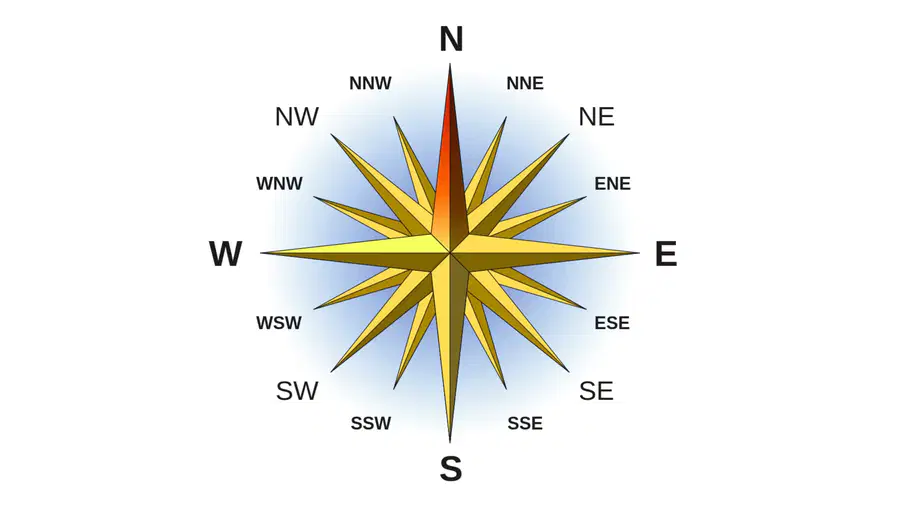
COMPASS DIRECTIONS
Compass directions are vital for finding your way around a
map. There are many ways to remember where each
direction goes.
Starting at the top and moving clockwise the directions on a
compass or map are:
•North
•East
•South
•West
5
6

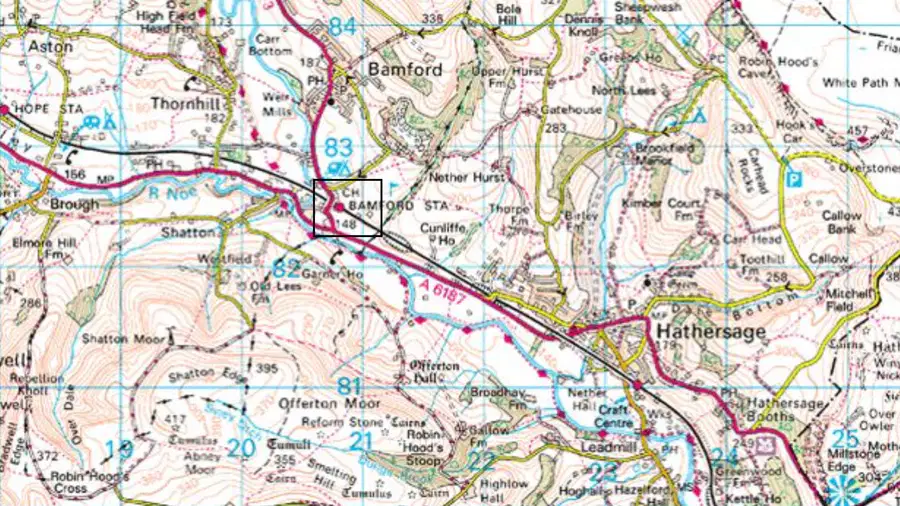
GRID REFERENCES
OS maps are divided into numbered squares.
These squares can be used to give a place a four or six-figure
grid reference.
It is important that you know both four-figure and six-figure
grid references.
OS - Ordnance Survey is the national mapping agency for Great
Britain and the largest producer of maps.
7

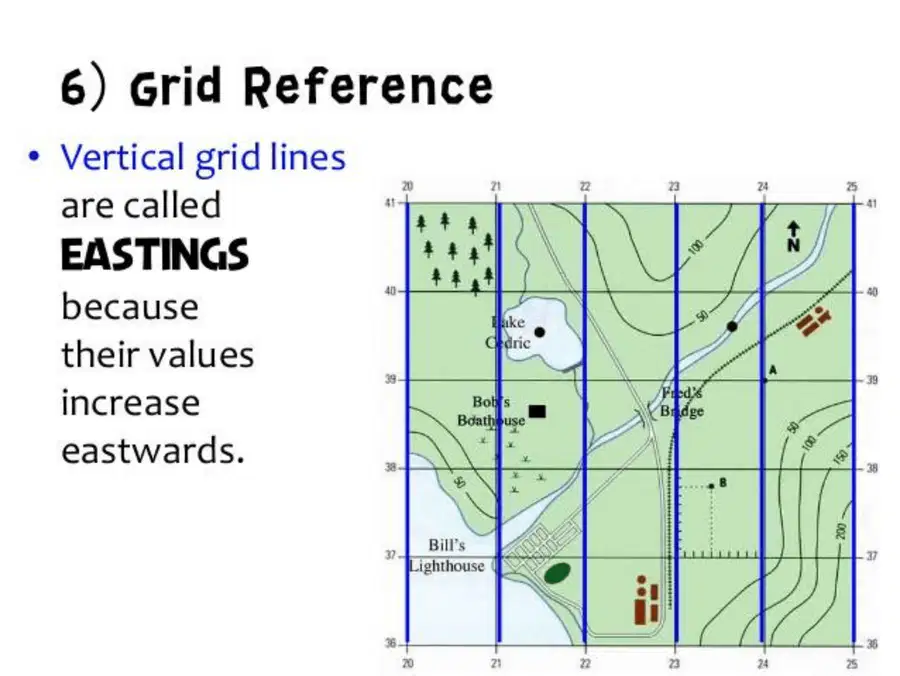
EASTINGS
Eastings are lines that run up and down the map vertically.
They increase in number the further you move east (or right).
You can use them to measure how far to travel east.
8

9

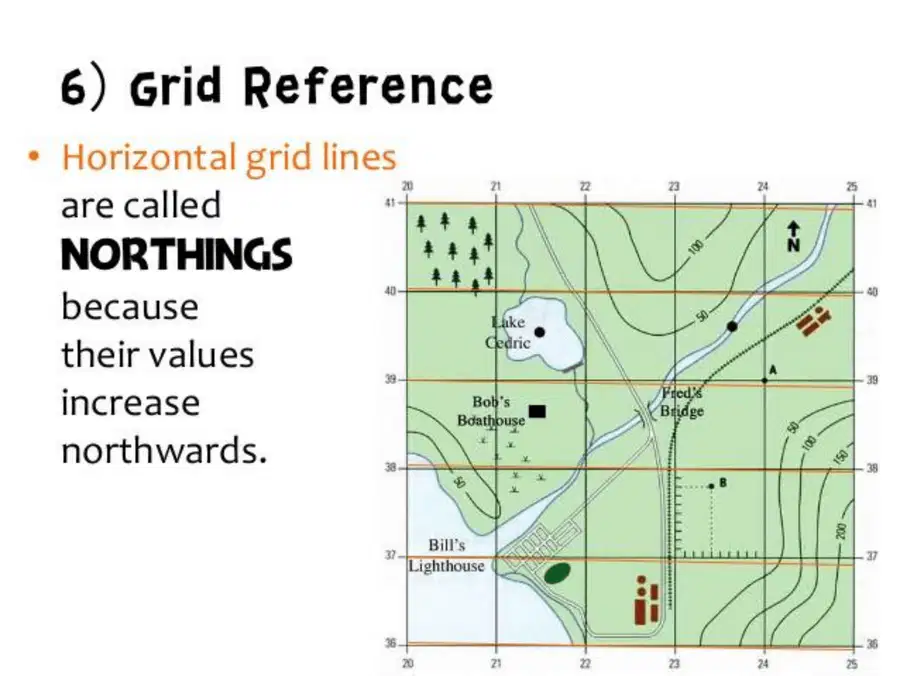
NORTHINGS
Northings are lines that run across the map horizontally.
They increase in number the further you move north (or up
the map).
You can use them to measure how far to travel north.
10

11
12
LOCATE PLACES USING GRID REFERENCES
A grid of squares helps the map-reader to locate a place.
The horizontal lines crossing the map from one side to the
other are called northings.
They are numbered – the numbers increase to the north.
The vertical lines crossing the map from top to bottom are
called eastings as the numbers increase in an easterly
direction.
Things to remember:
On an OS map each grid square is 1 km x 1 km or 1 sq km.
When you give a grid reference, always give the easting first...
"Along the corridor and up the stairs".
13
FOUR GRID REFERENCES
Four-figure grid references can be used to pinpoint a location
to within a square measuring 1 sq km.
To find the number of the square:
•Start at the left-hand side of the map and go east until you
get to the easting crossing through the bottom-left-hand
corner of the square you want. Write this number down.
•Move north until you get to the northing crossing the
bottom-left-hand corner of the square you want. Look at the
number of this grid line and add it to the two-digit number
you already have. This is your four-figure grid reference.
14

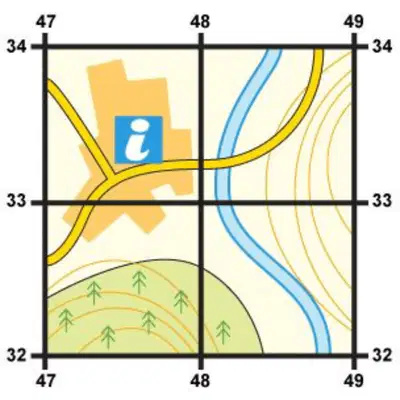
In this case, the tourist information
office is in grid square 4733.
15
SIX GRID REFERENCES
Sometimes it is necessary to be even more accurate. In this
case you can imagine that each grid is divided into 100 tiny
squares. The distance between one grid line and the next is
divided into tenths.
•First, find the four-figure grid reference but leave a space
after the first two digits. When you get to the easting at the
left-hand side of the grid square you want, keep moving east
and estimate or measure how many tenths across your
symbol lies. Write this number after the first two digits.
•Next, move north from the bottom-left-hand corner of your
grid square and estimate how many tenths your symbol is
from this point. Put them together to create a six figure grid
reference.
16

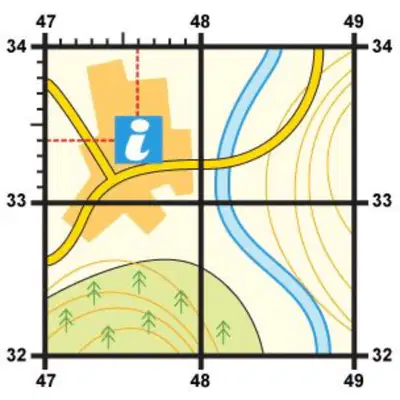
In this instance, the tourist information
office is located at 476334.
17

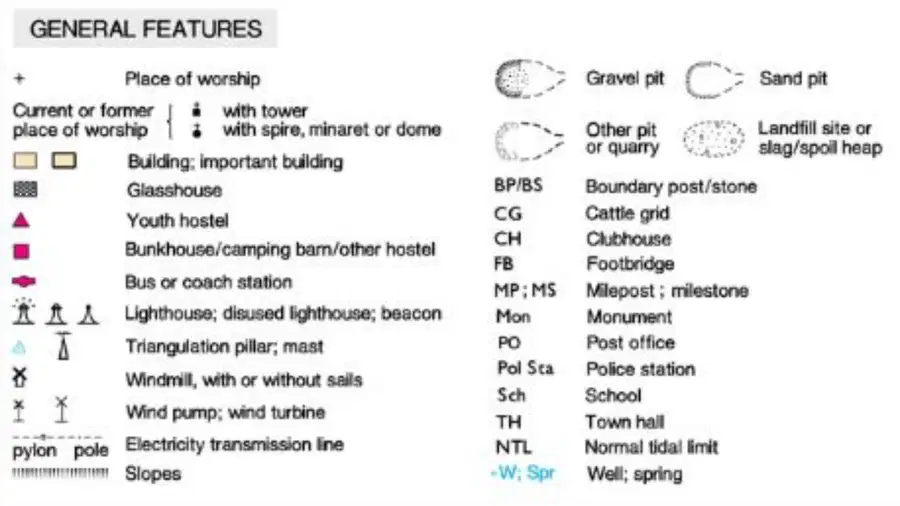
KEY
Just like a key to a door, the key helps you to unlock the
information stored in the colours and symbols on a map.
You must understand how the key relates to the map before
you can unlock the information it contains.
The key will help you to identify types of boundaries, roads,
buildings, agriculture, industry, places of interest and
geographical features.
18

19

TITLE
Make sure you read the title of a map before you start to use
it.
This will give you a general idea about the information it
stores.
While it may appear a straightforward thing to do, under exam
conditions, it is easy to confuse different maps or not use the
one that is most useful.
20

SCALE
The scale of a map allows a reader to calculate the size, height
and dimensions of the features shown on the map, as well as
distances between different points.
The scale on a map is the ratio between real life sizes and how
many times it has been shrunk to fit it on the map.
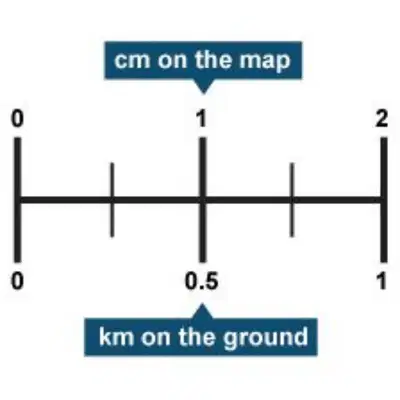
On a 1:50,000 scale map, 1 cm on the map represents 50,000 cm
on the ground (= 500 m or 0.5 km).
21

22

HEIGHTS ON MAP
Maps show heights in a number of ways.
23
SPOT HEIGHTS AND TRIANGULATION
•Spot heights and triangulation pillars
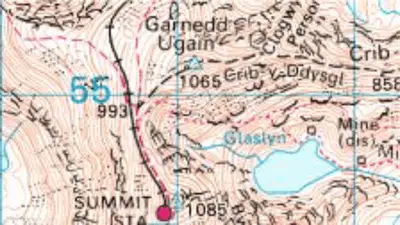
This map extract shows exact heights by a black dot with a
number next to it. The number is the height above sea level in
metres. The blue triangle represents a triangulation pillar.
24

CONTOUR LINES
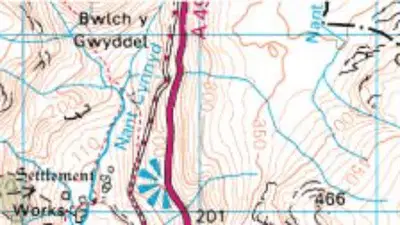
•These are lines drawn on maps that join places of the same
height. They are usually an orange or brown colour.
•Some contour lines have their height above or below sea
level written on them.
•It is possible to use them to see the shape of the land – if
contour lines are close together the slope is steep, if they are
far apart the slope is gentle.
•Contour lines are usually drawn at 10 metre intervals on a
1:50,000 scale map and at 5 metre intervals on a 1:25,000
scale map.
25

26

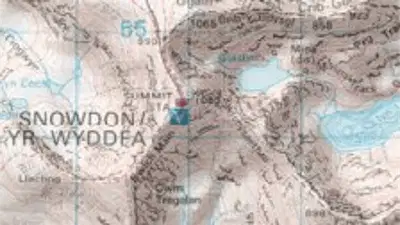
LAYER SHADING
•Maps are sometimes shaded to show the height of land.
27

CROSS-SECTIONS
•By putting a piece of plain paper or graph paper on top of the
contours we can mark out the different lines and height at
which they represent.
•By doing this you can easily draw a cross section.
•Remember to properly label features on the cross section
such as a river, settlement, farm etc.
28
MAPS
Ordnance Survey maps, the most common type of map in the
UK, come in several scales.
Travel maps have a scale of 1:125,000. This means 1 cm on the
map represents 125,000 in the real world or 1 cm = 1.25 km.
These are used by drivers going long distances.
Landranger maps are 1:50,000 (1 cm = 500 m). These are useful
for drivers going shorter distances.
Explorer maps are 1:25,000 (1 cm = 250 m). These are useful for
walking and other outdoor pursuits.
Landplan maps are 1:10,000 (1 cm = 100 m). These show
individual streets clearly and might be used by town planners.
29
ORDNANCE SURVEY MAPS
You will be asked to interpret maps to find out specific
information.
Being able to distinguish between different types of land use on
an Ordnance Survey (OS) map will help you interpret maps
during your exams.
30
ORDNANCE SURVEY MAPS cont.
Make sure you can tell the difference between urban and rural
land use. Start by looking at the key.
Are the features in the key related to the countryside or to
towns?
Look out for features of the urban landscape that are
represented in symbols on the OS map.
Start by looking at modes of transport (eg junctions of main
roads, railways, ports and airports).
Look for rural features. Study the key carefully to see what
different areas of shading on the map represent.
For example, different types of farmland will be shaded
differently.
31
ORDNANCE SURVEY MAPS cont.
Study the relief of the land on your OS map by looking for the
contour lines.
Contours will show you where the hills (elevations) and valleys
(depressions) are on the map.
Contours will often show changes in height of 5 or 10 metres.
The closer the contours are together the steeper the slope is.
If the contours are far apart, you might be looking at a flat flood
plain.
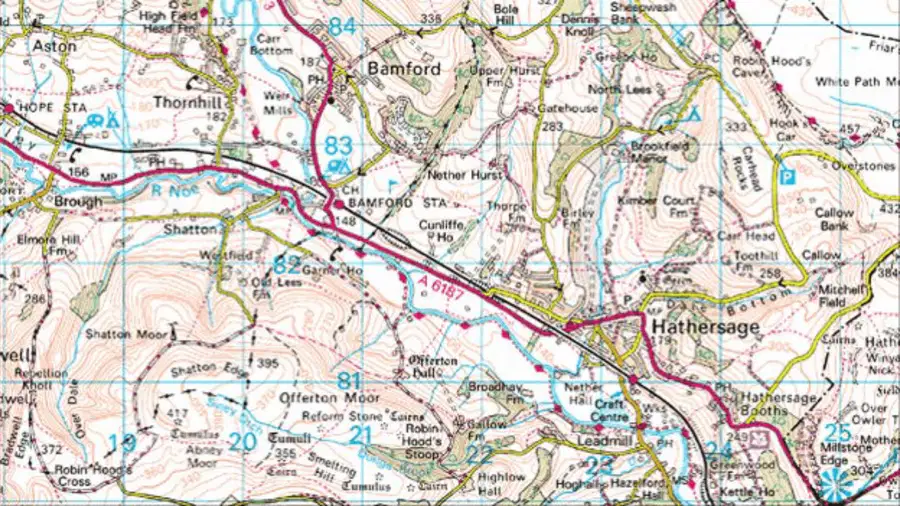
On the NEXT map the contours in square 1981 are quite close
together - indicating a fairly steep gradient.
32

33
GLOSSARY
contour line
Line on a map joining points of equal height above sea level -
thus representing the slope of the land.
gradient
Another word for steepness. On a graph, the gradient is defined
as being the change in the y value divided by the change in the
x value, and defines how steep a line is.
navigate
Find your way around.
Ordnance Survey (OS)
The national mapping agency for Great Britain and the largest
producer of maps.
IGCSE GEOGRAPHY
1. MAP SKILLS
THE BASICS OF MAPPING.
COMPASS DIRECTIONS.
4 AND 6 GRID REFERENCES.
HEIGHTS AND CONTOUR LINES.
Show answer
Auto Play
Slide 1 / 33
SLIDE
Similar Resources on Wayground
![Natural Vegetation [Practise]](https://cf.quizizz.com/image/image-loader.svg)
27 questions
Natural Vegetation [Practise]
Presentation
•
10th Grade
26 questions
Circuits and Symbols
Presentation
•
9th - 12th Grade
25 questions
Domains and Kingdoms
Presentation
•
10th Grade
28 questions
Electromagnet
Presentation
•
10th Grade
27 questions
Unit 1.7 Regional Analysis
Presentation
•
10th Grade
26 questions
Texas Independence
Presentation
•
10th Grade
28 questions
Procedure Text
Presentation
•
10th Grade
29 questions
Ionic Bonding
Presentation
•
10th Grade
Popular Resources on Wayground
10 questions
Safety Day 2026 – Student Review

Quiz
•
9th Grade
21 questions
Continents and Oceans
Quiz
•
6th Grade
20 questions
Parts of Speech
Quiz
•
5th Grade
16 questions
Subject & Predicate
Quiz
•
5th Grade
25 questions
Multiplication Facts
Quiz
•
5th Grade
12 questions
Map Skills
Quiz
•
3rd Grade
22 questions
Continents and Oceans
Quiz
•
5th Grade
15 questions
Rounding Decimals
Quiz
•
5th Grade
Discover more resources for Geography
13 questions
5 Themes of Geography
Presentation
•
9th - 12th Grade
10 questions
Reteach Unit 4: Latin America Review
Presentation
•
9th - 10th Grade
20 questions
US & Canada Physical and Political Geography
Quiz
•
9th - 12th Grade
7 questions
Prairie, Pacific, and Territories
Presentation
•
9th - 12th Grade
8 questions
The Fight Against Terrorism
Presentation
•
9th - 12th Grade
45 questions
US & Canada Review-B
Quiz
•
9th - 12th Grade
8 questions
Canada: Atlantic and Core Provinces
Presentation
•
9th - 12th Grade