

DNA: Intro and History

Presentation
•
Science
•
7th Grade
•
Easy
+20
Standards-aligned

Tabatha Duffey
Used 20+ times
FREE Resource
16 Slides • 9 Questions
1

DNA
History, Structure, Genetics
2
By the end of this lesson you should understand what DNA is, its structure, and the key scientists involved in its discovery. Today we will learn the history of DNA's discovery and how it revolutionized biology and genetics.
3
Use models to investigate the structure of DNA.
Describe the structure and function of DNA.
Discuss how the discovery of DNA, genes, chromosomes, and traits illustrate the nature of science.
4
Gene: A section of DNA that codes for a specific trait or characteristic.
Chromosome: A long thread-like structure made of DNA and proteins that carries genes.
Double Helix: The twisted ladder structure of DNA, made of two strands.
5
Multiple Choice
6
DNA stands for...
DeoxyriboNucleic Acid

7
Deoxyribonucleic Acid
Made of:
Phosphate groups
Deoxyribose sugars
Nitrogenous Bases
Series of nucleotides creating a long stranded molecule
Code for ALL life; from us to the bacteria that make us sick!
Molecule resides in the nucleus of eukaryotic cells and freely floats in prokaryotic cells
What is DNA?

8
Multiple Choice

What type of organic molecule is DNA?
lipid
protein
carbohydrate
nucleic acid
9
DNA is packed tightly within the chromosomes within the nucleus
Genes are a segment of DNA code for traits

10
Multiple Choice

Where in the cell is DNA found?
cytoplasm
ribosome
vacuole
nucleus
11


DNA = chemical instructions for making proteins
Proteins determine your traits!
DNA Function
12
Spiral shaped - Double Helix
made of repeating subunits called nucleotides
a nucleotide- composed of a phosphate group, deoxyribose sugar, a nitrogenous base

13
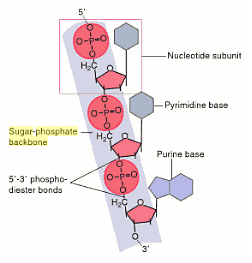
These alternate to form the ladder-like backbone of DNA
What do the sugar and phosphate group do?
14

Nitrogenous bases are the "code" part of DNA and/or RNA. Their order is what tells the cell what to make and how to do it.
4 bases found in DNA; in RNA U replaces T.
BASES include:
Adenine - Thymine (DNA ONLY!)
Cytosine - Guanine
(Uracil takes the place of Thymine in RNA ONLY!!) -
What is a nitrogenous base?
What is the difference between a Purine and a pyrimidine? Purines have a double-ring structure and consist of adenine and guanine, while pyrimidines have a single-ring structure and consist of cytosine, thymine, and uracil.
15
Fill in the Blanks
DNA makes proteins that determine your
Type answer...
16
Multiple Select

A single nucleotide is made of 3 components. Which of the following are components of a single nucleotide?
sugar
amino acid
a nitrogen base
phosphate group
17

Some text here about the topic of discussion.
Nucleotides
Base pairs = 2 nucleotides
Adenine (A) can only pair with Thymine (T)
Guanine (G) can only pair with Cytosine (C)
18
Multiple Choice
A, G, T, and C are all ______________.
Organelles
Nucleotides
19
Match
Match the following base pairs.
A
G
T
U
C
T
C
A
A
G
T
C
A
A
G
20
specific base pairs in a specific order
code that tells proteins what traits to give you

= Height Gene

Example
ATCG/TAGC = Tall
21
Multiple Choice
Each section of DNA that codes for a specific trait is called a _______.
gene
DNA
base pair
22
In 1953, two scientists named Watson and Crick discovered that DNA is made of two chains of nucleotides that are joined together at the nitrogen bases by hydrogen bonds.
By using special X-ray techniques, another scientist named Rosalind Franklin discovered that DNA is made of two strands and that the sugar & phosphate molecules make up its backbone.
Watson & Crick put this information together with what they knew and they discovered that DNA is twisted into a shape called a double helix.
The complementary nitrogen bases make up the “rungs” (steps) of the double helix “ladder” structure

23
Watson and Crick's discovery
the two-strand DNA, double helix
DNA-the molecule containing human genes was discovered in 1953

24
8. Hydrogen bonds
9. Nucleotide
10. Nitrogen base
11. Sugar
12. Phosphate
13. Base pair

A - Adenine
T -Thymine
C - Cytosine
G - Guanine
Remember: These 4 bases form complimentary pairs:
A pairs with T, C pairs with G.
25
Poll
How are you feeling about understanding the structure of DNA?
Really good. It makes sense.
Okay. I know I will get better.
Meh. Some of it is still confusing.
Terrible. None of this makes sense.
DNA
History, Structure, Genetics
Show answer
Auto Play
Slide 1 / 25
SLIDE
Similar Resources on Wayground

21 questions
Mixtures & Pure Substances
Presentation
•
7th Grade
21 questions
Genetics Review
Presentation
•
7th Grade
20 questions
Age structure
Presentation
•
7th Grade
20 questions
Nutrition in Plants
Presentation
•
7th Grade
20 questions
3 States of Matter / Physical & Chemical Properties
Presentation
•
7th Grade
19 questions
Temperature and Thermal Energy
Presentation
•
7th Grade
20 questions
Introduction to Atoms
Presentation
•
7th Grade
21 questions
Homeostasis and Behavior Interactive Lesson
Presentation
•
7th Grade
Popular Resources on Wayground
21 questions
Continents and Oceans

Quiz
•
6th Grade
20 questions
Parts of Speech
Quiz
•
5th Grade
16 questions
Subject & Predicate
Quiz
•
5th Grade
25 questions
Multiplication Facts
Quiz
•
5th Grade
12 questions
Map Skills
Quiz
•
3rd Grade
22 questions
Continents and Oceans
Quiz
•
5th Grade
15 questions
Rounding Decimals
Quiz
•
5th Grade
20 questions
Brand Labels
Quiz
•
5th - 12th Grade
Discover more resources for Science
17 questions
7.6D Aqueous Solutions
Quiz
•
7th Grade
20 questions
Claim, Evidence and Reasoning (CER)
Quiz
•
6th - 8th Grade
10 questions
Exploring Chemical and Physical Changes

Interactive video
•
6th - 10th Grade
16 questions
Photosynthesis and Cellular Respiration Review
Quiz
•
7th Grade
20 questions
Food Webs + Energy Pyramids
Quiz
•
7th Grade
24 questions
Cell Organelles
Quiz
•
7th Grade
20 questions
Human Body Systems
Quiz
•
7th Grade
10 questions
Exploring the Periodic Table
Interactive video
•
6th - 10th Grade