

TRANSIENTS

Presentation
•
Other
•
Vocational training
•
Practice Problem
•
Hard

ANDREW MASIBAI
Used 1+ times
FREE Resource
100 Slides • 0 Questions
1
Discover new features in Lessons!
Finish all phases of “I-do ; We-do ; You-do” with Quizizz




You can also create lessons directly on Google Slides using “Quizizz Extension”.
Read more about it here
2

Unit IV: TRANSIENT ANALYSIS
3

7.1
INTRODUCTION
So far steady state analysis of electric circuits was discussed. Electric circuits will be
subjected to sudden changes which may be in the form of opening and closing of
switches or sudden changes in sources etc. Whenever such a change occurs, the
circuit which was in a particular steady state condition will go to another steady state
condition. Transient analysis is the analysis of the circuits during the time it changes
from one steady state condition to another steady state condition.
Transient analysis will reveal how the currents and voltages are changing during the
transient period. To get such time responses, the mathematical models should
necessarily be a set of differential equations. Setting up the mathematical models for
transient analysis and obtaining the solutions are dealt with in this chapter.
A quick review on various test signals is presented first. Transient response of simple
circuits using classical method of solving differential equations is then discussed.
Laplace Transform is a very useful tool for solving differential equations. After
introducing the Laplace Transform, its application in getting the transient analysis is
also discussed.
4

C
1 vC
iC
0
E
R
S2
S1
C
1
vC
iC
0
R
E
C
R
S2
S1
With steady
state
condition, at
time t = 0
switch position
is changed
from S1 and S2
For t ≥ 0, both vC and iC change with respect time.
What is TRANSIENT ANALYSIS?
5

Step function
Step function is denoted as u(t) and is described by
u(t) = X for t ≥ 0
= 0 for t < 0
Fig. (a) shows a step function.
The step function with X = 1 is called as unit step function. It is described as
u(t) = 1.0 for t ≥ 0
= 0 for t < 0
Unit step function is shown in Fig. (b).
(7.2)
(7.3)
1.0
0
u(t)
t
(a) (b)
X
0
u(t)
t
6

Exponentially decaying function
Exponentially decaying function is described by
x(t) = X e - α t for t ≥ 0
= 0 for t < 0
The value of this function decreases exponentially with time as shown in Fig. below.
(7.4)
X
0
x(t)
t
(a) (b)
X
0
x(t)
t
7

t = 0
t = 0
For exponentially decaying function, the time required for the signal to reach zero value,
when it is decreased at a constant rate, equal to the rate of decay at time t = 0, is called
TIME CONSTANT. Time constant is the measure of rate of decay.
Consider the exponentially decaying signal shown and described by
x(t) = X e - α t (7.5)
Its slope at time t = 0 is given by
dt
dx = - α X e - α t = - α X (7.6)
Minus sign indicates that the function value is decreasing with increase in time. Then,
as stated by the definition, time constant τ is given by τ =
Xα
X = α
1 (7.7)
0.368 X
τ
X
0
x(t)
t
8

t = τ
t = τ
For this exponentially decaying function, knowing α τ = 1, the value of x(t) at time t = τ
is obtained as
x(t) = X e - α t = X e - 1 = 0.368 X
Therefore, for exponentially decaying function, time constant τ is also defined as the
time required for the function to reach 36.8 % of its value at time t = 0. This aspect is
shown in previous Fig.
Now consider the two exponentially decaying signals shown. They are described by
x1 (t) = X
tα1e
x2 (t)= X
tα2e
Their time constants are
1τ and
2τ respectively. It is seen that
1τ <
2τ and hence
α1 > α2. Further, it can be noted that, smaller the time constantfaster is the rate of
decay.
2τ
1τ
X
0
x(t)
t
x1 (t) = X e - α1 t
x2 (t) = X e - α2 t
9

t = 0
t = 0
Exponentially increasing function
The plot of x(t) = X (1 - e- α t) (7.36)
is shown in the Fig. It is to be seen that at time t = 0, the function value is zero and the
function value tends to X as time t tends to ∞. This is known as exponentially increasing
function
For such exponentially increasing function, time constant, τ is the time required for the
function to reach the final value, if the function is increasing at the rate given at time
t = 0.
dt
dx = 0 + α X e - α t = α X Therefore τ =
α
1
Xα
X
(7.37)
The value of x(t) at time t = τ is obtained as x(t) = X (1 - e-1) = 0.632 X (7.38)
Thus, for exponentially increasing function, time constant τ is also defined as the time
taken for the function to reach 63.2 % of the final value. This is shown in Fig. above.
τ
X
0.632 X
x(t)
t
10

In the Fig. (a) shown below, x(t) is continuous.
In Fig. (b) shown, x(t) has discontinuity at time t = t1. The value of dt
dx at time t = t1
tends to infinity.
0
x(t)
t
(a)
0
t1
x(t)
t
(b)
11

7.3
CERTAIN COMMON ASPECTS OF RC AND RL CIRCUITS
While doing transient analysis on simple RC and RL circuits, we need to make use of
the following two facts.
1.
The voltage across a capacitor as well as the current in an inductor cannot
have discontinuity.
2.
With dc excitation, at steady state, capacitor will act as an open circuit and
inductor will act as a short circuit.
These two aspects can be explained as follows.
The current through a capacitor is given by iC = C (dv / dt). If the voltage across the
capacitor has discontinuity, then at the time when the discontinuity occurs, dv / dt
becomes infinity resulting the current iC to become infinity. However, in physical
system, we exclude the possibility of infinite current. Then, we state that in a capacitor,
the voltage cannot have discontinuity. Suppose, if the circuit condition is changed at
time t = 0, the capacitor voltage must be continuous at time t = 0 and hence
vC(0+) = vC(0-). (7.14)
where time 0+ refers the time just after t = 0 and time 0- refers the time just before t = 0.
12

Similarly the voltage across an inductor is vL = L (di / dt). If the current through the
inductor has discontinuity, then at the time when the discontinuity occurs, di / dt
becomes infinity resulting the voltage vL to become infinity. However, in physical
system, we exclude the possibility of infinite voltage. Then, we state that in an inductor,
the current cannot have discontinuity. Suppose, if the circuit condition is changed at
time t = 0, the inductor current must be continuous at time t = 0 and hence
iL(0+) = iL(0-) (7.15)
With dc excitation, at steady state condition, all the element currents and voltages are
of dc in nature. Therefore, both di / dt and dv / dt will be zero. Since iC = C (dv / dt) and
vL = L (di / dt), with dc excitation, at steady state condition, the current through the
capacitor as well as the voltage across the inductor will be zero. In other words, with dc
excitation, at steady state condition, the capacitor will act as an open circuit and the
inductor will act as a short circuit.
13

Switching occurs at time t = 0
vC(0+) = vC(0-) iL(0+) = iL(0-)
With DC excitation, at steady state
capacitor acts as OPEN CIRCUIT and
inductor acts as SHORT CIRCUIT
14

7.4
TRANSIENT IN RC CIRCUIT
While studying the transient analysis of RC and RL circuits, we shall encounter with two
types of circuits namely, source free circuit and driven circuit.
Source free circuit
A circuit that does not contain any source is called a source free circuit. Consider the
circuit shown in Fig. 7.7 (a). Let us assume that the circuit was in steady state condition
with the switch is in position S1 for a long time. Now, the capacitor is charged to
voltage E and will act as open circuit.
Suddenly, at time t = 0, the switch is moved to position S2. The voltage across the
capacitor and the current through the capacitor are designated as vC and iC
respectively. The voltage across the capacitor will be continuous. Hence
vC(0+) = vC(0-) = E (7.16)
1
vC
iC
0
E
C
R
S2
S1
C
R
(a) (b)
Fig. 7.7 Source free RC circuit.
15

The circuit for time t > 0 is shown in Fig. 7.7 (b). We are interested in finding the voltage
across the capacitor as a function of time. Later, if required, current through the
capacitor can be calculated from iC = C
dt
dv . Voltage at node 1 is the capacitor voltage
vC. The node equation for the node 1 is
0
dt
dv
C
R
v
C
C
(7.17)
i.e.
0
CR
v
dt
dv
C
C
(7.18)
We have to solve this first order differential equation (DE) with the initial condition
vC(0+) = E (7.19)
We notice that DE in Eq. (7.18) is a homogeneous equation and hence will have only
complementary solution. Let us try vC(t) = K est (7.20)
as a possible solution of Eq. (7.18).
1
vC
iC
0
C
R
Fig. 7.7 (b)
16

0
CR
v
dt
dv
C
C
with the initial condition vC(0+) = E
A possible solution is: vC(t) = K est
Substituting the solution in the DE. we get
s K est
CR
1
K est = 0 i.e. K est ( s + RC
1 ) = 0
The above equation will be satisfied if
K est = 0 and or (s + RC
1 ) = 0
From Eq. (7.20) it can be seen that K est = 0 will lead to the trivial solution of vC(t) = 0.
We are looking for the non-trivial solution of Eq. (7.18). Therefore
s + RC
1 = 0 (7.21)
17

s +
RC
1 = 0 (7.21)
This is the characteristic equation of the DE given in Eq. (7.18). Its solution s = -
RC
1 is
called the root of the characteristic equation. It is also called as the natural frequency
because it characterizes the response of the circuit in the absence of any external
source. Thus the solution of the DE (7.18) is obtained by substituting s = -
RC
1 in the
solution vC(t) = K est. Therefore,
vC(t) = K
t
CR
1
e
(7.22)
The constant K can be found out by using the initial condition of vC(0) = E Substituting
t = 0 in the above equation, we get
vC(0) = K = E (7.23)
Thus the solution is vC(t) = E
t
CR
1
e
(7.24)
18

Thus the solution is vC(t) = E
t
CR
1
e
(7.24)
It can be checked that this solution satisfy
0
CR
v
dt
dv
C
C
with the initial condition vC(0+) = E
Obtained solution is sketched in Fig. 7.8. It is an exponentially decaying function.
In this case, the time constant τ = RC. By varying values of R and C, we can get
different exponentially decaying function for vC(t). The dimension of time constant RC
can be verified as time as shown below.
RC =
.sec
amp.
sec.
amp.
volt
coulomb
amp.
volt
E
0
vC(t)
t
Fig. 7.8 Plot of vC(t) as given by Equation (7.24).
19

vC(t) = E
t
CR
1
e
(7.24)
The current through the capacitor, in the direction as shown in Fig. 7.7 (b), is given by
iC(t) = C
t
CR
1
C
e)
CR
1
(EC
dt
dv
= -
t
CR
1
e
R
E
(7.25)
Since the capacitor is discharging, the current is negative in the direction shown in
Fig. 7.7 (b). The plot of capacitor current iC(t) is shown in Fig. 7.9.
-
R
E
iC(t)
t
Fig. 7.9 Plot of iC(t) as given by Equation (7.25).
1
vC
iC
0
C
R
Fig. 7.7 (b)
20

Driven circuit
Again consider the circuit shown in Fig. 7.7 (a) which is reproduced in Fig. 7.10 (a). Let
us say that the switch was in position S2 long enough so that vC(t) = 0 and iC(t) = 0 i.e.
all the energy in the capacitor is dissipated and the circuit is at rest. Now, the switch is
moved to position S1. We shall measure time from this instant. As discussed earlier,
since the capacitor voltage cannot have discontinuity,
vC(0+) = vC(0-) = 0 (7.26)
The circuit applicable for time t > 0, is shown in Fig. 7.10 (b).
Node equation for the node 1 gives
0
dt
dv
C
R
E
v
C
C
i.e.
CR
E
CR
v
dt
dv
C
C
(7.28)
(a) (b)
Fig. 7.10 Driven RC circuit.
E
C
R
S2
S1
0
1
iC
vC
E
C
R
(7.27)
21

CR
E
CR
v
dt
dv
C
C
(7.28)
Unlike in the previous case, now the right hand side is not zero, but contains a term
commonly called the forcing function. For this reason, this circuit is classified as driven
circuit. The initial condition for the above DE is
vC(0+) = 0 (7.29)
The complete solution is given by
vC(t) = vcs(t) + vps(t) (7.30)
where vcs(t) is the complementary solution and vps(t) is the particular solution.
The complementary solution vcs(t) is the solution of the homogeneous equation
0
CR
v
dt
dv
C
C
(7.31)
Recalling that Eq. (7.22) is the solution of Eq. (7.18), we get
vcs(t) = K
t
CR
1
e
(7.32)
22

Since the forcing function is a constant, the particular solution can be taken as
vps(t) = A
Since it satisfies the non-homogeneous equation given by Eq. (7.28),
CR
E
CR
v
dt
dv
C
C
on substitution, we get
CR
E
CR
A
0
i.e. A = E.
Thus vps(t) = E (7.33)
Addition of vcs(t) and vps(t) yields vC(t) = K
t
CR
1
e
+ E (7.34)
To determine the value of K, apply the initial condition of vC(0) = 0 to the above
equation. Thus
0 = K + E i.e. K = - E
Thus, the complete solution is vC(t) = - E
t
CR
1
e
+ E = E (1 -
t
CR
1
e
) (7.35)
23

The plot of capacitor voltage vC(t) = E (1 -
t
CR
1
e
) is shown in Fig. 7.11.
For this function, time constant τ is = RC.
The current through the capacitor is calculated as
iC(t) = C dt
dvC = C
CR
E
t
CR
1
e
= R
E
t
CR
1
e
(7.39)
Now, the capacitor current as marked in Fig. 7.10 (b), is positive and the capacitor gets
charged. This capacitor current is plotted as shown in Fig. 7.12.
Fig. 7.12 Plot of iC(t) as given by Eqn. (7.39).
R
E
0
iC(t)
t
τ
E
0.632 E
vC (t)
t
Fig. 7.11 Plot of vC(t) as given by Eqn. (7.35).
0
1
iC
vC
E
C
R
Fig. 7.10 (b)
24

We have solved the circuits shown in Fig. 7.10 (b) and the resulting solutions are shown
in Figs. 7.11 and 7.12. They are reproduced in Fig. 7.13.
These results can be obtained straight away recognizing the following facts.
The solution of first order differential equation will be either exponentially decreasing or
exponentially increasing. It is known that vC(0+) = 0. With dc excitation, at steady state,
the capacitor will act as open circuit and hence vC( ) = E. Thus, the capacitor voltage
exponentially increases from 0 to E.
Since vC(0+) = 0, initially the capacitor is short circuited and hence iC(0) = R
E . With dc
excitation, at steady state, the capacitor will act as open circuit and hence iC( ) = 0.
Thus the capacitor current exponentially decreases from R
E to zero.
Similar reasoning out is possible, in other cases also, to obtain the responses directly.
1
0
iC
vC
E
C
R
Fig. 7.13 RC driven circuit and voltage and current responses.
R
E
0
iC(t)
t
E
vC(t)
t
25

More general case of finding the capacitor voltage
In the previous discussion, it was assumed that the initial capacitor voltage vC(0) = 0.
There may be very many situations wherein initial capacitor voltage is not zero. There
may be initial charge in the capacitor resulting non-zero initial capacitor voltage
(Example 7.8). Further, the circuit arrangements can also cause non-zero initial
capacitor voltage. For this purpose consider the circuit shown below. The switch was in
position S1 for a long time. It is moved from position S1 to S2 at time t = 0.
R1
t = 0
E2
R2
E1
C
S2
S1
26

We shall assume the following:
1. At time t = 0- the circuit was at steady state condition with the switch in position S1
2. After switching to position S2, the circuit is allowed to reach the steady state condition
Thus, we are interested about the transient analysis for one switching period only.
Initial capacitor voltage vC(0) is E1 and the final capacitor voltage vC(),will be E2.
The more general expression for the capacitor voltage can be obtained as
vC(t) = vC() + [vC(0) - vC()]
t
CR
1
2
e
(7.47)
R1
t = 0
E2
R2
E1
C
S2
S1
27

Summary of formulae useful for transient analysis on RC circuits
1.
Time constant τ = RC α = 1 / RC
2.
When the capacitor is discharging from the initial voltage of E
vC(t) = E
t
CR
1
e
3.
When the capacitor is charged from zero initial voltage to final voltage of E
vC(t) = E ( 1 -
)
e
t
CR
1
4.
When the capacitor voltage changes from vC(0) to
)(vC
vC(t) = vC() + [vC(0) - vC()]
t
CR
1
e
5.
Capacitor current iC(t) = C
dt
(t)dvC
Plot of vC(t) depends on values of vC(0) and vC()
E
vC(t)
t
vC(0)
vC(∞)
vC(t)
t
vC(t)
E
t
28

Example 7.1 An RC circuit has R = 20 Ω and C = 400 µF. What is its time constant?
Solution For RC circuit, time constant τ = RC.
Therefore, τ = 20 x 400 x 10-6 s = 8 ms
Example 7.2 A capacitor in an RC circuit with R = 25 Ω and C = 50 µF is being
charged with initial zero voltage. What is the time taken for the capacitor voltage to
reach 40 % of its steady state value?
Solution With R = 25 Ω and C = 50 µF, τ = RC = 1.25 x 10⁻³ s; hence 1/RC = 800 s-1.
Taking the capacitor steady state voltage as E, vC(t) = E (1 -
t
CR
1
e
)
Let t1 be the time at which the capacitor voltage becomes 0.4 E. Then
0.4 E = E (1-
1t800e
) i.e. 0.4 = 1 -
1t800e
1t800e
= 0.6 i.e. - 800 t1 = ln 0.6 = - 0.5108
Therefore, t1 =
ms
0.6385s
10x
0.6385s
800
0.5108
3
29

Example 7.3 In an RC circuit, having a time constant of 2.5 ms, the capacitor
discharges with initial voltage of 80 V. (a) Find the time at which the capacitor voltage
reaches 55 V, 30 V and 10 V (b) Calculate the capacitor voltage at time 1.2 ms, 3 ms
and 8 ms.
Solution (a)
Time constant RC = 2.5 ms; Thus
RC
1 =
2.5
1000 = 400 s-1
During discharge, capacitor voltage is given by vC(t) = 80 e- 400 t V
Let t1, t2 and t3 be the time at which capacitor voltage becomes 55 V, 30 V and 10 V.
55 = 80
1
t400e
; - 400 t1 = ln
80
55 = - 0.3747; Thus t1 = 0.93765 ms
30 = 80
2
t400e
; - 400 t2 = ln
80
30 = - 0.9808; Thus t2 = 2.452 ms
10 = 80
3
t400e
; - 400 t3 = ln
80
10 = - 2.0794; Thus t3 = 5.1985 ms
(b) vC(1.2x 10⁻³) = 80 e- 400 t = 80 e-0.48 = 49.5027 V
vC(3x 10⁻³) = 80 e- 400 t = 80 e-1.2 = 24.0955 V
vC (8x 10⁻³) = 80 e- 400 t = 80 e-3.2 = 3.261 V
30

Example 7.4 Consider the circuit shown below.
(a)
Find the values of R and C.
(b)
Determine the time constant.
(c)
At what time the voltage vC(t) will reach half of its initial value?
Solution (a)
Given that vC(t) = 56 e- 250 t V. Therefore τ = RC = 250
1
s
Resistance R =
Ω
8000
(t)i
(t)v C
; Thus capacitance C =
μF0.5F
8000X
250
1
(b)
Time constant = RC = 4 x 10⁻³ s = 4 ms
(c)
Let t1 be the time taken for the voltage to reach half of its initial value of 56 V.
Then, 56
1
t250e
= 28; i.e.
1
t250e
= 0.5 i.e. - 250 t1 = ln 0.5 = - 0.6931;
Time t1 =
ms
2.7724s
10x
2.7724s
250
0.6931
3
Given
vC(t) = 56 e- 250 t V for t > 0
i(t) = 7 e- 250 t mA for t > 0
vC(t)
i
R
C
+
-
31

Example 7.5
Find the time constant of the RC circuit shown in below.
Solution Thevenin’s equivalent across the capacitor, is shown below.
Referring to Fig. (b) above, RTh = 44 + (20││80) = 60 Ω
Time constant τ = RC = 60 x 0.5 x 10-3 s = 30 ms
(a) (b)
VTh
0.5 mF
RTh
-
+
RTh
20 Ω
80 Ω
44 Ω
30 V
0.5 mF
20 Ω
80 Ω
44 Ω
-
+
32

Example 7.6 The switch in circuit shown was in position1 for a long time. It is moved
from position 1 to position 2 at time t = 0. Sketch the wave form of vC(t) for t > 0.
Solution With switch is in position 1, capacitor gets charged to a voltage of 75 V.
i.e. vC(0+) = 75 V. The switch is moved to position 2 at time t = 0.
Time constant RC = 8 X 103 X 500 X 10-6 = 4 s
Finally the capacitor voltage decays to zero. Thus,
vC(t) = 75 e- 0..25 t
Wave form of the capacitor voltage is shown.
t = 0
2
1
500 µF
8 kΩ
5 kΩ
75 V
-
+
vC(t)
75 V
0
t
33

Example 7.7 A series RC circuit has a constant voltage of E, applied at time t = 0 as
shown in Fig. below. The capacitor has no initial charge. Find the equations for i, vR
and vC. Sketch the wave shapes.
Solution Since there is no initial charge, vC(0+) = vC(0-) = 0
For t ˃ 0, capacitor is charged to final voltage of 100 V.
Time constant RC = 5000 x 20 x 10-6 = 0.1 sec.
vC(t) = E (1 -
t
CR
1
e
). Thus, vC(t) = 100 (1 - e-10 t) V
i(t) = C dt
dvC = 20 X 10-6 X 100 x 10 e-10 t = 0.02 e-10 t A
Voltage across the resistor is vR(t) = R i(t) = 100 e-10 t V
Wave shapes of i, vR(t) and vC(t) are shown.
E
+
0
1
vR
-
t = 0
i
C
R
+
-
vC
E = 100 V
R = 5000 Ω
C = 20 µF
0.02 A
0
i(t)
t
vR(t)
100 V
vC(t)
t
34

Example 7.8 A 20 µF capacitor in the RC circuit shown has an initial charge of
q0 = 500 µC with the polarity as shown. The switch is closed at time t = 0. Find the
current transient and the voltage across the capacitor. Find the time at which the
capacitor voltage is zero. Also sketch their wave shape.
Solution Initial charge of q0 in the capacitor is equivalent to initial voltage of
vC(0) = -
;V25
10X20
10X
500
C
q
6
6
0
Further, vC() = E = 50 V
Time constant RC = 1000 X 20 X 10-6 = 20 X 10-3 s. Thus 1/RC = 50 s-1
vC(t) = vC() + [vC(0) - vC()]
t
CR
1
e
vC(t) = 50 + [ - 25 - 50 ] e- 50 t = 50 - 75 e- 50 t
Current i(t) = C dt
dvC = 20 X 10-6 X 75 X 50 e-50 t A = 0.075 e-50 t A
E = 50 V
R = 1000 Ω
C = 20 µF
0
1
t = 0
i
E
C
R
-
+
q0
35

Let t1 be the time at which the capacitor voltage becomes zero. Then
50 - 75
1
t50e
= 0 i.e.
1
t50e
= 0.6667
- 50 t1 = - 0.4054 i.e. t1 = 8.108 X 10⁻³ s
The capacitor voltage becomes zero at time t1 = 8.108 ms
Wave forms are shown in Fig. 7.24
Fig. 7.24 Wave forms - Example 7.8.
0.075 A
0
i(t)
t
- 25 V
50 V
vC(t)
t
36

Example 7.9
Consider the circuit shown below. The switch was in closed position for a long time. It is
opened at time t = 0. Find the current i(t) for t > 0.
Solution Circuit at time t = 0 - is shown.
vC(0-) = 35 X
V10
500
200
200
For time t > 0, capacitor voltage of 10 V is discharged through a resistor of 250 Ω.
Time constant RC = 250 X 2 X 10-3 = 0.5 s; vC(t) = 10 e-2 t V
iC(t) = C dt
dvC = 2 X 10⁻³ X ( - 20) e-2 t A = - 40 X 10-3 e-2 t A = - 0.04 e-2 t A
Thus i(t) = - iC(t) = 0.04 e-2 t A
i
2 mF
50 Ω
200 Ω
t = 0
500 Ω
35 V
-
+
iC(t)
vC(0-)
-
+
50 Ω
200 Ω
500 Ω
35 V
-
+
37

Example 7.10 Consider the circuit shown. The switch was in open position for a long
time. It is operated as shown. Compute and plot the capacitor voltage for t > 0. Also find
the time at which the capacitor voltage is 50 V.
Solution Circuit at time t = 0 - is shown in Fig. (a).
Capacitor acts as open circuit. I16 Ω = 0. Voltage VA = 80 V and voltage VB = 60 V
Thus vC(0) = 20 V
vC
+
2.5 F
t = 0
16 Ω
80 V
3 A
20 Ω
-
+
-
-
-
A
B
0
0
B
A
-
+vC(0)
2.5 F
16 Ω
80 V
3 A
20 Ω
+
vC
+
2.5 F
16 Ω
80 V
3 A
+
-
(a) (b)
38

With the switch is in closed position, the circuit will be as shown in Fig. (b). With the
steady state reached, Capacitor acts as open circuit. I16 Ω = 0.
Voltage VA = 80 V and voltage VB = 0 V. Thus vC() = 80 V
RC = 16 X 2.5 = 40 s
Using vC(t) = vC() + [vC(0) - vC()]
t
CR
1
e
we get
vC(t) = 80 + [20 - 80] e-0.025 t = 80 - 60 e-0.025 t V
Plot of the capacitor voltage is shown.
Let t1 be the time at which the capacitor voltage = 50 V. Then
80 - 60
1
t0.025e
= 50 i.e. 60
1
t0.025e
= 30 i.e.
1
t0.025e
= 0.5 i.e. - 0.025 t1 = - 0.6932
Thus t1 = 27.728 s
Capacitor voltage becomes 50 V at time t1 = 27.728 s
20 V
80 V
vC(t)
t
39

Example 7.11 Consider the circuit shown below. The switch was in position S1 for a
long time. It is operated as shown. Compute and plot the capacitor voltage for t > 0.
Also find the time at which the capacitor voltage becomes zero.
Solution Voltage vC(0) = - 20 V
Circuit for time t > 0 and its Thevenin’s equivalent are shown below.
VTh =
V20
25X
5
20
20
RTh = 5││ 20 = 4 Ω; Thus RC = 4 x 0.5 = 2 s
Using vC(t) = vC() + [vC(0) - vC()]
t
CR
1
e
we get
vC(t) = 20 + [ - 20 - 20] e-0.5 t = 20 - 40 e-0.5 t V
20 V
-
+
8 Ω
20 Ω
t = 0
25 V
0.5 F
5 Ω
S1
S2
-
+
i
20 Ω
25 V
0.5 F
5 Ω
S2
-
+
i
VTh
0.5 F
S2
-
+
RTh
40

vC(t) = 20 - 40 e-0.5 t V
iC(t) = C dt
dvC = 0.5 X 20 e-0.5 t A = 10 e-0.5 t A
Wave shapes of vC(t) and iC(t) are shown below.
Let t1 be the time at which the capacitor voltage reaches zero value. Then
20 - 40
1
t0.5e
= 0; i.e.
1
t0.5e
= 0.5; i.e. - 0.5 t1 = - 0.6931; Thus t1 = 1.3863 s
Capacitor voltage reaches zero value at time t1 = 1.3863 s
So far we have done transient analysis for one switching period. Now we shall illustrate
how to carry out transient analysis for two switching period through an example.
- 20 V
20 V
vC(t)
t
10 A
0
i(t)
t
41

Example 7.12 In the initially relaxed RC circuit shown the switch is closed on to
position S1 at time t = 0. After one time constant, the switch is moved on to position S2.
Find the complete capacitor voltage and current transients and show their wave forms.
Solution RC = 500 X 0.5 X 10-6 s = 0.25 X 10⁻³ s = 0.25 ms 1/RC = 4000 s-1
During the first switching period, capacitor gets charged from zero volt. Its voltage
exponentially increases towards 20 V. Thus
vC(t) = 20 (1 - e- 4000 t) V
At t = 1 time constant, vC = 20 (1 - e-1) = 12.64 V
For the second switching operation, there is initial capacitor voltage of 12.64 V.
S2
S1
E2
E1 = 20 V; E2 = 40 V
R = 500 Ω
C = 0.5 µF
0
vC
iC
E1
C
R
42

Let the second switching occurs at time t’ = 0. Time t’ = 0 implies time t = 0.25 X 10⁻³ s
i.e. t’ = t - 0.25 X 10⁻³. For t’ > 0, capacitor voltage changes from its initial value, vC(0),
of 12.64 V to final value, vC)( , of - 40 V. Knowing that
vC(t) = vC() + [vC(0) - vC()]
t
CR
1
e
we get
vC(t’) = - 40 + [12.64 + 40] e- 4000 t’ = 52.64 e- 4000 t’ - 40 V
Therefore, capacitor voltages for the two switching periods are
vC(t) = 20 (1 - e- 4000 t) V for t > 0 and ≤ 0.00025 s
vC(t) = 52.64 e- 4000 (t - 0.00025) - 40 V for t ≥ 0.00025 s
with vC(0.00025-) = vC(0.00025+) = 12.64 V
(Note that the capacitor voltage shall maintain continuity)
43

Knowing that
vC(t) = 20 (1 - e- 4000 t) V for t > 0 and ≤ 0.00025 s
vC(t) = 52.64 e- 4000 (t - 0.00025) - 40 V for t ≥ 0.00025 s
For the first switching period
Capacitor current iC(t) = C dt
dvC = 0.5 X 10-6 X 20 X 4000 e- 4000 t = 0.04 e- 4000 t A
iC(0.00025-) = 0.04 e-1 = 0.01472 A
For the second switching period,
vC(t’) = 52.64 e- 4000 t’ - 40 V
iC(t’) = 0.5 X 10⁻⁶ X ( - 52.64 X 4000 e- 4000 t’) = - 0.10528 e- 4000 t’ A
i.e. iC(t - 0.00025) = - 0.10528 e- 4000 (t - 0.00025) A iC(0.00025+) = - 0.10528 A
44

Note: At the switching time, voltage across the capacitor does not have discontinuity i.e.
vC(0.25 X 10⁻³)- = vC(0.25 X 10⁻³)+. On the other hand, the current through the capacitor
has discontinuity at the instant of switching. The current just before switching and just
after switching can be calculated by considering the circuit conditions at the respective
time. At time t = (0.25 X 10⁻³)-, current i =
A
0.01472
500
12.64
20
At time t = (0.25 X 10⁻³)+, current i =
A
0.10528
500
12.64
40-
t
- 0.10528 A
0.01472 A
0.04 A
τ
iC(t)
ms25τ
- 40 V
12.64 V
τ
20 V
vC(t)
t
45

RC Circuit
RL Circuit
τ = RC α = 1 / RC
Switching at t = 0 vC(0+) = vC(0-)
With DC, at SS capacitor acts as open circuit
vC(0) ≠ 0; vC() = 0; Then
vC(t) = vC(0)
t
CR
1
e
vC(0) = 0; vC() ≠ 0;Then
vC(t) = vC() (1 -
t
CR
1
e
)
vC(0) ≠ 0; vC() ≠ 0; Then
vC(t) = vC() + [vC(0) - vC()]
t
CR
1
e
iC(t) = C
dt
(t)dvC
τ = L / R α = R / L
Switching at t = 0 iL(0+) = iL(0-)
With DC, at SS inductor acts as short circuit
iL(0) ≠ 0; iL() = 0; Then
iL(t) = iL(0)
t
L
R
e
iL(0) = 0; iL() ≠ 0; Then
iL(t) = iL() ( 1 -
t
L
R
e
)
iL(0) ≠ 0; iL() ≠ 0; Then
iL(t) = iL() + [iL(0) - iL()]
t
L
R
e
vL(t) = L
dt
(t)diL
46

7.5
TRANSIENT IN RL CIRCUIT
Now we shall consider RL circuit for the transient analysis. As stated earlier,
1.
The current in an inductor cannot have discontinuity at the time when switching
occurs.
2.
With dc excitation, at steady state, inductor will act as a short circuit.
Now also we shall end up with first order DE whose solution will be exponential in
nature.
Source free circuit
A circuit that does not contain any source is called a source free circuit. Consider the
circuit shown in Fig. 7.35 (a). Let us assume that the circuit was in steady state
condition with the switch is in position S1 for a long time. Now the inductor acts as short
circuit and it carries a current of
R
E .
iL
1
vL
iL
0
L
R
(a) (b)
Fig. 7.35 Source free RL circuit.
R
L
E
S2
S1
47

Suddenly, at time t = 0, the switch is moved to position S2. The current through the
inductor and the voltage across the inductor are designated as i L and vL respectively.
The current through the inductor will be continuous. Hence
iL(0+)= iL(0-) =
R
E (7.49)
The circuit for time t > 0 is shown above. We are interested in finding the current
through the inductor as a function of time. Later, if required, voltage across the inductor
can be calculated from vL = L
dt
di . The mesh equation for the circuit is
0
dt
di
LiR
L
L
(7.50) i.e.
0i
L
R
dt
di
L
L
(7.51)
We need to solve the above equation with the initial condition
iL(0+) =
R
E (7.52)
1
vL
iL
0
L
R
48

The structure of the equation (7.51) is the same as Eq. (7.18). In this case, the time
constant, τ is R
L . The inductor current exponentially decays from the initial value of R
E
to the final value of zero. Thus the solution of equation 7.51 yields
iL(t) = R
E
t
L
R
e
(7.53)
The plot of inductor current is shown in Fig. (a).
It can be seen that the dimension of L / R is time. Dimensionally
sec.
sec/
linkage
Flux
linkage
Flux
volt
amp.
amp.
linkage
Flux
R
L
The voltage across the inductor is: vL(t) = L dt
di = L R
E ( -
)
L
R
t
L
R
e
= - E
t
L
R
e
(7.54)
The plot of the voltage across the inductor is shown in Fig. (b).
- E
vL(t)
t
(a) (b)
R
E
0
iL(t)
t
49

Driven circuit
Consider the circuit shown in Fig. 7.37 (a). After the circuit has attained the steady state
with the switch in position S2, the switch is moved to position S1 at time t = 0. We like to
find the inductor current for time t > 0.
Since the current through the inductor must be continuous
iL(0+) = iL(0-) = 0 (7.55)
The circuit for time t > 0 is shown in Fig. 7.37 (b). The mesh equation is
E
dt
di
LiR
L
L
(7.56) i.e.
Ei
L
R
dt
di
L
L
(7.57)
We need to solve the above DE with the initial condition i L(0) = 0
iL
(a) (b)
Fig. 7.37 Driven RL circuit.
0
E
L
R
S2
S1
iL
vL
E
L
R
50

E
i
L
R
dt
di
L
L
ics = K
t
L
R
e
and ips = A
Substituting ips in the DE, we get
0 =
R
E
A
hence
and
L
E
A
L
R
This gives, ips = E / R
The total solution is iL(t) = K
t
L
R
e
+ R
E
Using the initial condition in the above, we get
0 = K + R
E i.e. K = - R
E
Therefore the inductor current is
iL(t) = - R
E
t
L
R
e
+ R
E = R
E (1 -
t
L
R
e
) (7.58)
51

Inductor current iL(t) exponentially increases from 0 to
R
E with time constant, τ =
R
L as
shown in Fig. 7.38 (a).
Now, the voltage across the inductor is obtained as
vL(t) = L
t
L
R
e
L
R
R
E
L
dt
di
= E
t
L
R
e
(7.59)
It can be seen that the voltage vL(t) exponentially decreases from E to zero with the time
constant,τ = R
L as shown in Fig. 7.38 (b).
It is to be noted that the initial and the final values of the inductor current and the
voltage across it can be readily computed by considering the circuit condition at that
time.
E
0
vL(t)
t
R
E
632.0
R
E
τ
iL(t)
t
(a) (b)
Fig. 7.38 Plot of iL(t) and vL(t).
52

More general case of finding the inductor current
In the previous discussion, it was assumed that the initial inductor current iL(0) = 0.
There may be very many situations wherein initial inductor current is not zero.
The circuit arrangements can cause non-zero initial inductor current. For this purpose
consider the circuit shown below. The switch was in position S1 for a long time. It is
moved from position S1 to S2 at time t = 0.
t = 0
E2
R2
E1
L
R1
S2
S1
53

We shall assume the following:
1. At time t = 0- the circuit was at steady state condition with the switch in position S1
2. After switching to position S2, the circuit is allowed to reach the steady state condition
Thus, we are interested about the transient analysis for one switching period only.
Initial inductor current iL(0) is E1 / R1 and the final inductor current iL(),will be E2 / R2.
The more general expression for the inductor current can be obtained as
iL(t) = iL() + [iL(0) - iL()]
t
L
R2
e
(7.63)
t = 0
E2
R2
E1
L
R1
S2
S1
54

Summary of formulae useful for transient analysis on RL circuits
1.
Time constant τ = L / R Hence α = R / L
2.
When the inductor current is decaying from the initial value of iL(0) to zero
iL(t) = iL(0)
t
L
R
e
3.
When the inductor current is exponentially increasing from zero to iL()
iL(t) = iL() ( 1 -
)
e
t
L
R
4.
When the inductor current changes from iL(0) to
)(iL
iL(t) = iL() + [iL(0) - iL()]
t
L
R
e
5.
Inductor voltage vL(t) = L
dt
(t)diL
iL(t)
iL(0)
0
t
iL(∞)
iL(t)
t
iL(0)
iL(∞)
iL(t)
t
Plot of iL(t) depends on values of iL(0) and iL()
55

Example 7.13 An RL circuit with R = 12 Ω has time constant of 5 ms. Find the value of
the inductance.
Solution R = 12 Ω; Time constant, L / R = 5 X 10⁻³ s
Inductance L = 12 X 5 X 10-3 = 60 mH
Example 7.14
In an RL circuit having time constant 400 ms the inductor current decays and its value
at 500 ms is 0.8 A. Find the equation of iL(t) for t > 0.
Solution L / R = 400 X 10-3 s; R / L = 2.5 s-1; As iL(t) decays, iL(t) = iL(0)
t
L
R
e
When t = 500 ms, iL(t) = 0.8 A. Using this
0.8 = iL(0) e- 2.5 X 0.5 = iL(0) e- 1.25 = 0.2865 iL(0)
Thus iL(0) = 0.8 / 0.2865 = 2.7923 A
Therefore iL(t) = 2.7923 e- 2.5 t
56

Example 7.15 In a RL circuit with time constant of 1.25 s, inductor current increases
from the initial value of zero to the final value of 1.2 A.
(a) Calculate the inductor current at time 0.4 s, 0.8 s and 2 s.
(b) Find the time at which the inductor current reaches 0.3 A, 0.6 A and 0.9 A.
Solution L / R = 1.25 s iL(0) = 0 iL() = 1.2 A α = 1/1.25 = 0.8 s-1
(a) iL(t) = 1.2 (1 - e- 0.8 t) A
When time t = 0.4 s, iL = 1.2(1 - e-0.32) = 0.3286 A
When time t = 0.8 s, iL = 1.2(1 - e-0.64) = 0.5672 A
When time t = 2 s, iL = 1.2(1 - e-1.6) = 0.9577 A
(b)
Let t1, t2 and t3 be the time at which current reaches 0.3 A, 0.6 A and 0.9 A.
0.3 = 1.2 (1 -
)
e
1t0.8
i.e.
1t0.8e
= 0.75 i.e. 0.8 t1 = 0.2877 i.e. t1 = 0.3596 s
0.6 = 1.2 (1 -
)
e
2t0.8
i.e.
2t0.8e
= 0.5 i.e. 0.8 t2 = 0.6931 i.e. t2 = 0.8664 s
0.9 = 1.2 (1 -
)
e
3t0.8
i.e.
3t0.8e
= 0.25 i.e. 0.8 t3 = 1.3863 i.e. t3 = 1.7329 s
57

Example 7.16
In the RL circuit shown in Fig. below, the voltage across the inductor for t > 0 is given
by vL(t) = 0.16
V
e
t200
. Determine the value of the inductor L and obtain the equation
for current iL(t). Also compute the value of voltage E.
Solution vL(t) = 0.16
V
e
t200
; R = 0.2 Ω α = R
0.2
200;
i.e.L
H1mH
L
200
When the switch is closed inductor current exponentially increases from 0 to i L( ). It is
iL(t) = iL() ( 1 -
)
e
t
L
R
Also vL(t) = L
t
L
R
L
t
L
R
L
L
e)(iR
e
L
R
)(iL
dt
di
Comparing vL(t) =
R t
L
L
R i ( ) e
with vL(t) = 0.16
V
e
t200
Therefore, 0.2 iL() = 0.16 i.e. iL() = 0.16 / 0.2 = 0.8 A
Thus, iL(t) = 0.8 (1 -
)
e
t200
Also iL() = E
0.2 Therefore,
V
0.16E
Thus
0.8;
0.2
E
t = 0
0
iL
vL
E
L
0.2 Ω
58

Example 7.17 The switch in the circuit shown was in open position for a long time. It
is closed at time t = 0. Find iL(t) for time t > 0.
Solution Current iL(0) = 0
When the switch is closed, Current iL( ) = 24 / 2 = 12 A
Thevenin’s resistance = 8││2 = 1.6 Ω τ = L / R = 0.8 / 1.6 = 0.5 s ; α = 2 s-1
Inductor current exponentially increases from 0 to 12 A.
Current iL(t) = 12 ( 1- e- 2 t) A
Same result can be obtained by getting the Thevenin’s equivalent circuit for time t > 0
as shown in Fig. below.
8 Ω
0.8 H
iL
t = 0
24 V
2 Ω
-
+
1.6 Ω
0.8 H
iL
19.2 V
-
+
59

Example 7.18 The switch in the circuit shown was in closed position for a long time.
Find current iL(t) for time t > 0.
Solution
Circuit for t = 0- and t = are shown in Fig. (a) and (b) below.
Current iL(0) = 20 / 40 = 0.5 A Further, current iL( ) = 20 / 40 = 0.5 A
Therefore, current iL(t) = iL() + [iL(0) - iL()]
t
L
R
e
= 0.5 A
iL(0)
30 Ω
8 Ω
20 V
10 Ω
-
+
)(iL
30 Ω
20 V
10 Ω
-
+
(a) (b)
30 Ω
8 Ω
0.5 H
iL
t = 0
20 V
10 Ω
-
+
60

Example 7.19 In the circuit shown the switch was in open position for a long time.
Determine the current iL(t) and the voltage vR(t) for time t > 0.
Solution
Circuit for t = 0- and t = are shown in Fig. (a) and (b) below.
Current iL(0) = 20 / (10 + 30) = 0.5 A; Current iL() = 0: Thevenin’s resistance = 10 Ω
Time constant = L / R = 2.5 / 10 = 0.25 s; α = 4 s-1
Thus iL(t) = 0.5 e- 4t A Voltage vR(t) = - 10 iL(t) = - 5 e- 4 t V
(a) (b)
+ vR-
30 Ω
20 V
10 Ω
-
+
)(iL
+ vR-
30 Ω
iL(0)
20 V
10 Ω
-
+
+ vR-
30 Ω
2.5 H
iL
t = 0
20 V
10 Ω
-
+
61

Example 7.20
The circuit shown was in steady state condition with the switch open. Find the inductor
current for time t > 0.
Solution
Current iL(0) = 8 / (4 + 4) = 1 A
Thevenin’s resistance wrt inductor = 4 + 3 = 7 Ω
Time constant L / R = 1.4 / 7 = 0.2 s; α = 5 s-1
Current iL(t) = iL() + [iL(0) - iL()]
t
L
R
e
= 0.8571 + [1 - 0.8571] e- 5 t A
= 0.8571 + 0.1429 e- 5 t A
Circuit for t = is
iT = 8 / 7 = 1.1429 A
iL() = (12/16) 1.1429 A
= 0.8571 A
4 Ω
12 Ω
1.4 H
iL
t = 0
8 V
4 Ω
-
+
4 Ω
12 Ω
iL
t = 0
8 V
4 Ω
-
+
62

Example 7.21 With the switch open, the circuit shown below was in steady state
condition. At time t = 0, the switch is closed. Find the inductor current for time t > 0 and
sketch its wave form.
Solution
Circuit for t = 0- and t = are shown in Fig. (a) and (b).
To find iL(0): RT = 16 + 8 = 24 Ω; IT = 12 / 24 = 0.5 A; iL(0) = 0.5 X
50
10 = 0.1 A
To find iL(); 12 / 40 = 0.3 A; Further, RTh = 40 Ω
40 Ω
10 Ω
8 H
iL
t = 0
12 V
16 Ω
-
+
40 Ω
10 Ω
iL(0)
12 V
16 Ω
-
+
40 Ω
10 Ω
)(iL
12 V
-
+
63

Time constant = L / RTh = 8 / 40 = 0.2 s α = 5 s-1
Current iL(t) = iL() + [iL(0) - iL()]
t
L
R
e
= 0.3 + [0.1 - 0.3] e- 5 t
= 0.3 - 0.2 e- 5 t A
Current wave form is shown in Fig. 7,51.
t
0.3 A
0.1 A
0
iL(t)
Fig. 7.51 Wave form of iL(t) - Example 7.21.
64

Example 7.22
For the initially relaxed circuit shown, the switch is closed on to position S 1 at time t = 0
and changed to position S2 at time t = 0.5 ms. Obtain the equation for inductor current
and voltage across the inductor in both the intervals and sketch the transients.
Solution
With the switch is in position S1, inductor current exponentially increases from zero to
the steady state value of 100 / 100 = 1 A. Knowing the time constant as L / R =
0.2 / 100 = 1 / 500 s, equation of inductor current in the first switching interval is
vL
S2
S1
E2
E1 = 100 V; E2 = 50 V
R = 100 Ω
L = 0.2 H
0
iL
E1
L
R
65

iL(t) = 1 - e- 500 t A Corresponding voltage is
vL(t) = L dt
diL = 0.2 X 500 e- 500 t V = 100 e- 500 t V for 0.5 X 10⁻³ ≥ t > 0
Therefore iL(0.5 X 10⁻³) = 1 - e- 0.25 = 0.2212 A
vL(0.5 X 10⁻³) = 100 e- 0.25 = 77.88 V
Let the second switching occurs at time t’ = 0.
Then, t’ = t - 0.5 X 10 -3
For time t’ > 0, the mesh equation is
R iL(t’) + L dt'
diL = - E2 i.e. dt'
diL + L
R iL(t’) = - L
E2 with i(0) = 0.2212 A
vL
S2
S1
E2
0
iL
E1
L
R
66

dt'
diL +
L
R iL(t’) = - L
E2 with i(0) = 0.2212 A
ics = K
t'
L
R
e
and ips = A
Substituting the particular solution to the non-homogeneous DE, we get
L
R A = - L
E2 i.e. A = - R
E2 = - 0.5
Complete solution is
iL(t’) = K e- 500 t’ - 0.5
Using the initial condition
K - 0.5 = 0.2212 i.e. K = 0.7212. Thus
iL(t’) = 0.7212 e- 500 t’ - 0.5 A
vL(t’) = 0.2 X (- 0.7212 X 500) e- 500 t’ = - 72.12 e- 500 t’ V
67

When t’ = 0, inductor voltage = - 72.12 V
The current and voltage transients are shown in Fig. 7.53.
0
tC
Fig. 7.53 Wave forms - Example 7.22.
t
- 0.5 A
0.2212 A
1.0 A
iL(t)
tC = 0.5 ms
tC
0
vL(t)
77.88 V
100 V
- 72.12 V
t
68

7.6
LAPLACE TRANSFORM
In circuits with several capacitances and inductors, we often come across with integro-
differential equations. Such equations can be rewritten as higher order DEs. The
classical method of solving the DEs is rather involved. Here, the complimentary solution
and the particular solution have to be determined and finally the arbitrary constants
have to be obtained from the initial conditions. The Laplace Transform (LT) method is
much superior to the classical method due to the following reasons.
1.
Laplace transformation transforms exponential and trigonometric functions into
algebraic functions.
2.
Laplace
transformation
transforms
differentiation
and
integration
into
multiplication and division respectively.
3.
It transforms integro-differential equations into algebraic equations which are
much simpler to handle.
4.
The arbitrary constants need not be determined separately. Complete solution
will be obtained directly.
The LT of f(t) is defined by F(s) =
dt
ef(t)
0
ts
(7.65)
69

The following Table 7.1 gives the LT of some important functions used quite often in
transient analysis.
Table 7.1 Laplace transform of certain time functions.
Time function f(t) Laplace transform F(s) Time function f(t) Laplace transform F(s)
u(t)
e- a t
sin ωt
cos ωt
dt
df
0
dtf(t)
f(t - t1)
s
1
as
1
2
2ω
s
ω
2
2ω
s
s
s F(s) - f(0+)
s
F(s)
F(s)
est1
E
e a t
sin (ωt + θ)
cos (ωt + θ)
2
2
dt
fd
e- α t f(t)
t
s
E
as
1
2
2ω
s
θcosωθ sin s
2
2ω
s
θsinωθ cos s
s2 F(s) - s f(0+} - f’(0+)
F(s + α)
2s
1
70

While finding inverse Laplace Transform, in many cases, as a first step, F(s) is to be
split into sum of functions in s. This is done using partial fraction method. The results of
two cases that are used quite often are furnished below.
1. F(s) =
c)
(sb)
(sa)
(s
qsp
s2
=
cs
K
bs
K
as
K
3
2
1
Here K1 = (s + a) F(s)
K2 = (s + b) F(s)
K3 = (s + c) F(s)
2. F(s) =
1
2
k
k
A
A 1
A
1
A 1
1
(
)
s (s
B)
ss + B
B s
B s
BBssB
s = - c
s = - b
s = - a
(7.66)
(7.67)
71

7.7
TRANSFORM IMPEDANCE AND TRANSFORM CIRCUIT
When LT method is used for transient analysis, Transform Circuit shall be arrived
first. In the transform circuit, all the currents and voltages are the transformed
quantities of the currents and voltages. Further, all the element parameters are
replaced by their Transform Impedances. Transform impedances of the individual
element shall be arrived at as discussed below.
Resistor
The terminal relationship for the resistor, in time domain is
v(t) = R i(t) (7.68)
Taking LT on both sides, V(s) = R I(s) (7.69)
Fig. below shows the terminal relationships of resistor in time and transform domains.
+ V(s) -
I(s)
R
R
+ v(t) -
i(t)
72

Inductor For an inductor, v-i relationships in time domain are
v(t) = L
dt
di (7.70) i(t) =
)(0i
dtv
L
1
t
0
(7.71)
where i(0+) is the current flowing through the inductor at time t = 0+. On taking LT of
these equations, we get
V(s) = L s I(s) - L i(0+) (7.72) I(s) =
s
)(0i
sL
V(s)
(7.73)
Note that above two equations are not different. Fig. below shows the representation of
the terminal relationship of inductor in time and transform domains.
It is to be noted that both the transform domain circuits shown above are equivalent of
each other. One can be obtained from the other using source transformation.
+ V(s) -
L i(0+)
- +
L s
+ V(s) -
I(s)
i(0+)
L
+ v(t) -
i(t)
s
)(0i
L s
I(s)
73

Capacitor For a capacitor, v-i relationships in time domain are
i(t) = C
dt
dv (7.74) v(t) =
)(0v
dti
C
1
t
0
(7.75)
where v(0+) is the voltage across the capacitor at time t = 0+. On taking LT of these
equations, we get
I(s) = C s V(s) - C v(0+) (7.76) V(s) =
s
)(0v
sC
(s)
I
(7.77)
Note that the above two equations are not different. They are written in different form.
Fig. below shows the representation of the terminal relationship of capacitor in the time
and transform domains.
Here again, both the transform domain circuits shown are equivalent of each other. One
can be obtained from the other using source transformation.
s
v(0 )
sC
1
+ v(0+) -
C
+ v(t) -
i(t)
C v(0+)
sC
1
I(s)
+ -
+ V(s) -
I(s)
+ V(s) -
74
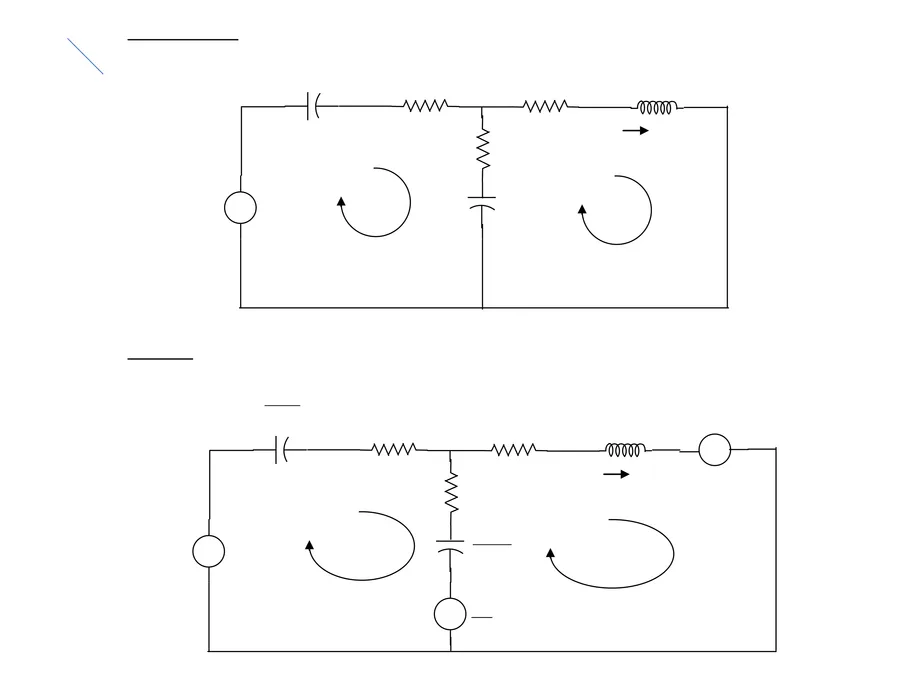
Example 7.23 For the circuit shown below, obtain the transform circuit.
Solution Fig. below shows the transform circuit.
Li0
- +
s
e0
sC
1
1
I2(s)
I1(s)
i0
+
-
-
+
E(s)
Ls
R3
R2
R1
sC
1
2
i2
i1
i0
e0
+
-
-
+
e(t)
C2
L
R3
R2
R1
C1
75

7.8.1 RL CIRCUIT
Consider the RL circuit shown in Fig. 7.59(a). Assume that the switch is closed at time t
= 0 and assume that the current i at the time of switching is zero.
The transform circuit in s domain is shown in Fig. 7.59 (b). From this,
I(s) =
L
R
s
1
s
1
L/R
L/E
)
L
R
(ss
L/E
sL
R
s/E
=
L
R
s
1
s
1
R
E
(7.78)
Taking inverse LT i(t) =
)
e1(
R
E
t
L
R
(7.79)
Thus, inductor current rises exponentially with time constant L / R.
(a) (b)
Fig. 7.59 Time domain and s domain - R-L circuit.
s
E
I(s)
vL
0
R
Ls
i
vL
0
R
L
E
S1
76

Voltage across the inductor is given by
V(s) = L s I(s) =
L
R
s
E
(7.80)
Taking inverse LT vL(t) = E
t
L
R
e
(7.81)
Inductor voltage increases exponentially with time constant L / R. The current and
voltage transients are shown in Fig. 7.60.
τ
E
0
vL(t)
t
R
E
τ
i(t)
t
(a) (b)
Fig. 7.60 Plot of iL(t) and vL(t).
77

Consider the circuit shown in Fig.(a). Let us say that with the switch in position S1,
steady state condition is reached. The current flowing through the inductor is E / R. At
time t = 0, the switch is turned to position S2. Then
i(0+) = i(0-) = E / R
The transform circuit for time t > 0 is shown in Fig. (b).
Considering the transformed circuit I(s) =
L
R
s
R
E
sLR
R
LE
(7.82)
Taking inverse LT i(t) =
t
L
R
e
R
E (7.83)
The current decays exponentially with time constant L / R.
(a) (b)
E
L
R
S2
S1
R
LE
+
-
Ls
0
I(s)
V(s)
R
78

Since R I(s) + V(s) = 0 the voltage across the inductor is
V(s) = - R I(s) = -
L
R
s
E
(7.84)
Taking inverse LT vL(t) = - E
t
L
R
e
(7.85)
The inductor voltage exponentially changes from - E to zero with time constant L / R.
The current and voltage transients are given by the above two equations are shown.
τ
τ
- E
vL(t)
t
R
E
0
i(t)
t
79

Example 7.24 Initially relaxed series RL circuit with R = 100 Ω and L = 20 H has dc
voltage of 200 V applied at time t = 0. Find (a) the equation for current and voltages
across different elements (b) the current at time t = 0.5 s and 1.0 s (c) the time at which
the voltages across the resistor and inductor are equal.
Solution Transform circuit for time t > 0 is shown.
(a) I(s) =
s20
100
s
200
=
5s
1
s
1
2
5)
(ss
10
Therefore, current i(t) = 2 (1-
)
et5 A
Voltage vR(t) = R i(t) = 200 (1-
)
et5 V
Voltage vL(t) = L
V
e
200
e5X2X20
dt
di
t5
t5
(b) i(0.5) = 2 (1-
)
e5.2 = 1.8358 A i(1.0) = 2 (1-
)e5 = 1.9865 A
(c) Let t1 be the time at which vR(t) = vL(t). Then
200 (1-
)
e
1t5
= 200
1t5e i.e.
1t5e = 0.5 This gives t1 = 0.1386 s
+ vR -
I(s)
s
200
vL
0
100
20 s
80

Example 7.25 For the circuit shown, with zero inductor current the switch is closed on
to position S1 at time t = 0. At one mille second it is moved to position S2 Obtain the
equation for the currents in both the intervals.
Solution Transform circuits are shown.
The transform circuit for the first interval is shown in Fig. 7.65 (a). From this
I(s) =
s0.2
50
s
100
=
250s
1
s
1
2
250)(ss
500
Thus, i(t) = 2 (1-
)
e
t 250
A i(0.001) = 2 (1-
)
e0.25
= 0.4424 A
s
100
s
100
0.2 s 0.2 s
(a) (b)
0 0
0.08848
s
50
+
-
Ls
I(s)
V(s)
R
+
-
0.2 s
I(s)
V(s)
50
I(s)
vL
0
50
I(s)
vL
0
50
vL
S2
S1
E2
E1 = 100 V; E2 = 50 V
R = 50 Ω
L = 0.2 H
0
iL
E1
L
R
81

At time t = 0.001 s, the switch is moved to position S2. We shall say that this is done at
time t’ = 0. Thus t’ = 0 implies that t = 0 and hence t’ = t - 0.001.
The transform circuit for time t’ > 0 is shown in Fig. 7.65 (b) in which
L i(0+) = 0.2 X 0.4424 = 0.08848
Now, I(s) =
s0.2
50
s
50
08848.0
=
250s
K
s
K
250)
(ss
s
0.4424
250
s)0.2
(50s
s
0.08848
50
2
1
K1 =
1
250s
s
0.4424
250
K2 =
0.5576 -
s
s
0.4424
250
Thus, I(s) =
250s
0.5576
s
1
Taking inverse LT we get, current i(t’) = 1 - 0.5576
t'250e
Thus for the two intervals currents are given by
i(t) = 2 (1-
)
e
t 250
A 0.001 ≥ t > 0
i(t) = 1 - 0.5576
A
e
0.001) - (t250
t > 0.001
s = 0
s = - 250
82

Example 7.26 In the previous example, compute the voltage across the inductor in
both the intervals and sketch the wave form.
Solution In the first interval, i(t) = 2 (1-
)
et 250
A
vL(t) = L
V
e100
e250X2X0.2
dt
di
t250
t250
vL(0.001) = 100
V
77.88
e0.25
In the second interval, i(t’) = 1 - 0.5576
t'250e
vL(t’) = L
V
e
27.88
e
27.88
e250X
0.5576X0.2
dt'
di
0.001)-(t250-
t'250
t'250
vL(0.001) = vL(t’) = 27.88 V
The wave form of the voltage across the inductor is shown below.
t’ = 0
t = 0.001 s
27.88 V
t
0
vL(t)
77.88 V
100 V
83

Example 7.27
In the initially relaxed RL circuit shown, the sinusoidal source of e = 100 sin (500 t) V is
applied at time t = 0. Determine the resulting transient current for time t > 0.
Solution
e = 100 sin (500 t) V; Its LT is
E(s) =
4
2
4
2
10X25
s
10X5
250000
s
500X
100
Impedance = 5 + j 0.01 s
e
i
5 Ω
0.01 H
-
+
~
84

Current I(s) =
s)0.01
(5)10X25
(s
10X5
4
2
4
=
500)(s)10X25
(s
10X5
4
2
6
=
4
2
2
1
10X25
s
KsK
+
500s
K 3
K3 =
4
2
6
10X25
s
10X5
= 10
Since
500)(s)10X25
(s
10X5
4
2
6
=
4
2
2
1
10X25
s
KsK
+
10
s500
5 X 106 = (K1 s + K2) (s + 500) + 10 (s2 + 25 X 104)
= (K1 + 10) s2 + (500 K1 + K2) s + (500 K2 + 25 X 105)
Comparing the coefficients, in LHS and RHS
K1 + 10 = 0 i.e. K1 = - 10
500 K1 + K2 = 0 i.e. K2 = - 500 K1. Thus K2 = 5000
Therefore, I(s) = [
2
4
-10 s
s25 X10
+
2
4
5000
s25 X10
+
10
s500
]
On taking inverse LT, we get i(t) = 10 [- cos 500 t + sin 500 t +
t500e] A
= 14.14 sin (500 t - 450) + 10
A
e
t500
s = - 500
85

7.8.2 RC CIRCUIT Consider the RC circuit shown in Fig. 7.68 (a). Assume that the
switch is closed at time t = 0 and assume that the voltage across the capacitor at the
time of switching is zero.
The transform circuit for time t > 0 is shown in Fig. 7.68 (b). From this
I(s) =
CR
1
s
R / E
1sCR
CE
sC
1
R
s/E
(7.85)
Taking inverse LT i(t) =
t
RC
1
e
R
E
(7.86)
Voltage across the capacitor is VC(s) =
CR
1
s
1
s
1
E
)
CR
1
(ss
CR/E
(s)
sC
1 I
(7.87)
(a) (b)
Fig. 7.68 Time domain and s domain - RC circuit.
sC
1
0
s
E
I(s)
VC(s)
R
0
i
vC
R
C
E
S1
86

Voltage across the capacitor is VC(s) =
CR
1
s
1
s
1
E
)
CR
1
(ss
CR/E
(s)
sC
1 I
(7.87)
Taking inverse LT, we get the capacitor voltage as
vC(t) = E (1 -
t
CR
1
e
) (7.88)
The circuit current and the voltage across the capacitor vary as shown in Fig. below.
(a) (b)
E
vC(t)
t
R
E
0
i(t)
t
87

Now, consider the circuit shown in Fig. (a).The switch was in position S1 for sufficiently
long time to establish steady state condition. At time t = 0, it is moved to position S2.
Before the switch is moved to position S2, the capacitor gets charged to voltage E.
Since the voltage across the capacitor maintains continuity,
vC(0+) = vC(0-) = E
The transform circuit for time t > 0 is shown in Fig. (b). From this
I(s) = -
CR
1
s
R / E
1sCR
CE
sC
1
R
s/E
(7.89)
Taking inverse LT i(t) = -
t
RC
1
e
R
E (7.90)
(a) (b)
E
C
R
S2
S1
s
E
-
+
0
I(s)
V(s)
R
sC
1
88

It is to be seen that R I(s) + VC(s) = 0
Thus VC(s) = - R I(s) =
CR
1
s
E
(7.91)
Taking inverse LT vC(t) = E
t
CR
1
e
(7.92)
The wave form of circuit current and the capacitor voltage are shown in Fig. 7.71.
E
R
E
i(t)
0
vC(t)
t
0
t
(a) (b)
Fig. 7.71 Plot of i(t) and vC(t) as given by Eq. (7.90) and (7.92).
89

Example 7.28 In the RC circuit shown below, the capacitor has an initial charge q0 =
2500 µC. At time t = 0, the switch is closed. Find the circuit current for time t > 0.
Solution
vC(0) =-
V50
10X50
10X
2500
C
q
6
6
0
Transform circuit for time t > 0 is shown in Fig. 7.73.
Referring to Fig. 7.73,
I(s) =
2000s
15
20000s10
150
s
20000
10
s
50
s
100
Taking inverse LT, current i(t) = 15
A
e
t2000
50 µF
+
-
0
i
vC
10 Ω
q0
100 V
S1
106 / 50 s
s
100
+
-
0
V(s)
R
+
-
50 / s
0
I(s)
V(s)
10
Fig. 7.73 Circuit - Example 7.28.
90

Example 7.29 For the circuit shown below, find the transient current, assuming that
the initial charge on the capacitor as zero, when the switch is closed at time t = 0.
Solution E(s) =
s25
10
sC
1
;
250000
s
500X
200
6
2
Therefore, I(s) =
)10X4s
(100
250000)
(s
s
10
s
10X4
100
250000
s
10
4
2
5
4
2
5
=
400)s(
250000)
(s
s
1000
2
=
250000
s
KsK
2
2
1
+
400s
K 3
(200 sin 500 t) V
25 µF
0
i
vC
100 Ω
S1
-
+
~
91

K3 =
250000
s
s
1000
2
= - 0.9756
Further, 1000 s = (K1 s + K2) (s + 400) - 0.9756 (s2 + 250000)
= (K1 - 0.9756) s2 + (400 K1 + K2) s + (400 K2 - 0.9756 X 250000)
Comparing the coefficients, in LHS and RHS we have
K1 - 0.9756 = 0 and 400 K1 + K2 = 1000
On solving, K1 = 0.9756; K2 = 609.76
Thus, I(s) =
250000
s
s
0.9756
2
+
250000
s
609.76
2
-
400s
0.9756
= 0.9756
400s
0.9756
500
s
500
1.2195
500
s
s
2
2
2
2
Taking inverse LT i(t) = 0.9756 cos 500 t + 1.2195 sin 500 t - 0.9756
t400e
A
Knowing that
1.5617
(1.2195)
(0.9756)
2
2
and tan-1 (0.9756 / 1.2195) = 38.660
current i(t) = 1.5617 sin (500 t + 38.660) - 0.9756
A
e
t400
s = - 400
92

7.8.3 RLC CIRCUIT
Consider the RLC series circuit shown in Fig. 7.75 (a). Assume that there is no initial
charge on the capacitor and there is no initial current through the inductor. The switch is
closed at time t = 0. Transform circuit for time t > 0 is shown in Fig. 7.75 (b).
Using the transform circuit, expression for the current is obtained as
I(s) =
CL
1
s
L
R
s
L/E
1sCLsCR
CE
sC
1
sLR
s/E
2
2
(7.93)
The roots of the denominator polynomial are
s1, s2 = -
βα
CL
1
)
L2
R
(
L2
R
2
(7.94)
where α = -
CL
1
)
L2
R
(
βand
L2
R
2
(7.95)
(a) (b)
Fig. 7.75 Time domain and s domain - RLC circuit.
L
i
R
C
E
L s
sC
1
s
E
I(s)
R
93

Depending on whether
2)
L2
R
(
>
CL
1 ,
2)
L2
R
(
=
CL
1 or
2)
L2
R
(
<
CL
1 the discriminant
value will be positive, zero or negative and three different cases of solutions are
possible.
The value of R, for which the discriminant is zero, is called the critical resistance, RC.
Then
;
CL
1
L4
R
2
2
C
C
L
2
R
Thus
C
(7.96)
If the circuit resistance R > RC, then
2)
L2
R
(
>
CL
1 .
If the circuit resistance R < RC, then
2)
L2
R
(
<
CL
1 .
94

Case 1
2)
L2
R
(
>
CL
1 i.e. R > RC (7.97)
The two roots s1 and s2 are real and distinct. s1 = α + β and s2 = α - β (7.98)
Then, I(s) =
β)
(αs
K
β)
(αs
K
2
1
(7.99)
Taking inverse LT, we get
i(t) = K1
tβ)(αe
+ K2
tβ)(αe
=
]tβ
2
tβ
1
tα
eK
eK[e
(7.100)
Its plot is shown in Fig. 7.76. In this case the current is said to be over-damped.
i(t)
0
t
Fig. 7.76 RLC circuit over-damped response.
95

Case 2
2)
L2
R
(
=
CL
1 i.e. R = RC (7.101)
Then, β = 0 and hence the roots are s1 = s2 = α (7.102)
Thus, I(s) =
2
2
α)
(s
K
α)
(s
L/E
(7.103)
Taking inverse LT, we get i(t) = K t
tαe (7.104)
The plot of this current transient is shown in Fig. 7.77. In this case, the current is said to
be critically damped.
i(t)
0
t
Fig. 7.77 RLC circuit critically-damped response.
96

Case 3
2)
L2
R
(
<
CL
1 i.e. R < RC (7.105)
For this case, the roots are complex conjugate, s1 = α + j β and s2 = α - j β (7.106)
Then, I(s) =
β)jα-(sβ)jα(s
L/E
=
22β)α(s
L/E
=
22β
α)(s
β
βL
E
(7.107)
=
22β
α)(s
β
A
(7.108)
Taking inverse LT, we get i(t) = A
tβsinetα
(7.109)
As seen in Equation 7.95, α will be a negative number. Thus, for this under damped
case, the current is oscillatory and at the same time it decays.
t
i(t)
Waveform shown is a
exponentially decaying
sinusoidal wave
97

Example 7.30 For the RLC circuit shown, find the expression for the transient current
when the switch is closed at time t = 0. Assume initially relaxed circuit conditions.
Solution The transform circuit is shown in Fig. 7.80.
Current I(s) =
100000s
1000
s
2000
10000s100
s0.1
200
s
10000
s0.1
100
s/ 200
2
2
0.1 H
i
100 Ω
100 µF
200 V
0.1 s
s
10000
s
200
I(s)
100
Fig. 7.80 Transform circuit - Example 7.30.
98

Current I(s) =
100000s
1000
s
2000
10000s100
s0.1
200
s
10000
s0.1
100
s/ 200
2
2
The roots of the denominator polynomial are
s1, s2 =
887.3
and
1127
2
10X0.4
10
10
6
6
3
Therefore, I(s) =
887.3s
K
1127s
K
887.3)
(s
1127)
(s
2000
2
1
K1 =
887.3s
2000
= 2.582
K2 =
112.7s
2000
= - 2.582
Thus, I(s) = 2.582 [
]
887.3s
1
112.7s
1
Taking inverse LT, we get current i(t) = 2.582 (
A)
e
e
t887.3
t112.7
This is an example for over-damped.
s = - 112.7
s = - 887.3
99

Example 7.31 Taking the initial conditions as zero, find the transient current in the
circuit shown in Fig. 7.81 when the switch is closed at time t = 0.
Solution The transform circuit is shown in Fig. 7.82.
Current I(s) =
20000s50
s
1000
2000s5
s0.1
100
s
500
10
s0.15
s/ 100
2
2
6
0.1 s
s
500
106
s
100
I(s)
5
Fig. 7.82 Transform circuit - Example 7.31.
0.1 H
i
5 Ω
500 µF
100 V
Fig. 7.81 Circuit for Example 7.31.
100

Current I(s) =
20000s50
s
1000
2000s5
s0.1
100
s
500
10
s0.15
s/
100
2
2
6
The roots of the denominator polynomial are
s1, s2 =
139.1941j
25
2
80000
2500
50
It can be seen that
s2 + 50 s + 20000 = (s + 25)2 + (139.1941)2
Thus, I(s) =
2
2
2
2
(139.1941)
25)
(s
139.1941
7.1842
(139.1941)
25)
(s
0
100
Taking inverse LT, we get i(t) = 7.1842
At)
(139.1941sin
e
t25
This is an example for under-damped.
Discover new features in Lessons!
Finish all phases of “I-do ; We-do ; You-do” with Quizizz
You can also create lessons directly on Google Slides using “Quizizz Extension”.
Read more about it here
Show answer
Auto Play
Slide 1 / 100
SLIDE
Similar Resources on Wayground

96 questions
Prova enfermagem cirurgica
Presentation
•
Professional Development
100 questions
汉语(1)
Presentation
•
KG
90 questions
Unit - II
Presentation
•
Professional Development
96 questions
PRESENTASI QUZIZ
Presentation
•
Professional Development
89 questions
Repàs UT 6, 7 i 9 JIM (Casos Pràctics)
Presentation
•
Professional Development
93 questions
Rappelle A2: cours d'automne
Presentation
•
Professional Development
99 questions
Continuity and Unity of Life
Presentation
•
10th - 12th Grade
96 questions
Trắc nghiệm Lịch sử đảng 1
Presentation
•
Professional Development
Popular Resources on Wayground
10 questions
Safety Day 2026 – Student Review

Quiz
•
9th Grade
21 questions
Continents and Oceans
Quiz
•
6th Grade
20 questions
Parts of Speech
Quiz
•
5th Grade
16 questions
Subject & Predicate
Quiz
•
5th Grade
25 questions
Multiplication Facts
Quiz
•
5th Grade
12 questions
Map Skills
Quiz
•
3rd Grade
22 questions
Continents and Oceans
Quiz
•
5th Grade
15 questions
Rounding Decimals
Quiz
•
5th Grade