Unit 5: Protein Synthesis and Mutations
Presentation
•
Science
•
9th Grade
•
Medium
Standards-aligned
Jasmine Rodriguez
Used 3+ times
FREE Resource
8 Slides • 53 Questions
1
Protein Synthesis Final
By Sydney Mendel
2
DNA vs RNA
DNA contains the information to code for proteins.
DNA is found in the nucleus and cannot leave. However, proteins are made at the ribosome. DNA's code mut be copied so that the information can leave the nucleus. RNA is the complementary copy of DNA's code.
3
Multiple Choice
In RNA, Adenine (A) pairs with...
T
U
C
G
4
Multiple Choice
Which of the following is a characteristic of RNA?
Double stranded
Contains the base Thymine
Can leave the nucleus
Contains the sugar deoxyribose
5
Types of RNA
3 Types:
Messenger RNA (mRNA) copies DNA’s code & carries the genetic information to the ribosomes
Ribosomal RNA (rRNA), along with protein, makes up the ribosomes
Transfer RNA (tRNA) transfers amino acids to the ribosomes
where proteins are synthesized
6
Types of RNA
7
Multiple Choice
Which type of RNA is responsible for bringing amino acids to the ribosome?
mRNA
rRNA
tRNA
DNA
8
Multiple Choice
What would be the complementary RNA sequence for the following DNA sequence?
ATTCGT
UAAGCA
TAAGCA
GCCTAC
UGCUAC
9
Pathway to Making a Protein
DNA -> RNA -> Protein
Subject | Subject
Some text here about the topic of discussion
10
Step 1: Transcription
DNA -> RNA
The process of copyingthe sequence of one strand of DNA, the
template strand
mRNA copies the template strand
This process occurs in the nucleus
mRNA is complementary to DNA (not an exact copy)
11
Step 2: Translation
RNA -> Protein
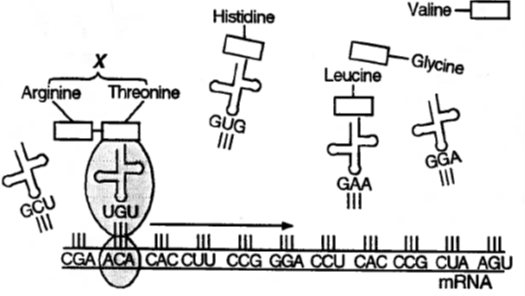
Translation is the process of decoding the mRNA into a protein
Ribosomes read mRNA three bases or 1 codon at a time and construct the proteins
tRNA brings the correct amino acid as coded for in the mRNA
Occurs in the cytoplasm at the ribosome
12
Multiple Choice
What is the name of the process in which DNA is transcribed into RNA?
Photosynthesis
Protein Synthesis
Translation
Transcription
13
Multiple Choice
What amino acid is coded for by the RNA sequence below?
AGG
Gly
Leu
Arg
Val
14
Multiple Choice
Which process is shown?
Replication
Transcription
Translation
Photosynthesis
15
The number of nucleotides changes.
Insertion: Adding a nucleotide
Deletion: Removing a nucleotide
Frameshift
The number of nucleotides stays the same, but a nucleotide changes.
Substituion
Mutations - Changes in nucleotides sequences
Some text here about the topic of discussion
16
Multiple Choice
What type of mutation has occured to the DNA sequence below?
Original DNA: AAC - GTA
Mutated DNA: AAG - TA
Substitution
Deletion
Insertion
Non - sense
17
Multiple Choice
Select the DNA sequence below that demonstrates a subsitution mutation.
Original DNA: AAT - GCC
Mutated DNA:
AAT - GGC - C
Mutated DNA:
AAG- CC
Mutated DNA:
ATT - GCC
AAT - TGC - C
18
Multiple Select
A frameshift mutation is which of the following?
Point mutation
Insertion
Deletion
Subtitution
19
Multiple Choice
Which mutation would be more harmful for an organism?
Point mutation (substitution)
Frameshift (insertion/Deletion)
20
Multiple Choice
Why would a frameshift be more harmful?
It changes all the code downstream
Only one nucleotide is changing
All mutations are harmful
It can't correct iself
21
Multiple Choice
Which of the following is not a type of mutation?
Substitution
Insertion
Prescription
Deletion
22
Multiple Choice
What mutation has occurred here?
T-G-A-C-C-A
T-G-A-G-C-A
Substitution
Deletion
Insertion
Frameshift
23
Multiple Choice
ATTTGAGCC- Original
ATTGAGCC - Mutated
The example above is an example of a
Insertion- Frameshift
Deletion- Substitution
Deletion -Frameshift
All of the above
24
Multiple Choice
Why are insertion and deletion (frameshift) mutations so harmful?
They change all of the codons from the mutation on down the line, which changes the amino acid sequence
They insert things that an organism doesn't need.
They often delete things that organisms need.
Insertion and deletions are not any more harmful than substitution mutations.
25
Multiple Choice
Which mutation will cause translation to stop?
Mutations 1 and 3 only
Mutation 1 only
Mutation 2 only
Muations 1, 2, 3
26
Multiple Choice
In what process is mRNA synthesized?
Transcription
Translation
DNA Replication
Mitosis
27
Multiple Choice
In what process is mRNA synthesized?
Transcription
Translation
DNA Replication
Mitosis
28
Multiple Choice
Where does TRANSCRIPTION occur?
Nucleus
Ribosome
Cytoplasm
Mitochondria
29
Multiple Choice
Where does TRANSCRIPTION occur?
Nucleus
Ribosome
Cytoplasm
Mitochondria
30
Multiple Choice
Why must transcription occur where DNA can be found?
because DNA can't leave
because ribosomes are in the nucleus
because DNA polymerase is found there
because helicase unzips the DNA
31
Multiple Choice
Which of the following is a codon?
ATG
AUG
AUT
32
Multiple Choice
Why must transcription occur where DNA can be found?
because DNA can't leave
because ribosomes are in the nucleus
because DNA polymerase is found there
because helicase unzips the DNA
33
Multiple Choice
How many codons equals 1 amino acid?
1
2
3
4
34
Multiple Choice
How many nucleotides equal 1 amino acid?
1
2
3
4
35
Multiple Choice
How many nucleotides equal 1 amino acid?
1
2
3
4
36
Multiple Choice
On which molecule can an anticodon be found?
mRNA
DNA
tRNA
rRNA
37
Multiple Choice
Where is the anticodon located?
at the top of the molecule it's found on
at the bottom of the molecule it's found on
on the right of the molecule it's found on
on the left of the molecule it's found on
38
Multiple Choice
TRANSCRIBE this DNA sequence: TACGTTACT
AUGCAAUGA
ATGCAATGA
AUGGATUGA
TACGTTACT
39
Multiple Choice
What is the purpose for anti-codons?
to ensure the correct amino acid is dropped off
to match the strand of DNA
to decode a sequence of 4 nucleotides into an amino acid
to make me hate biology
40
Multiple Choice
A polypeptide is a sequence of ____________________ held together by a ______________ bond.
amino acids; peptide
fatty acids; ionic
proteins; hydrogen
fatty acids; covalent
41
Multiple Select
Which of the following are differences in the structure between RNA and DNA
DNA uses deoxyribose sugar, RNA uses sugar ribose
DNA pairs Adenine with Uracil, RNA pairs Adenine with Thymine
DNA is a double helix, RNA is a single helix
DNA pairs Adenine with Thymine, RNA pairs Adenine with Uracil
42
Multiple Choice
Which two thing are found on a molecule of tRNA?
amino acids; anticodons
amino acids; codons
ribose sugar; proteins
deoxyribose sugar; codons
43
Multiple Choice
How do you know when to begin translating a strand of mRNA?
look for AUG
start at the beginning
look for ATG
when Ms. H tells me to
44
Multiple Choice
Which organelle is the location where protein is made?
Ribosome
Nucleus
Cytoplasm
Nucleotide
45
Multiple Choice
How do you know when to STOP translating a strand of mRNA?
look for STOP on the decoder
stop at the end of the strand
you don't
when Ms. H tells me to
46
Multiple Choice
TRANSCRIBE this DNA sequence: TACGTTACT
AUGCAAUGA
ATGCAATGA
AUGGATUGA
TACGTTACT
47
Multiple Choice
When these bond together, they form a protein
Amino Acids
Peptide Bonds
Ribose
Nucleotides
48
Multiple Choice
TRANSLATE this RNA sequence: AUGCAAUGA
Met-Glu-Stop
Met-His-Stop
Thr-Glu-Stop
Thr-Pro-Stop
49
Multiple Choice
50
Multiple Choice
51
Multiple Choice
52
Multiple Choice
A DNA nucleotide may be made up of a phosphate group, along with
deoxyribose sugar and uracil
ribose sugar and cytosine
deoxyribose sugar and thymine
ribose sugar and adenine
53
Multiple Choice
54
Multiple Choice
Which of the following units are repeatedly joined together to form a strand of DNA? (This is the MONOMER of DNA.)
amino acids
nucleotides
fatty acids
polysaccharides
55
Multiple Choice
The important enzyme related with transcription is;
gyrase
DNA polymerase
RNA polymerase
ligase
56
Multiple Choice
57
Multiple Choice
58
Multiple Choice
59
Multiple Choice
60
Multiple Choice
61
Multiple Choice
Protein Synthesis Final
By Sydney Mendel
Show answer
Auto Play
Slide 1 / 61
SLIDE

Similar Resources on Wayground
56 questions
Cell Organelles
Presentation
•
9th Grade
56 questions
SEV1a par 2Lesson
Presentation
•
9th - 10th Grade
57 questions
Biology Review Lesson
Presentation
•
9th - 10th Grade
54 questions
Metamorphic Rocks Lesson
Presentation
•
9th - 10th Grade
60 questions
Mock CDEs
Presentation
•
9th Grade
57 questions
Prehistory
Presentation
•
9th - 10th Grade
55 questions
CH 2.4: How do Elements Form Compounds?
Presentation
•
9th Grade
56 questions
Jupiter
Presentation
•
9th Grade
Popular Resources on Wayground
20 questions
Math Review
Quiz
•
3rd Grade
15 questions
Fast food
Quiz
•
7th Grade
20 questions
Context Clues
Quiz
•
6th Grade
20 questions
Inferences
Quiz
•
4th Grade
19 questions
Classifying Quadrilaterals
Quiz
•
3rd Grade
20 questions
Figurative Language Review
Quiz
•
6th Grade
20 questions
Equivalent Fractions
Quiz
•
3rd Grade
10 questions
Identify Fractions, Mixed Numbers & Improper Fractions
Quiz
•
3rd - 4th Grade
Discover more resources for Science
25 questions
Naming Ionic and Covalent Compounds
Quiz
•
9th Grade
40 questions
NCFE Earth and Environmental Science Released Test
Quiz
•
9th - 12th Grade
10 questions
Exploring Weather Influences and Map Reading
Interactive video
•
6th - 10th Grade
20 questions
Human Impact on the Environment Review #2
Quiz
•
9th Grade
20 questions
Balancing Chemical Equations
Quiz
•
9th Grade
61 questions
End of the Year Trivia Fun
Quiz
•
9th Grade
15 questions
Protein synthesis
Quiz
•
9th Grade
30 questions
Environmental Science Final Exam REVIEW
Quiz
•
9th - 12th Grade