
Session 4 Lesson 16

Presentation
•
Mathematics
•
6th Grade
•
Practice Problem
•
Easy
+15
Standards-aligned

Chantele Quenard
Used 2+ times
FREE Resource
10 Slides • 13 Questions
1
Lesson 16: Session 4
LEARNING TARGETS:
-Solve unit rate problems including those involving unit pricing and constant speed.
Use ratio reasoning to convert measurement units; manipulate and transform units appropriately when multiplying or dividing quantities.
2
Poll
Click all you believe to be the same...
5/6 hour
.75 hour
45 minutes
2700 seconds
3
Open Ended
For the previous question, how are they the same and how are they different?
4
Discuss the gist with your table and read the problem again to yourself.
Make sense of the problem
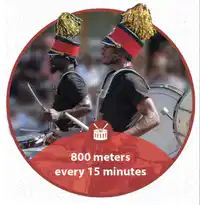
A band marches in the African American Day Parade in New York City. The band marches 800 meters every 15 minutes.

5
Discuss with your table how you would go about solving this problem.
Make sense of the problem
A band marches in the African American Day Parade in New York City. The band marches 800 meters every 15 minutes.
At this rate, how many kilometers does the band march in 1 hour?
6
Draw
Go ahead and solve the problem here on your own.
A band marches in the African American Day Parade in New York City. The band marches 800 meters every 15 minutes. At this rate, how many kilometers does the band march in 1 hour?
7
Discuss with a partner...
How how you solved your problem with a partner.
Did you get the same answer?
Did you solve it the same way?
8
Open Ended
What was the answer to the question? How do you know your answer is reasonable? Respond here with..My answer makes sense because...
9
Let's look at some strategies....
1000 meters = 1 kilometer
Meters | Kilometers |
|---|---|
1,000 | 1 |
1 | .001 |
800 | .8 |
You can use a table of equivalent ratios to convert between units of measure.
Minutes | Hours |
|---|---|
60 | 1 |
15 | 1/4 |
60 minutes = 1 hour
The band marches 0.8 kilometers in hour. Multiply by 4 to find the number of kilometers the band marches in 1 hour.
4 x 0.8


10


You can multiply by a unit rate to convert between units of measure.
Write the rate for kilometers per meter.
1 kilometer = 1,000 meters
kilometer per meter
Find the number of meters the band marches
in 1 hour.
4 800 = 3,200
To convert 3,200 meters to kilometers, multiply by the unit rate.
11
Let's Connect it.....
Look at the first Model It below. How are the relationships 1,000 meters = 1 kilometer and 60 minutes = 1 hour similar to rates? Discuss...

12
Let's Connect it.....

13
Let's Connect it.....
14
Open Ended

How many kilometers does the band march in 1 hour?
15
Open Ended
How is converting between measurements
similar to finding equivalent ratios?
16
Open Ended
Reflect : Think about all the models and
strategies you have discussed today.
Describe how one of them helped you better
understand how to convert between units
of measure.
17
18
Draw
LET'S PRACTICE!!
The unit of money in England is the pound .
When Anne visits England, 10 pounds equals $13.
She sees a bike rental that costs 3 pounds per hour.
Anne wants to spend less than $20. Can Anne
rent the bike for 5 hours? Show your work here.
19
Open Ended
So...Can Anne rent the bike for 5 hours? Explain
20
Draw
A can contains 4 cups of pineapple juice.
The can of juice costs $2.56. What is the unit
price in dollars per fluid ounce? Show your work here.
21
Multiple Choice
What is the unit price in dollars per fluid ounce?
$12.50 per fluid ounce
$1.56 per fluid ounce
$0.64 per fluid ounce
$.08 per fluid ounce
22
Draw
Exit Ticket....
A model train takes 10 seconds to travel along
a section of track that is 5 yards long. At this
rate, how many feet does the model train
travel every minute? Show your work here.
23
Fill in the Blanks
Lesson 16: Session 4
LEARNING TARGETS:
-Solve unit rate problems including those involving unit pricing and constant speed.
Use ratio reasoning to convert measurement units; manipulate and transform units appropriately when multiplying or dividing quantities.
Show answer
Auto Play
Slide 1 / 23
SLIDE
Similar Resources on Wayground

19 questions
6.11A Graphing
Presentation
•
6th Grade
18 questions
9.1 Introduction to Statistics
Presentation
•
6th Grade
16 questions
Combining Like Terms
Presentation
•
6th Grade
18 questions
Powers and Exponents
Presentation
•
6th Grade
18 questions
GCF and LCM
Presentation
•
6th Grade
17 questions
Surface Area 6th Grade
Presentation
•
6th Grade
17 questions
Personal Financial Literacy
Presentation
•
6th Grade
17 questions
Parts of an Expression
Presentation
•
6th Grade
Popular Resources on Wayground
16 questions
Grade 3 Simulation Assessment 2

Quiz
•
3rd Grade
19 questions
HCS Grade 5 Simulation Assessment_1 2526sy
Quiz
•
5th Grade
10 questions
Cinco de Mayo Trivia Questions

Interactive video
•
3rd - 5th Grade
17 questions
HCS Grade 4 Simulation Assessment_2 2526sy
Quiz
•
4th Grade
24 questions
HCS Grade 5 Simulation Assessment_2 2526sy
Quiz
•
5th Grade
13 questions
Cinco de mayo
Interactive video
•
6th - 8th Grade
20 questions
Math Review
Quiz
•
3rd Grade
30 questions
GVMS House Trivia 2026
Quiz
•
6th - 8th Grade
Discover more resources for Mathematics
36 questions
6th Grade Math STAAR Review
Quiz
•
6th Grade
20 questions
Math Review
Quiz
•
6th Grade
20 questions
Graphing Inequalities on a Number Line
Quiz
•
6th - 9th Grade
23 questions
6th Grade Math Review
Quiz
•
6th Grade
15 questions
Order of Operations (no exponents)
Quiz
•
5th - 6th Grade
5 questions
8.PS/PFA Quizizz Day 4
Quiz
•
6th - 8th Grade
5 questions
8.MG.1-5 Quizizz Day 2
Quiz
•
6th - 8th Grade
18 questions
Mean, Median, mode, and range
Quiz
•
6th Grade