

Atmospheric Stability

Presentation
•
Computers
•
12th Grade
•
Easy

Catherine L Hulcher
Used 1+ times
FREE Resource
13 Slides • 11 Questions
1
Atmospheric Stability
Atmospheric stability is defined as the resistance of the atmosphere to vertical motion.
Unstable atmosphere allows an upward or downward disturbance to grow into a vertical (convective) current. Think thunderstorm development and towering cumulus clouds.
Unstable air can often result in weather conditions unfavorable to sUAS operations. Warming from below, such as the sun shining on pavement or rock, could cause unstability of an air mass.
A stable atmosphere resists any upward or downward movement.
A stable layer of air would be associated with a temperature inversion (a condition in which warm air is situated above cool or cold air).
Determining the stability of the atmosphere requires measuring the difference between the actual existing (ambient) temperature lapse rate of a given parcel of air and the dry adiabatic (3°C per 1,000 feet) lapse rate. Because sUAS operate at low
altitudes, it may seem as though lapse rate may not be a factor, but the stability of the local air mass can have significant impact on ambient conditions. Unstable air can often result in weather conditions unfavorable to sUAS operations.
2
Atmospheric Stability
Atmospheric stability is defined as the resistance of the atmosphere to vertical motion.
3
Dropdown
4
Unstable Atmosphere
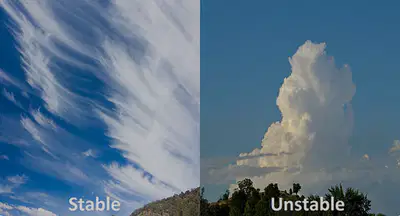
Unstable atmosphere allows an upward or downward disturbance to grow into a vertical (convective) current. Think thunderstorm development and towering cumulus clouds.
Unstable air can often result in weather conditions unfavorable to sUAS operations. Warming from below, such as the sun shining on pavement or rock, could cause unstability of an air mass.
5
Dropdown
6
Atmospheric Stability
Unstable Air
Cumuliform clouds
Showery precipitation
Turbulent air
Good visibility
Stable Air
Stratiform clouds
Fog
Steady rain fall
Smooth air
Poor visbility, haze, smoke
7
Multiple Choice
Can you list some characteristics of stable air?
Poor visibility and intermittent precipitation.
Good visibility and steady precipitation.
Poor visibility and steady precipitation.
8
Atmospheric Stability
Unstable Air
Cumuliform clouds
Showery precipitation
Turbulent air
Good visibility
Stable Air
Stratiform clouds
Fog
Steady rain fall
Smooth air
Poor visbility, haze, smoke
9
Atmospheric Stability
Weather forecasts often refer to either rain or showers, but did you know they often give a very different 'feel' to the day?
Showers imply the weather will change a lot during the day with rain on and off.
Whereas rain will bring continuous wet weather for hours at a time, and then it will clear.
10
Categorize
Cumuliform clouds
Stratiform clouds
Showery precipitation
Continuous precipitation
Rough Air
Smooth Air
Good Visibility
Poor Visibility
Fog
No Fog
Organize these options into the right categories
11
Stable Atmosphere
A stable atmosphere resists any upward or downward movement.
A stable layer of air would be associated with a temperature inversion (a condition in which warm air is situated above cool or cold air).
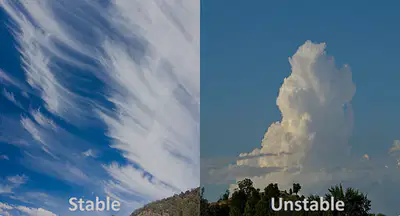
Stable Air
Stratiform clouds
Fog
Steady rain fall
Smooth air
Poor visbility, haze, smoke
12
Multiple Choice
A stable air mass is most likely to have which characteristic?
Showery precipitation.
Turbulent air.
Poor surface visibility.
13
Unstable Atmosphere
Unstable atmosphere allows an upward or downward disturbance to grow into a vertical (convective) current. Think thunderstorm development and towering cumulus clouds.
Unstable air can often result in weather conditions unfavorable to sUAS operations. Warming from below, such as the sun shining on pavement or rock, could cause unstability of an air mass.
14
Multiple Choice
What are characteristics of a moist, unstable air mass?
Turbulence and showery precipitation
Poor visibility and smooth air.
Haze and smoke.
15
Stable Atmosphere
A stable atmosphere resists any upward or downward movement.
A stable layer of air would be associated with a temperature inversion (a condition in which warm air is situated above cool or cold air).
Stable Air
Stratiform clouds
Fog
Steady rain fall
Smooth air
Poor visbility, haze, smoke
16
Multiple Choice
What are characteristics of stable air?
Good visibility and steady precipitation.
Poor visibility and steady precipitation.
Poor visibility and intermittent precipitation.
17
Temperature Lapse Rate
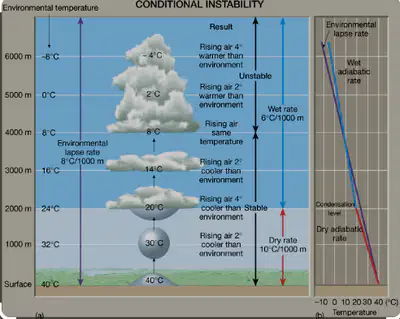
Determining the stability of the atmosphere requires measuring the difference between the actual existing (ambient) temperature lapse rate of a given parcel of air and the dry adiabatic (3°C per 1,000 feet) lapse rate. Because sUAS operate at low
altitudes, it may seem as though lapse rate may not be a factor, but the stability of the local air mass can have significant impact on ambient conditions. Unstable air can often result in weather conditions unfavorable to sUAS operations.
18
Multiple Choice
What measurement can be used to determine the stability of the atmosphere?
Atmospheric pressure.
Actual lapse rate.
Surface temperature.
19
Explanation Slide...
When air near the surface is warm and moist, suspect instability. Surface heating, cooling aloft, converging or upslope winds, or an invading mass of colder air may lead to instability nd cumuliform clouds
20
Multiple Choice
What would decrease the stability of an air mass?
Warming from below.
Cooling from below.
Decrease in water vapor.
21
Explanation Slide...
Unstable conditions are characterized by cumulus clouds, turbulence, showery precipitation, and good visibility
22
Multiple Choice
Upon your preflight evaluation of weather, the forecasts you reference state there is an unstable air mass approaching your location. Which would not be a concern for your impending operation?
Thunderstorms.
Stratiform clouds.
Turbulent conditions.
23
low-level temperature inversion - Smooth Air
A "low-level temperature inversion with high relative humidity" means you should anticipate foggy or misty conditions near the ground, potentially impacting visibility, as a layer of warmer air traps cooler air near the surface, and the high humidity allows for more moisture to condense into fog.
Key points about this weather scenario:
Temperature inversion: This is a situation where a layer of warmer air sits above a layer of cooler air, which is the opposite of the usual temperature decrease with altitude.
Low-level: The inversion is occurring close to the ground.
High relative humidity: The air is near saturation with moisture, which increases the potential for fog formation.
What to expect:
Fog: Dense fog patches or widespread low visibility, especially in the early morning or late evening hours.
Reduced visibility: Difficulty seeing objects at a distance.
Potential for icing: If temperatures are near freezing, fog droplets can freeze on surfaces.
Air pollution trapping: Inversions can trap pollutants close to the ground, leading to poor air quality.
24
Multiple Choice
You have received an outlook briefing from flight service through 1BOOwxbrief.com.The briefing indicates you can expect a low-level temperature inversion with high relative humidity. What weather conditions would you expect?
Smooth air, poor visibility, fog, haze, or low clouds.
Light wind shear, poor visibility, haze, and light
rain.
Turbulent air, poor visibility, fog, low stratus type clouds, and showery precipitation.
Atmospheric Stability
Atmospheric stability is defined as the resistance of the atmosphere to vertical motion.
Unstable atmosphere allows an upward or downward disturbance to grow into a vertical (convective) current. Think thunderstorm development and towering cumulus clouds.
Unstable air can often result in weather conditions unfavorable to sUAS operations. Warming from below, such as the sun shining on pavement or rock, could cause unstability of an air mass.
A stable atmosphere resists any upward or downward movement.
A stable layer of air would be associated with a temperature inversion (a condition in which warm air is situated above cool or cold air).
Determining the stability of the atmosphere requires measuring the difference between the actual existing (ambient) temperature lapse rate of a given parcel of air and the dry adiabatic (3°C per 1,000 feet) lapse rate. Because sUAS operate at low
altitudes, it may seem as though lapse rate may not be a factor, but the stability of the local air mass can have significant impact on ambient conditions. Unstable air can often result in weather conditions unfavorable to sUAS operations.
Show answer
Auto Play
Slide 1 / 24
SLIDE
Similar Resources on Wayground

18 questions
Water Cycle Videoquiz
Presentation
•
12th Grade
20 questions
AKHLAK ISLAM: ALAM SEKITAR PENENANG MINDA
Presentation
•
12th Grade
18 questions
projectile motion
Presentation
•
12th Grade
16 questions
Powers of Congress
Presentation
•
12th Grade
21 questions
Newton's First Law of Motion
Presentation
•
11th Grade
20 questions
KEGUNAAN SENYAWA TURUNAN ALKANA DAN PENGANTAR BENZENA
Presentation
•
12th Grade
18 questions
Unit 3: Longer Fiction I (notes)
Presentation
•
12th Grade
20 questions
Day 3 MAP Lesson
Presentation
•
12th Grade
Popular Resources on Wayground
6 questions
Secondary Safety Quiz
Presentation
•
9th - 12th Grade
10 questions
Afterschool Activities & Sports

Quiz
•
6th - 8th Grade
19 questions
ROAR Week 2026
Quiz
•
9th - 12th Grade
20 questions
Lab Safety Quiz
Quiz
•
6th Grade
15 questions
Cool Tool:Chromebook
Quiz
•
6th - 8th Grade
22 questions
would you rather
Quiz
•
3rd - 11th Grade
21 questions
Continents and Oceans
Quiz
•
6th Grade
20 questions
Parts of Speech
Quiz
•
5th Grade