

7th Practice

Presentation
•
English
•
7th Grade
•
Practice Problem
•
Hard

Katherine McLane
Used 7+ times
FREE Resource
4 Slides • 12 Questions
1
Test Prep Practice Challenge
2


3
Multiple Choice
Ivy needs a new sentence to improve the introductory paragraph of her paper. Which sentence can BEST be added after sentence 1?
When I heard about the class, I knew the instructor would let me
copy her painting exactly.
I’m talking about the kind where an instructor tells you how to
make a painting step by step.
My friend Ella said we should spend time together over break, and
I told her we should paint.
When I first tried to paint sunflowers, I was grateful to see I had a
bit of natural talent for art.
4
Multiple Choice
Ivy needs a better transition between the second paragraph
(sentences 3–8) and the third paragraph (sentences 9–11). Which
phrase can she add to the beginning of sentence 9 to help with
this transition?
In response
For this reason
As the class began
In the same way
5
6
7
Multiple Choice
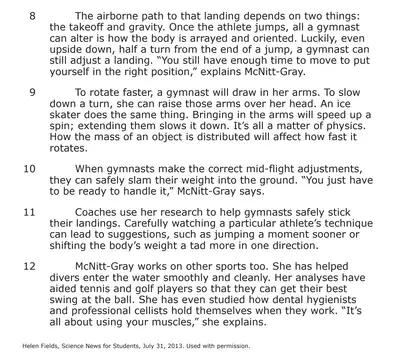
What is the most likely reason the author includes the details in
paragraph 1 of the excerpt from “Cool Jobs: Sports Science”?
To convey to the reader the pressure of Olympic gymnastic
performances
To draw the reader into the topic of sports science using a
true story
To highlight the way an error can keep a gymnast from victory
To show how well world-class athletes must be able to perform
8
Multiple Choice
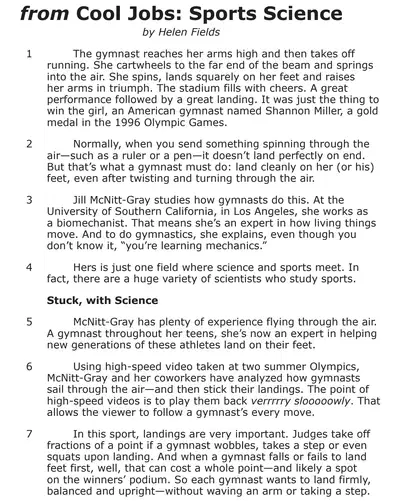
The problem-and-solution organizational pattern in paragraphs 7
through 11 of the excerpt from “Cool Jobs: Sports Science” supports
the topic by —
highlighting the way gymnasts cannot rely on their coaches
for feedback
suggesting that no gymnast can land perfectly every time, even
with practice
revealing how hard gymnasts must work to understand the
mechanics of their sport
illustrating how science helps gymnasts make adjustments to
land successfully
9
Multiple Choice
What is the controlling idea of the excerpt from “Cool Jobs:
Sports Science”?
Gymnasts must change their body position in order to stick landings.
Science helps gymnasts and other athletes improve performance.
Shannon Miller is an American gymnast who won the Olympic
gold medal.
Olympic gymnastics requires effort on the part of both athletes
and coaches.
10
Multiple Choice
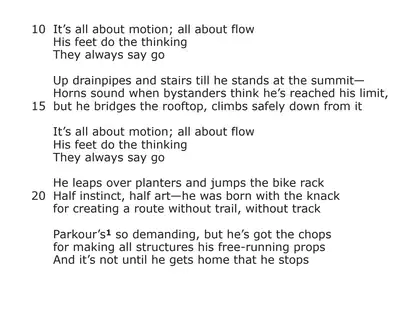
The poet most likely uses a repetitive structure in the poem in order
to —
show the height of the jumps
stress a pattern of actions
present the athlete as childlike
reveal a contrast between ideas
11
Multiple Choice
What does the meter of the poem “Adventure in the City” convey to
the reader?
The brief nature of the performance
The many risks that the athlete is taking
The quick, seamless movements of the athlete
The loud, excited cries of the spectators
12
Multiple Choice
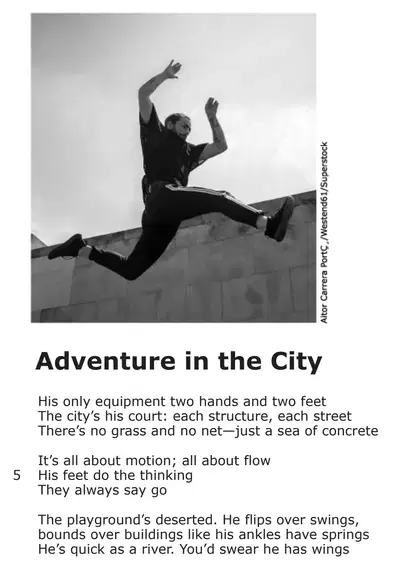
What is the most likely reason the poet includes a photograph with the
poem “Adventure in the City”?
To show what type of movements are used for parkour
To emphasize the importance of the setting for parkour
To indicate how popular parkour is
To stress the need for a proper landing in the sport of parkour
13
Multiple Choice
Read this sentence from line 9 of the poem “Adventure in the City.”
He’s quick as a river.
What is the most likely reason the poet uses a simile in this line?
To suggest the athlete’s strength as he moves
To suggest the onlookers’ excitement
To evoke sudden, choppy movement
To evoke rapid, smooth movement
14
Multiple Choice
Which theme about sports is found in BOTH the excerpt from “Cool
Jobs: Sports Science” and the poem “Adventure in the City”?
Great skill is required for superb results.
Acquired knowledge can improve performance.
Winning requires determination.
Recognition is the best reward.
15
Multiple Choice
Read lines 20 and 21 from the poem “Adventure in the City.”
Half instinct, half art—he was born with the knack
for creating a route without trail, without track
What do these lines suggest about a DIFFERENCE between
gymnastics in the excerpt from “Cool Jobs: Sports Science” and
parkour in the poem “Adventure in the City”?
They imply that parkour requires a greater amount of natural
talent than gymnastics does.
They show that unlike gymnasts, parkour athletes have regular
routines for practicing.
They communicate that unlike gymnastics, parkour requires a
dedicated space to train.
They suggest that parkour athletes do not rely on science the way
gymnasts do.
16
Multiple Choice
The author of the article “Cool Jobs: Sports Science” and the poet of
“Adventure in the City” BOTH suggest that sports —
require experts behind them
require planning for safety
can be done almost anywhere
can be thrilling to everyone involved
Test Prep Practice Challenge
Show answer
Auto Play
Slide 1 / 16
SLIDE
Similar Resources on Wayground

11 questions
gerunds vs. infinitives
Presentation
•
7th Grade
10 questions
Research Overview
Presentation
•
7th Grade
12 questions
Comma Rule: Introductory Phrases
Presentation
•
7th Grade
12 questions
Anne Frank Character Change
Presentation
•
6th - 9th Grade
13 questions
Mood vs. Tone
Presentation
•
7th Grade
11 questions
Comparing Audio to Text
Presentation
•
7th Grade
12 questions
7B WHILE, WHEN revision
Presentation
•
7th Grade
11 questions
Commonly Confused Words Round 1
Presentation
•
7th Grade
Popular Resources on Wayground
6 questions
Secondary Safety Quiz
Presentation
•
9th - 12th Grade
10 questions
MyPath Diagnostic Overview
Presentation
•
6th - 8th Grade
20 questions
Lab Safety Quiz

Quiz
•
6th Grade
21 questions
Continents and Oceans
Quiz
•
6th Grade
20 questions
Adding and Subtracting Decimals
Quiz
•
5th Grade
20 questions
Parts of Speech
Quiz
•
5th Grade
16 questions
Subject & Predicate
Quiz
•
5th Grade
21 questions
Lab Safety
Quiz
•
10th Grade
Discover more resources for English
10 questions
MyPath Diagnostic Overview
Presentation
•
6th - 8th Grade
13 questions
Parts of Speech
Quiz
•
7th Grade
18 questions
ADJECTIVES and ADVERBS
Presentation
•
5th - 7th Grade
10 questions
Differentiating Primary and Secondary Sources in History

Interactive video
•
6th - 10th Grade
25 questions
Making Inferences
Quiz
•
6th - 8th Grade
15 questions
Complete Subject and Predicate Quiz
Quiz
•
4th - 8th Grade
11 questions
Figurative Language
Presentation
•
5th - 7th Grade
17 questions
Figurative Language
Quiz
•
7th Grade