Unit 7 Review AP Bio
Presentation
•
Science
•
9th - 12th Grade
•
Hard
Standards-aligned
Emily Boatwright
FREE Resource
101 Slides • 39 Questions
1
2
3
4
5
6
7
8
9
Multiple Choice
10
Multiple Choice
Charles Darwin’s observation that finches of different species on the Galápagos Islands have many similar physical characteristics supports the hypothesis that these finches
have the ability to interbreed.
acquired traits through use and disuse.
all eat the same type of food.
descended from a common ancestor.
11
12
13
14
15
16
Multiple Choice
Being the "fittest" in evolutionary terms always means the biggest, strongest, fastest
True
False
17
Multiple Choice
When organisms are better adapted to their environment they will survive and reproduce more successfully than organisms less adapted. This process is called what?
Selective breeding
Natural Selection
Cloning
Evolution of all species
18
19
Multiple Choice
A physical or behavioral trait that helps an organism survive and reproduce in its environment is called a what?
An adaptation
A response to a stimulus
A mutation
Evolution
20
21
22
23
24
25
26
27
28
29
30
31
32
33
34
35
36
37
38
39
Multiple Choice
40
41
42
Multiple Choice
A category of structures that have a similar function, but are structurally different.
Homologous structures
Analogous structures
Vestigial structures
Common core structures
43
44
45
Multiple Choice
Species not closely related evolve similar traits due to their similar environment
Convergent evolution
divergent evolution
parallel evolution
46
47
48
Multiple Choice
An anatomical feature that no longer seems to have a purpose in the current form of an organism
Homologous structure
Analogous structure
Vestigial structure
None of the above
49
50
51
52
53
Multiple Choice
54
Multiple Choice
Which species is most likely to share a common ancestor with Species A?
B
C
D
E
55
Multiple Choice
By looking at the genes of some animals we can determine which living species are most closely related to each other. This also reveals which species most recently diverged from their common ancestor.
Based on the partial gene segments shown, which pair of animals are genetically most closely related and therefore most recently diverged from their common ancestor?
Chimpanzee and Mouse
Rat and Mouse
Rat and Chimpanzee
56
57
58
59
60
61
62
63
Multiple Choice
What does allele frequency refer to in a gene pool?
The number of genes in the pool
The number of times an allele occurs in a gene pool, compared to the total number of alleles in that pool for the same gene
The total number of alleles for all genes in the pool
The percentage of genes that are homozygous for a given allele
64
65
66
Multiple Choice
What is a population in genetic equilibrium?
A) A population where allele frequencies change and the population evolves.
B) A population where allele frequencies in the population remain the same and the population does not evolve.
C) A population that has an excess of mutations leading to rapid evolution.
D) A population that is isolated from other populations and evolves differently.
67
68
69
70
71
Multiple Choice
72
Multiple Choice
p + q = 1
p2 + 2pq + q2 = 1
p2 + pq2 + q2 = 1
p + 2pq + q3 = 1
73
Multiple Choice
74
Multiple Choice
The allele frequency of p=.20 What is the percentage of Heterozygous Dominant genotype?
.80
.04
.32
.64
75
Multiple Choice
76
Multiple Choice
A population's recessive allele frequency 25%. What is the percentage of the Homozygous Dominant genotype?
.5625
.3750
.0625
.25
.5
77
78
79
80
81
82
83
84
Multiple Choice
85
Multiple Choice
86
Multiple Choice
87
88
89
90
91
92
Multiple Choice
What occurs when allele frequencies change as a result of the migration of a small subgroup of a population?
Natural selection
Genetic drift
The bottleneck effect
The founder effect
93
94
Multiple Choice
What is the bottleneck effect in the context of genetic change in populations?
An increase in genetic diversity due to mutation
A change in allele frequency following a dramatic increase in the size of a population
A change in allele frequency following a dramatic reduction in the size of a population
The introduction of new alleles into a population through migration
95
96
97
98
99
100
101
102
Multiple Choice
What is the definition of Divergent Evolution?
The process where groups from the same common ancestor evolve and accumulate differences, resulting in the formation of new species.
The process where species that are not closely related independently evolve functionally or visually similar structures.
The process by which development of species is marked by isolated episodes of rapid adaptation to environments between long periods of little or no change.
The process of development of evolutionary change that occurs between pairs of species as they interact with one another.
103
Multiple Choice
The rapid evolution of a group following its introduction into a new habitat or occupation of newly available niches is called ________________?
adaptive radiation
microevolution
coevolution
convergent evolution
divergent evolution
104
105
Multiple Choice
106
107
Multiple Choice
Which of the following is required for a population to diverge into two separate species?
The two populations must have evolved different physical appearances.
The two populations must have mutated at least 10 times.
The two populations must have become reproductively isolated.
The two populations must have evolved analogous structures.
108
109
110
111
Multiple Choice
A new river forms and splits two populations, causing ______________ speciation
Sympatric
Allopatric
Extreme
Convergent
112
113
Multiple Choice
A speciation in which new species evolve from a single ancestral species while inhabiting the SAME geographic region.
Sympatric speciation
Allopatric speciation
Complex speciation
Divergent speciation
114
115
Multiple Choice
116
Multiple Choice
Which best describes punctuated equilibrium?
Speciation occurs due to natural selection
Speciation occurs due to isolation
Speciation occurs slowly in geologic time, followed by long periods with very fast evolutionary change.
Speciation occurs suddenly and rapidly in geologic time, followed by long periods with little evolutionary change.
117
118
119
120
121
122
123
124
125
126
127
Multiple Choice
128
129
130
131
132
133
134
135
136
Multiple Choice
Two unrelated species evolve in a way that makes them more similar.
adaptive radiation
microevolution
coevolution
convergent evolution
divergent evolution
137
Multiple Choice
According to this image, which two domains of life are most related?
Bacteria & Archaea
Archaea & Eukarya
Eukarya & Bacteria
138
Multiple Choice
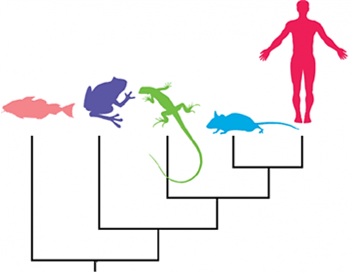
What is the human most closely related to?
Fish
mouse
Salamander
Human
139
Multiple Choice
According to this tree, which of these animal phyla are most closely related?
Arthropoda & Mollusca
Arthropoda & Chordata
Chordata & Mollusca
140
Multiple Choice
The Miller-Urey experiment of 1953 was designed to test the hypothesis that lightning supplied the energy needed to turn atmospheric gases into organic molecules such as amino acids. Which of the following describes why the Miller-Urey theory is widely accepted today?
Amino acids spontaneously form from molecules in the atmosphere today.
Organic molecules are present today in extremely high concentrations.
The process of synthesizing organic molecules from a mixture of gases has been successfully modeled in the laboratory.
No other alternative hypotheses have been introduced.
Show answer
Auto Play
Slide 1 / 140
SLIDE

Similar Resources on Wayground
140 questions
m6/12 final exam
Presentation
•
11th Grade
139 questions
Computer & internet 1
Presentation
•
9th - 12th Grade
138 questions
Evolve 3 unit 6
Presentation
•
KG - University
139 questions
will and going to
Presentation
•
KG - University
137 questions
DEVELOPMENT OF POLITICAL PARTIES IN NIGERIA
Presentation
•
12th Grade
135 questions
Unit 1 Lesson 2
Presentation
•
9th - 12th Grade
127 questions
Microscopes
Presentation
•
9th - 12th Grade
127 questions
physical science midterm exam
Presentation
•
9th - 12th Grade
Popular Resources on Wayground
20 questions
STAAR Review Quiz #3
Quiz
•
8th Grade
20 questions
Equivalent Fractions
Quiz
•
3rd Grade
6 questions
Marshmallow Farm Quiz
Quiz
•
2nd - 5th Grade
20 questions
Main Idea and Details
Quiz
•
5th Grade
20 questions
Context Clues
Quiz
•
6th Grade
20 questions
Inferences
Quiz
•
4th Grade
19 questions
Classifying Quadrilaterals
Quiz
•
3rd Grade
12 questions
What makes Nebraska's government unique?
Quiz
•
4th - 5th Grade
Discover more resources for Science
46 questions
Unit 4 Geosphere Test Review
Quiz
•
9th - 12th Grade
25 questions
Naming Ionic and Covalent Compounds
Quiz
•
9th Grade
20 questions
Human Impact on the Environment Review #2
Quiz
•
9th Grade
16 questions
Ecosystem Stability
Quiz
•
9th Grade
20 questions
Mendelian Genetics Review
Quiz
•
9th Grade
12 questions
Unit 6 Quiz #3 (Life Cycles of Stars)
Quiz
•
9th Grade
34 questions
Human Impact on Ecosystems Quiz
Quiz
•
9th Grade
10 questions
Exploring Alfred Wegener's Continental Drift Theory
Interactive video
•
6th - 10th Grade