Search Header Logo
G12 Chem Organic Chem 14 Jan Lesson

G12 Chem Organic Chem 14 Jan Lesson

Assessment

Presentation

Chemistry

12th Grade

Practice Problem

Hard

Created by

Michael Cumar

Used 1+ times

FREE Resource

7 Slides • 12 Questions

1
S3.2 Functional groups: Classification of organic compounds

media

2

Fill in the Blanks

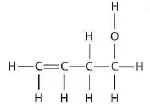
media image

Type answer...

3

Fill in the Blanks

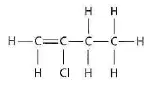
media image

Type answer...

4

Fill in the Blanks

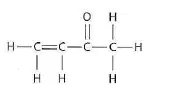
media image

Type answer...

5

Fill in the Blanks

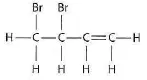
media image

Type answer...

6

Fill in the Blanks

media image

Type answer...

7

Fill in the Blanks

media image

Type answer...

8

Fill in the Blanks

media image

Type answer...

9

Fill in the Blanks

media image

Type answer...

10

Multiple Choice

Question image
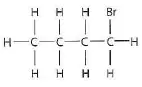
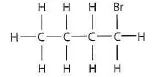
  1. What is the IUPAC name of this compound?

1

1-bromobutane

2

2-bromo-2-methylbutane

3

2-chloropropane

4

1-iodo-3-methylbutane

11

Multiple Choice

Question image
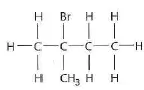
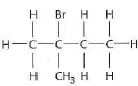
  1. What is the IUPAC name of this compound?

1

1-bromobutane

2

2-bromo-2-methylbutane

3

2-chloropropane

4

1-iodo-3-methylbutane

12

Draw

  1. Draw the displayed formula for the compound 3,3-dimethylbutan-2-ol

13

Isomers

media

14

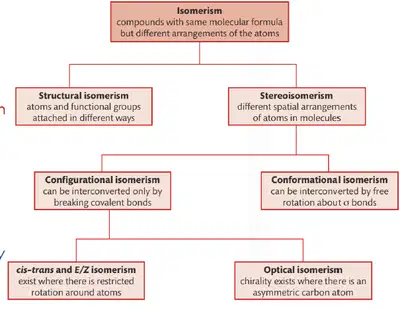
Structural isomers are two or more compounds that have the same molecular formula but different structural formulas - the atoms are joined together in different ways (they have different connectivities).

​STRUCTURAL ISOMERS

​CHAIN ISOMERS

POSITION
ISOMERS

FUNCTIONAL
ISOMERS

15

Multiple Select

  1. Identify the two compounds that are identical:

1
2
3
4

16

STERIOISOMERISM (HL ONLY)

media

17

STERIOISOMERISM (HL ONLY)

media

18

STERIOISOMERISM (HL ONLY)

cis-trans isomerism

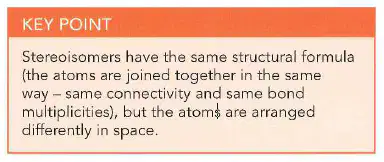
​In cis-trans isomerism, two compounds have the same structural formula, but the groups are arranged differently in space around a double bond or a ring.

KEY POINT
cis: same side

trans: opposite sides

KEY POINT
cis-trans isomerism requires two different groups on both sides of the double bond.

19

STERIOISOMERISM (HL ONLY)

optical isomerism

Chirality
Molecules are described as chiral if mirror images of the molecule are non-superimposable.

KEY POINT
Chiral molecules contain an asymmetric carbon atom, a carbon atom with 4 different groups attached. This carbon atom is called the chirality centre (chiral centre).

S3.2 Functional groups: Classification of organic compounds

media

Show answer

Auto Play

Slide 1 / 19

SLIDE