
Metals Lesson

Presentation
•
Chemistry
•
1st - 5th Grade
•
Practice Problem
•
Hard
+15
Standards-aligned

Jeffrey Reed
Used 7+ times
FREE Resource
19 Slides • 0 Questions
1
Metals: Alkali Metals, Alkaline Earth Metals and Transition Metals
REVIEW

2
Metals
Metals are located on the left side of Periodic table. All elements highlighted with blue are metals.
Shiny -Metallic Luster and Malleable (can be shaped)
Ductile (Able to stretch into wire) and Good conductors of heat and electricity
Solid at room temperature except mercury. An Example: Gold

3
Metals
Almost all elements on the left side and middle of the table
Majority (75%) of the elements are metals
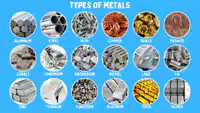
Examples: Magnesium, Calcium, Copper, Silver, Gold, Nickle
There are different types of metals, but for now we will focus on it as a general group

4

5
Physical Properties of Metals
Luster - Shines, reflects light
Great Conductivity - How well electricity and heat travels through the element
Malleable - Can be beaten into different shapes without breaking
Ductile - Turned into wires
Solid at room temperature - Except for Mercury

6
Ductile means metals can be stretched to wire but keeps its toughness. This is electricity cable very strong. Think of a metal Chain. Very tough, wont break easily.


7
Metals are on the left side of the Zig Zag line and bottom of the Periodic table. The ones in green. Non Metals are on the far right the ones on yellow. and metalloids are along Zig Zag line the ones on blue.

8
Properties of Metals
Malleable-Can be shaped and does not break easily.
Ductile-Can be pulled into long sheets of metal or wire.
Thermal Conductivity-Allows heat to pass easily-Example Pans.
Electrical Conductivity-Allows the easy flow of electric current.
9
Physical Properties of Metals
Lustrous-Shiny to the eye.
Opaque-Dose not allow ligh to pass through.
High Melting Points (with some expectations).
10
How are Metals identified
Alkali Metals Group 1
Alkaline Earth Metals Group 2
Transition Metals Group 3-12
11
12
Alkali Metals
Shiny
Soft
Extremley Reactive
One Valence Electron able to give up to another element.

13
14
15
Alkaline Earth Metals
1.Very Shiny
2.Hard, more Dense
Less Reactive
3.Give up 2 Valence Electrons.

16
17
Reactive Trends Periods of the Periodic Table
Electrons are used to bond atoms together. Group one will share with group 2.

18
19
Metals: Alkali Metals, Alkaline Earth Metals and Transition Metals
REVIEW
Show answer
Auto Play
Slide 1 / 19
SLIDE
Similar Resources on Wayground

14 questions
Electron Math
Presentation
•
9th - 12th Grade
13 questions
Major Domains of The Earth
Presentation
•
1st - 5th Grade
15 questions
Nickels
Presentation
•
KG - 5th Grade
14 questions
Lenses
Presentation
•
1st - 5th Grade
17 questions
Compare and Contrast
Presentation
•
1st - 5th Grade
11 questions
Verb Patterns
Presentation
•
1st - 5th Grade
15 questions
Adjetivos demostrativos
Presentation
•
KG
13 questions
Reading Practice!
Presentation
•
1st - 4th Grade
Popular Resources on Wayground
19 questions
Naming Polygons

Quiz
•
3rd Grade
10 questions
Prime Factorization
Quiz
•
6th Grade
20 questions
Math Review
Quiz
•
3rd Grade
15 questions
Fast food
Quiz
•
7th Grade
20 questions
Main Idea and Details
Quiz
•
5th Grade
20 questions
Context Clues
Quiz
•
6th Grade
20 questions
Inferences
Quiz
•
4th Grade
19 questions
Classifying Quadrilaterals
Quiz
•
3rd Grade