Search Header Logo
CCU6.1 Type of bonds & Intro to ionic bonding

CCU6.1 Type of bonds & Intro to ionic bonding

Assessment

Presentation

Chemistry

12th Grade

Medium

NGSS
HS-PS1-2, HS-PS1-1

Standards-aligned

Created by

Jolene Kayser

Used 2+ times

FREE Resource

17 Slides • 7 Questions

1

media

2

Categorize

Options (13)

electrons transfered

Sea of electrons

Sharing electrons

electrostatic attraction between cations and anions

Question image

Metals & Nonmetals

Question image
Question image
Question image

Nonmetal & nonmetal

Conducts well when dissolved in water

Insulator (does not conduct

Conducts well as a solid

Question image

Metal and Metal

Question image

Classify

Ionic
Covalent
Metallic

3

4

media

5

media

6

media

7

media

8

media

9

media

10

Multiple Choice

Question image

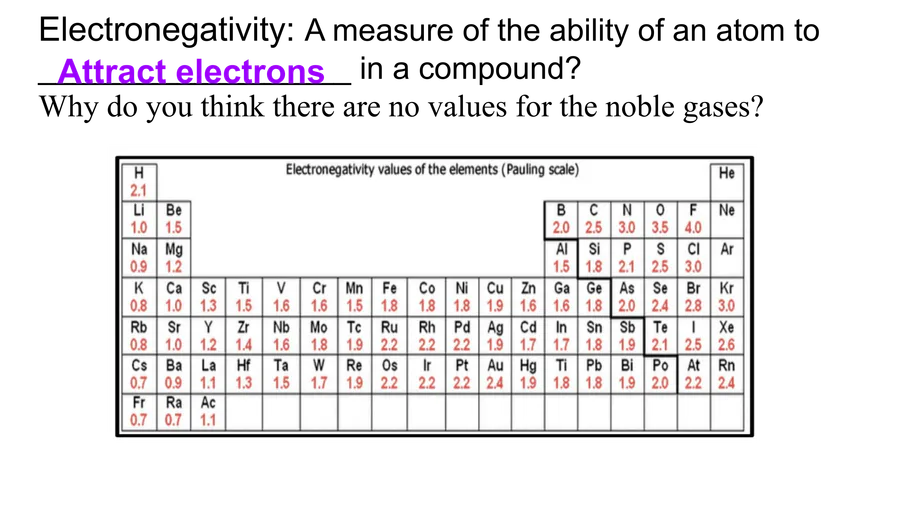
What is the definition of ELECTRONEGATIVITY?

1

The ability to ATTRACT electrons.

2

The ability of REPEL electrons.

11

Multiple Choice

Question image
This is an example of a __________ bond.
1
non-polar covalent
2
polar covalent
3
ionic
4
metallic

12

Multiple Choice

Question image
In this Lewis structure, the symbol above F means...
1
electrons are being transferred to Fluorine
2
electrons are less attracted to F than H
3
electrons are more attracted to F than H
4
Fluorine has formed a cation

13

Multiple Choice

Question image

Calculate ΔEN for Pb-S

1

1.1

2

-0.6

3

0.6

4

4.4

14

media

15

media

16

Dropdown

A diatomic molecule like O2 is always ​
​ because electrons are shared ​

17

Multiple Choice

Partial charges are present in which type of bond?

1

Ionic

2

Nonpolar Covalent

3

Polar Covalent

4

Both Polar Covalent and Ionic

18

media

19

media

20

media

21

media

22

media

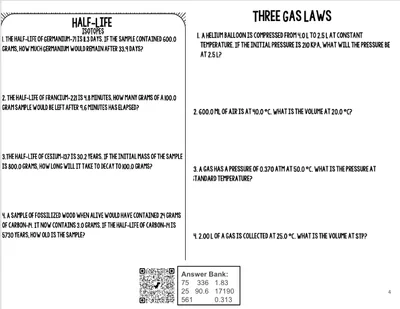
This unit does not have a lot of calculations but has embedded practice so the key skills do not atrophy

Thus complete page 4 after page 3.

23

media

24

media

Show answer

Auto Play

Slide 1 / 24

SLIDE