

Chapter 13 Section 4: North and South 1820m- 1860

Presentation
•
Social Studies
•
7th Grade
•
Medium

Anna Rogers
Used 2+ times
FREE Resource
17 Slides • 41 Questions
1

2

3

4

5

6

7
8
Multiple Choice
Which of the following was a category of white Southerners?
Yeomen
Industrialists
Merchants
Bankers
9
Multiple Choice
Fill in the blank: Very few _______ owners existed in the South.
Plantation
Factory
Store
Ship
10
Multiple Choice
Fill in the blank: Most Southerners were either small farmers without slaves or planters with a _______ of slaves.
Handful
Dozen
Hundred
Thousand
11
Multiple Choice
Which group made up the largest group in the south?
Yeomen
Tenant Farmers
Slaves
Merchants
12
Multiple Choice
What did rural poor typically plant?
Wheat
Corn
Rice
Barley
13
Multiple Choice
What activities did rural poor engage in for food?
Fishing and hunting
Trading and selling
Farming and exporting
Mining and gathering
14
Multiple Choice
Yeomen did not have ______.
land
slaves
crops
houses
15
Multiple Choice
What type of cabins did rural poor live in?
Modern
Crude
Spacious
Luxurious
16
Multiple Choice
The Metoyer family of Louisiana owned thousands of acres of land and more than how many slaves?
100
200
300
400
17
Multiple Choice
The fixed cost for plantation owners remained about the same every ____.
Month
Year
Season
Week
18
Multiple Choice
Cotton prices varied from season to season. Where were the best prices found?
New York
New Orleans
Los Angeles
Chicago
19
Multiple Choice
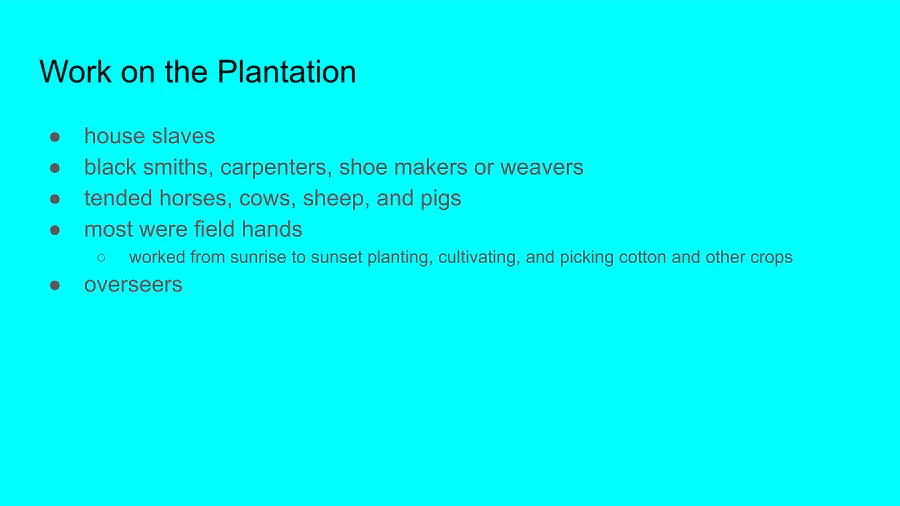
What tasks were most field hands responsible for on the plantation?
Tending to animals
Working in the house
Planting and picking crops
Supervising other workers.
20
Multiple Choice
Fill in the blank: On the plantation, _______ were responsible for tending horses, cows, sheep, and pigs.
House slaves
Blacksmiths
Field hands
Overseers
21
Multiple Choice
What was the primary role of house slaves on the plantation?
Supervising other workers
Working in the fields
Performing domestic tasks
Tending to animals
22

23

24

25

26

27

28

29
Multiple Choice
Josiah Henson is known for ______ slavery and describing his living conditions.
Supporting
Escaping
Ignoring
Promoting
30
Multiple Choice
Traditional African folk stories were ______ down by African Americans.
Written
Passed
Forgotten
Ignored
31
Multiple Choice
What did Christianity become for African Americans?
A) A religion of hope and resistance
B) A religion of despair
C) A religion of wealth
D) A religion of solitude
32
Multiple Choice
The passionate beliefs of the Southern slaves were expressed in the ______.
hymns
spirituals
dances
prayers
33
Multiple Choice
Between which years did the slave codes become more severe?
1800 and 1830
1830 and 1860
1860 and 1900
1900 and 1930
34
Multiple Choice
What was one of the aims of the slave codes?
To promote education
To prevent the slave rebellion
To encourage assembly in large groups
To allow freedom of movement.
35
Multiple Choice
Teaching slaves to read and write was considered ____.
legal
illegal
encouraged
optional
36
Multiple Choice
Slaves were prohibited from assembling in ____.
small groups
large groups
family gatherings
public places
37
Multiple Choice
Who was Nat Turner?
A famous musician
A popular religious leader among fellow slaves
A plantation owner
A politician
38
Multiple Choice
In what year did Nat Turner lead a group of followers on a violent rampage?
1821
1831
1841
1851
39
Multiple Choice
Before being captured, Nat Turner's group killed at least how many whites?
25
35
45
55
40
Multiple Choice
Most enslaved people rebelled by working slowly or faking ill. True or False?
True
False
41
Multiple Choice
Some enslaved people rebelled by ______ plantation buildings.
Painting
Building
Setting fire to
Cleaning
42
Multiple Choice
Who were two African American leaders who gained their freedom by fleeing to the North?
Harriet Tubman and Frederick Douglass
Martin Luther King Jr. and Rosa Parks
Malcolm X and Booker T. Washington
W.E.B. Du Bois and Sojourner Truth
43
Multiple Choice
The Underground Railroad was a network of 'safe houses' owned by free blacks and whites who opposed slavery. True or False?
True
False
44

45

46

47
Multiple Choice
By 1860, the South was the site of several large cities. What were the 10 largest cities in the South known for?
Manufacturing centers
Seaports or river ports
Educational hubs
Agricultural centers
48
Multiple Choice
With the coming of the RR, many other cities began to grow as centers of ____.
Education
Trade
Agriculture
Politics
49
Multiple Choice
The population of Southern cities included which of the following groups?
White city dwellers
Enslaved workers
Free African Americans
All of the above.
50
Multiple Choice
Free African Americans founded their own ____.
Schools
Churches and institutions
Businesses
Political parties
51
Multiple Choice
Free African Americans were denied an equal share in ____.
Economic and political life
Religious life
Educational opportunities
Social gatherings
52
Multiple Choice
Who operated the academy in Wellington, South Carolina?
Moses Waddel
John Smith
Thomas Jefferson
George Washington
53
Multiple Choice
Fill in the blank: Mathematics, religion, Greek, Latin, and _______ were taught at the Waddel academy.
public speaking
art
music
science
54
Multiple Choice
What type of schools did plantation owners send their children to?
Public schools
Private schools
Home schools
Charter schools
55
Multiple Choice
Fill in the blank: Some of the larger cities established _______ school systems.
private
public
charter
home
56
Multiple Choice
What was not a subject taught at the academy?
Greek
Latin
Public speaking
Science
57
Multiple Choice
In the mid-1800s, education was growing and hundreds of public schools were operating in which state?
Virginia
North Carolina
South Carolina
Georgia
58
Multiple Choice
Many states had charity schools for students whose parents couldn't afford tuition.
True
False
Show answer
Auto Play
Slide 1 / 58
SLIDE
Similar Resources on Wayground

49 questions
Measures of Variation 2020
Presentation
•
7th Grade
50 questions
Texas Republic and Annexation
Presentation
•
7th Grade
50 questions
Texas as a Republic
Presentation
•
7th Grade
55 questions
Meiosis
Presentation
•
7th Grade
54 questions
Eleutheran Adventurers 2024
Presentation
•
7th Grade
54 questions
Unit 3 Civics
Presentation
•
7th Grade
51 questions
Kegiatan Ekonomi
Presentation
•
7th Grade
54 questions
KS3 E-Safety 1: Account Security
Presentation
•
7th Grade
Popular Resources on Wayground
21 questions
Continents and Oceans

Quiz
•
6th Grade
20 questions
Parts of Speech
Quiz
•
5th Grade
16 questions
Subject & Predicate
Quiz
•
5th Grade
25 questions
Multiplication Facts
Quiz
•
5th Grade
12 questions
Map Skills
Quiz
•
3rd Grade
22 questions
Continents and Oceans
Quiz
•
5th Grade
15 questions
Rounding Decimals
Quiz
•
5th Grade
20 questions
Brand Labels
Quiz
•
5th - 12th Grade
Discover more resources for Social Studies
10 questions
Exploring the Age of Exploration: Key Events and Figures

Interactive video
•
6th - 10th Grade
12 questions
13 Colonies Geography and Economy
Quiz
•
7th Grade
26 questions
SW Asia History
Quiz
•
7th Grade
15 questions
Historical Inquiry Vocab Quiz
Quiz
•
6th - 8th Grade
20 questions
US Involvement in the Middle East
Quiz
•
7th Grade
19 questions
Influencing Govt (Interest Groups-Media)
Quiz
•
6th - 8th Grade
8 questions
Notes: Argumentative Writing
Presentation
•
7th - 8th Grade
5 questions
American Revolution
Interactive video
•
7th Grade