Search Header Logo
Energy

Energy

Assessment

Presentation

Science

7th Grade

Practice Problem

Medium

NGSS
MS-PS3-2, MS-PS3-5, HS-PS1-8

+13

Standards-aligned

Created by

Nikki Upchurch

Used 54+ times

FREE Resource

22 Slides • 30 Questions

1

Energy

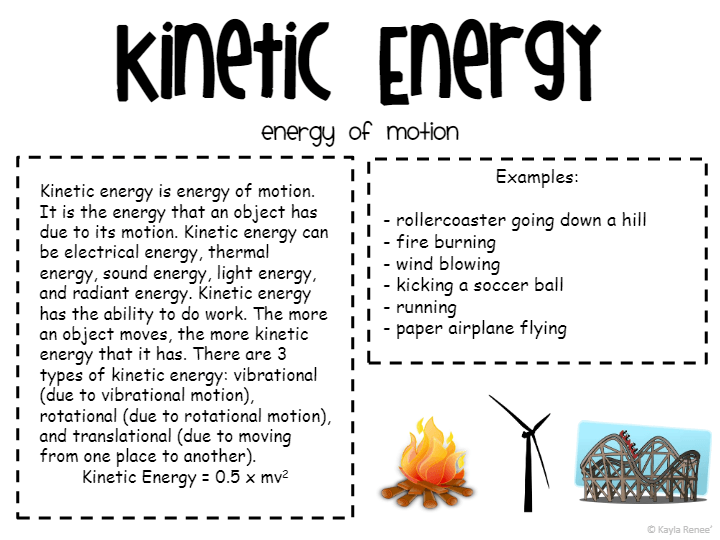
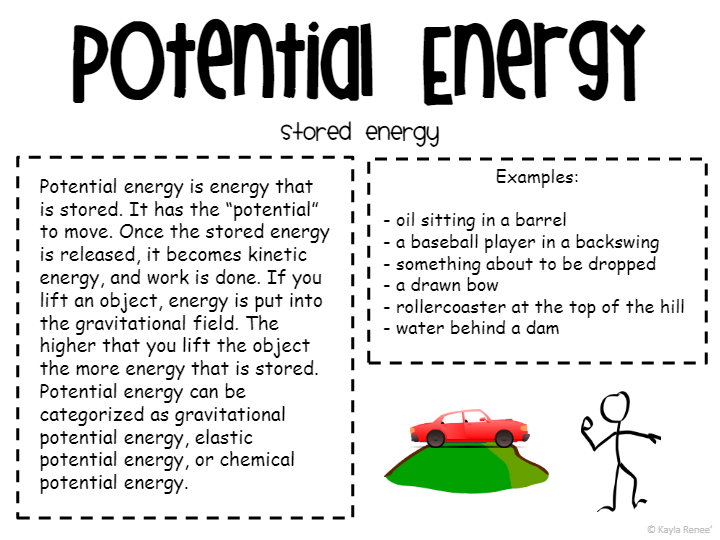
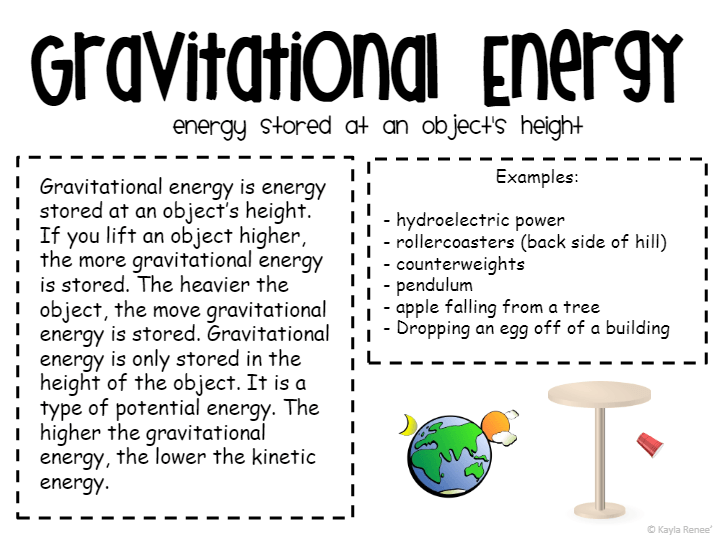
So in this lesson we will learn how are mechanical, kinetic, and potential energy related?

Slide image

2

Slide image

3

Slide image

4

Slide image

5

Slide image

6

Slide image

7

Slide image

8

Multiple Choice

Question image

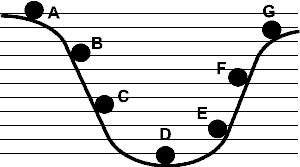
At what point does Potential Energy transform into Kinetic Energy?

1

Point A

2

Point B

3

Point C

4

Point D

9

Multiple Choice

Which of these is an example of kinetic energy?

1

a bicycle

2

a battery

3

a solar panel

4

firewood

10

Multiple Select

Which of these things is an example of potential energy?

1

a car motor

2

firewood

3

battery

4

a fan

11

Multiple Choice

What is kinetic energy?

1

moving energy

2

potential energy

3

stored energy

4

renewable energy

12

Multiple Choice

What is potential energy?

1

moving energy

2

stored energy

3

renewable energy

4

non renewable energy

13

Multiple Choice

What is energy?

1

moving energy

2

stored energy

3

renewable energy

4

The ability to do work.

14

Slide image

15

Slide image

16

Multiple Choice

How could you increase the gravitational potential energy of an object without changing its mass and gravity?

1

Make the object larger

2

Lower the object towards the ground

3

Raise the object farther off the ground

4

Allow the object to roll on the ground

17

Multiple Choice

Which would have the LEAST gravitational potential energy (GPE)?

1

A ball sitting on the ground

2

Moon viewed from the Earth

3

An airplane flying 30,000 feet above the ground

4

A rock sitting on top of Mt. Everest

18

Multiple Choice

Question image

At which point does the ball has the greatest gravitational potential energy (GPE)?

1

A

2

G

3

D

4

C

5

G

19

Slide image

20

Slide image

21

Multiple Choice

What do you call the temperature at which a substance changes from a liquid to a solid?
1
Melting Point
2
Boiling Point
3
Freezing Point
4
Solid Point

22

Multiple Choice

A student opens the top window and the bottom window in a hot room. What statement best describes the heat transfer occurring in the room?
1
conduction
2
radiation
3
convection
4
evaporation

23

Multiple Choice

Question image
The diagram to the right shows a solid iron bar that is being heated in a flame. The primary method of heat transfer in the solid iron bar is—
1
convection
2
conduction
3
absorption
4
radiation

24

Multiple Choice

A barefoot student steps on a hot concrete surface. Most of the heat transferred to the student’s skin by this contact is by the process of—
1
convection
2
conduction
3
vaporization
4
radiation

25

Slide image

26

Slide image

27

Multiple Choice

Which of these is not a source of chemical energy?

1

Spaghetti

2

The Sun

3

Battery

4

Petrol

28

Multiple Choice

Which of the following is an example of chemical energy being changed into kinetic energy?

1

Digested food giving you energy to jump.

2

A battery giving a flashlight energy to light up.

3

A hand hitting a drum making music.

4

Two liquids mixed together and get hot.

29

Multiple Choice

A battery transforms:

1

Chemical energy into electrical energy

2

Chemical energy into kinetic energy

3

Electrical energy into chemical energy

4

Electrical energy into kinetic energy

30

Multiple Choice

Which of the following is NOT an example of chemical energy?

1

A glow stick

2

A battery

3

A rock about to fall off a cliff

4

A burning match

31

Slide image

32

Multiple Choice

For a circuit to work, it must be...

1

open

2

incomplete

3

closed

4

have a switch

33

Multiple Choice

What flows in circuits?

1

neutrons

2

atoms

3

electrons

4

energy

34

Multiple Choice

Question image

Transfer of energy in electrical circuits

1

thermal energy

2

electrical energy

3

solar energy

4

mechanical energy

35

Slide image

36

Slide image

37

Slide image

38

Slide image

39

Multiple Choice

energy is transferred through electromagnetic waves.

1

Nuclear

2

Radiant

3

Thermal

4

Potential

40

Multiple Choice

1. Sources of radiant energy include .

1

Running, a potato, and gasoline

2

A microwave, fire, and water vapor

3

People, coal, and a blender

4

Stars, the Sun, and a lamp

41

Multiple Choice

1. Solar panels change energy from .

1

Chemical to thermal

2

Potential to mechanical

3

Radiant to electrical

4

Kinetic to chemical

42

Multiple Choice

2. WHICH OF THE FOLLOWING IS A SOURCE OF LIGHT?

1

the moon

2

our eyes

3

fire

4

a mirror

43

Multiple Choice

When you shine sunlight through a magnifying glass onto a piece of paper, you can sometimes set the paper on fire. Why does this happen?

1

The glass of the magnifier heats up.

2

The energy of the Sun is focused in one small place.

3

The energy of the Sun is spread out over the whole piece of paper.

4

Sunlight sets everything on fire if it sits still long enough.

44

Slide image

45

Slide image

46

Multiple Choice

All of the following are problems of nuclear energy except ---
1
storage of radioactive fuel
2
air pollution
3
security concerns
4
natural disasters (tsunamis, earthquakes, etc.)

47

Multiple Choice

Splitting a uranium atom is called - 
1
fission
2
fusion

48

Multiple Choice

Where does fusion occur naturally?
1
Underwater
2
All around us
3
In the radioactive waste
4
On the sun

49

Multiple Choice

Takes two small nuclei and combines them into a larger nucleus
1
fission
2
fusion

50

Multiple Choice

How do nuclear power-plants work?
1
Fusion
2
Half-life
3
Fission
4
Fusion or fission

51

Slide image

52

Slide image

Energy

So in this lesson we will learn how are mechanical, kinetic, and potential energy related?

Slide image

Show answer

Auto Play

Slide 1 / 52

SLIDE