

Imperialism Lesson 2-The Scramble for Africa: European Colonization and Its Impact (1881-1914)

Presentation
•
History
•
9th - 12th Grade
•
Easy

Riley Lucas
Used 4+ times
FREE Resource
14 Slides • 17 Questions
1

2

3
Multiple Choice
Which two African countries remained independent by 1914 during the Scramble for Africa?
Nigeria and Ghana
Ethiopia and Liberia
Kenya and Tanzania
Algeria and Morocco
4

5
Multiple Choice
What was the nature of European presence in Africa before 1881?
Extensive colonization
Mainly coastal trading posts
Complete control over interior regions
No presence at all
6
Multiple Choice
Which activity was carried out by Europeans in certain regions of Africa before 1881?
Industrialization
Missionary activities
Large-scale farming
Urban development
7
8
Multiple Choice
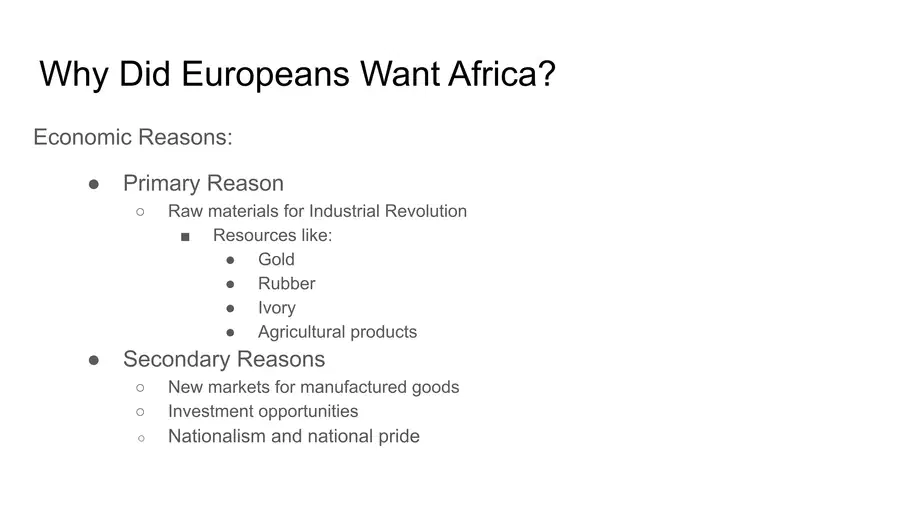
What was the primary economic reason for European nations to colonize Africa during the Scramble for Africa?
To spread Christianity
To acquire raw materials for the Industrial Revolution
To establish military bases
To promote European culture
9
Multiple Choice
Discuss the role of nationalism and national pride in motivating European countries to participate in the Scramble for Africa.
Nationalism led to the promotion of African cultures in Europe.
National pride encouraged European countries to compete for colonies to demonstrate their power and prestige.
Nationalism resulted in the unification of African territories.
National pride discouraged European involvement in Africa.
10
11
Multiple Choice
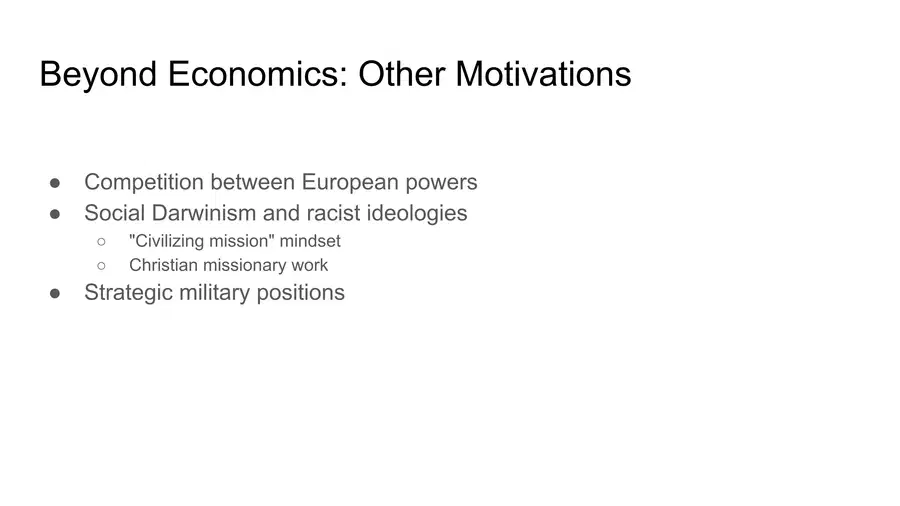
Describe the strategic military motivations behind European colonization of Africa.
To establish alliances with African kingdoms
To secure strategic military positions for global dominance
To promote peace and stability in Africa
To avoid military conflicts with other European nations
12
Multiple Choice
Evaluate the role of Christian missionary work in the context of the Scramble for Africa.
It was the primary reason for European colonization.
It was used to justify colonization under the guise of a "civilizing mission."
It led to the immediate independence of African nations.
It had no significant impact on European colonization efforts.
13

14
Multiple Choice
Explain how the Berlin Conference of 1884-1885 influenced the colonization of Africa. Provide specific examples of its impact on African territories.
The conference led to the establishment of African-led governments.
It resulted in the creation of new trade routes within Africa.
The conference established rules for European powers to claim African territories, leading to the division of Africa without African representation.
It promoted the development of African industries.
15
Multiple Choice
What was the "effective occupation" principle established during the Berlin Conference?
A requirement for European powers to establish a military presence in African territories
A rule that European powers must demonstrate control over a territory to claim it
A guideline for promoting African independence
A principle for sharing resources among European nations
16
17
Multiple Choice
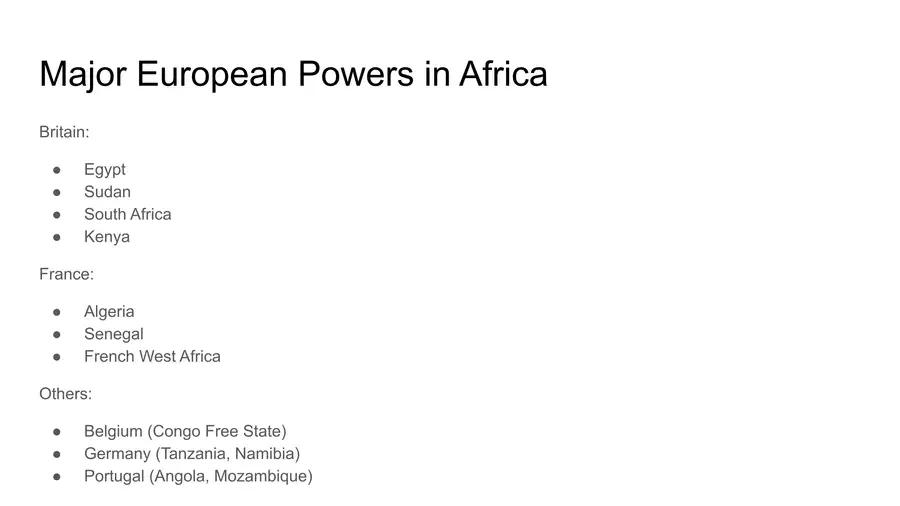
Identify the European power that controlled Egypt during the Scramble for Africa.
France
Germany
Britain
Portugal
18
19
Multiple Choice
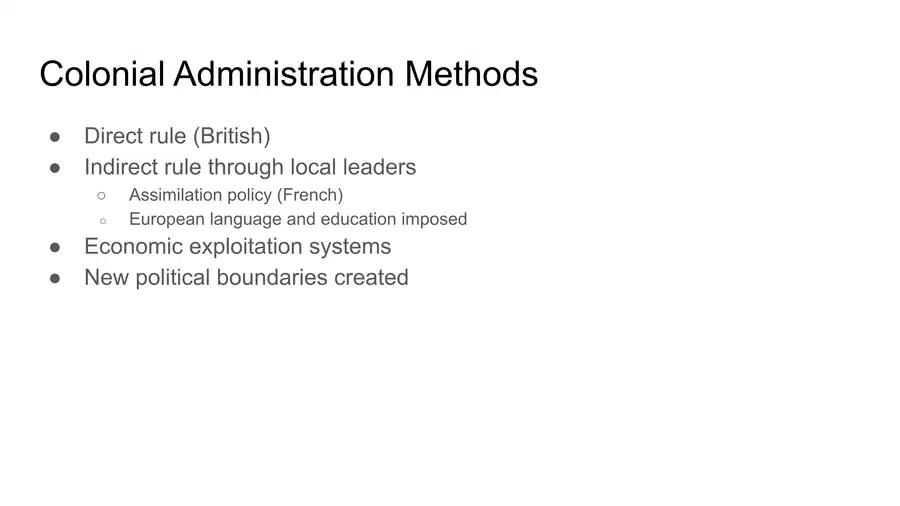
Which European country used the policy of assimilation in its African colonies, and what did this policy entail?
Britain, which focused on indirect rule
France, which aimed to integrate Africans into French culture
Germany, which promoted local governance
Portugal, which encouraged economic independence
20

21
Multiple Choice
What was the impact of European-imposed languages and education systems on African societies?
They preserved traditional African cultures.
They suppressed local languages and cultural practices.
They had no effect on African societies.
They promoted the use of African languages in Europe.
22
23
Multiple Choice
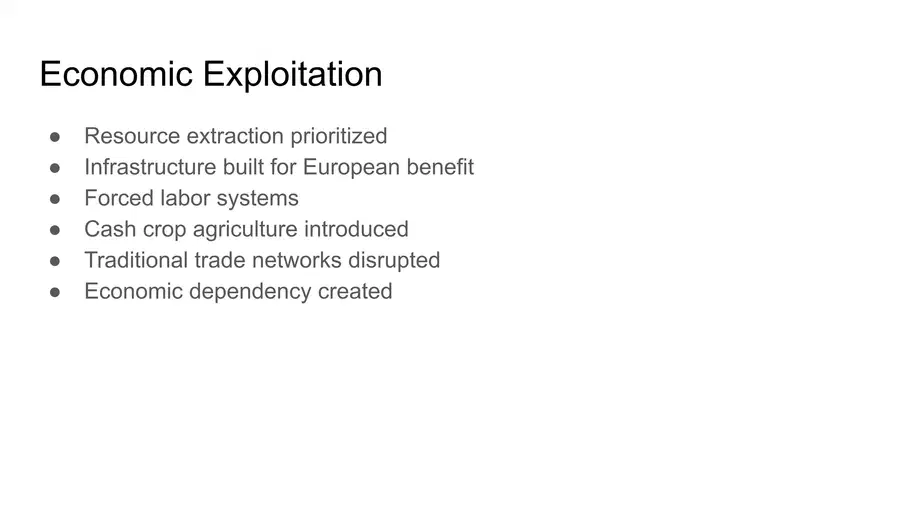
Analyze the economic exploitation systems introduced by European colonizers in Africa and their long-term effects on African economies.
They led to the development of diverse local industries.
They created economic dependency and underdevelopment in African economies.
They promoted fair trade practices.
They resulted in the equal distribution of resources.
24
25
Multiple Choice
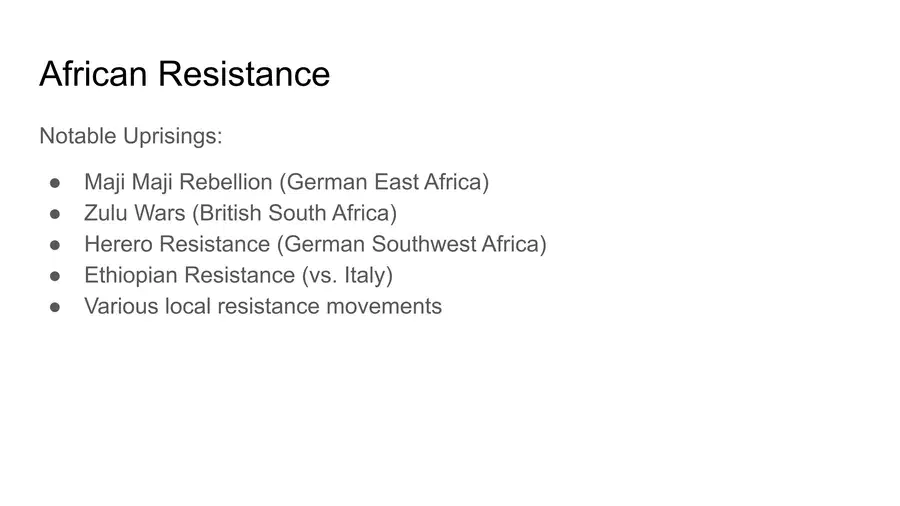
Which African resistance movement was against German colonial rule in East Africa?
Zulu Wars
Maji Maji Rebellion
Herero Resistance
Ethiopian Resistance
26
27
Multiple Choice
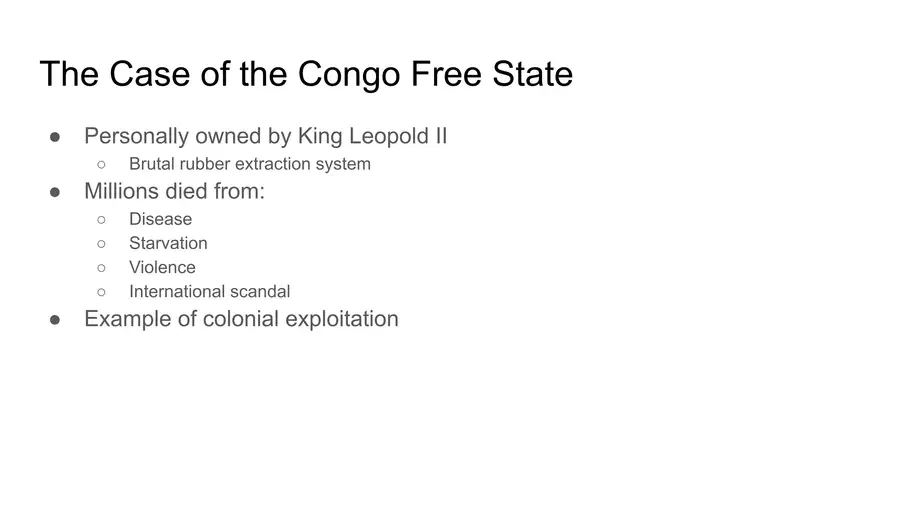
Identify the European power that controlled the Congo Free State and describe the impact of its administration on the local population.
France, which improved local infrastructure
Belgium, which implemented a brutal rubber extraction system
Germany, which introduced new educational systems
Portugal, which focused on agricultural development
28

29
Multiple Choice
What was the impact of new political boundaries created by European colonizers on African societies?
They strengthened traditional political systems.
They divided ethnic groups and disrupted existing social structures.
They promoted unity among African kingdoms.
They had no significant impact on African societies.
30
31
Multiple Choice
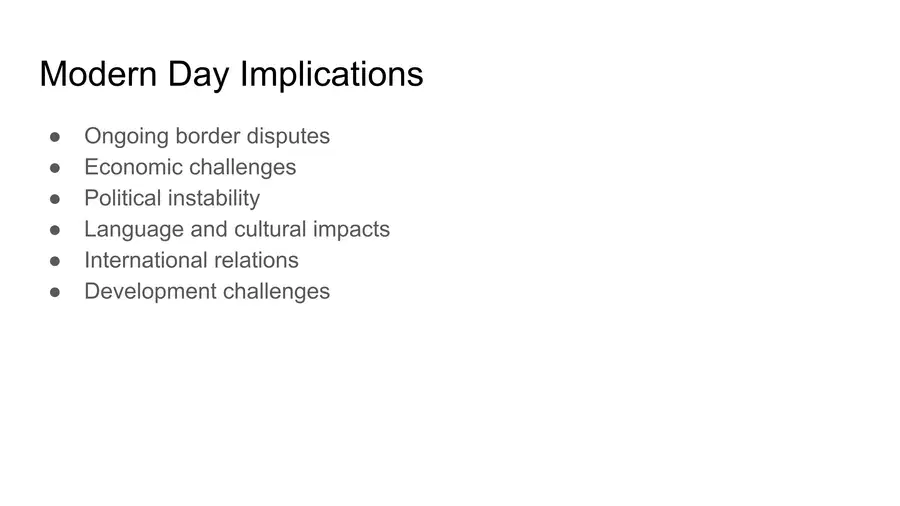
Discuss the modern-day implications of the arbitrary borders created during the Scramble for Africa.
They have led to stable political environments in African countries.
They have resulted in ongoing border disputes and ethnic conflicts.
They have promoted economic prosperity across Africa.
They have had no lasting impact on African nations.
Show answer
Auto Play
Slide 1 / 31
SLIDE
Similar Resources on Wayground

25 questions
The Mongols
Presentation
•
9th - 12th Grade
27 questions
Cold War Test Review
Presentation
•
9th - 12th Grade
28 questions
6.1 Causes of World War 1
Presentation
•
9th - 12th Grade
24 questions
Distance Time Graphs
Presentation
•
9th - 12th Grade
24 questions
Paraphrasing, Quoting, and Summarizing
Presentation
•
9th - 12th Grade
25 questions
Events of World War 1
Presentation
•
9th - 12th Grade
27 questions
Beginning of World War 2
Presentation
•
9th - 12th Grade
22 questions
Factors of Production
Presentation
•
10th - 12th Grade
Popular Resources on Wayground
11 questions
Hallway & Bathroom Expectations

Quiz
•
6th - 8th Grade
10 questions
HCS SCI 03 Summer School Assessment 2
Quiz
•
3rd Grade
11 questions
Home Scope
Quiz
•
7th - 8th Grade
12 questions
2026 TAP Technology in the Classroom
Presentation
•
Professional Development
15 questions
HCS SCI 05 Summer School Assessment 2 Review
Quiz
•
5th Grade
15 questions
HCS SCI 04 Summer School Review 2
Quiz
•
4th Grade
59 questions
Geometry Unit 3 Review
Quiz
•
9th - 12th Grade
14 questions
FAST ELA READING SMAPLE TEST MATERIALS

Passage
•
3rd Grade