

7.8: Health and Science in the Industrial Revolution

Presentation
•
Social Studies
•
9th - 12th Grade
•
Easy

Neil Johnson
Used 2+ times
FREE Resource
26 Slides • 6 Questions
1
Health & Science in the Industrial Revolution

Lesson 7.8
2
Draw
Previously, you learned industrialized cities quickly grew during the Industrial Revolution. Residents of these cities often faced health hazards in the urban setting. Journalists, artists, and activists called attention to these problems. The 1828 cartoon below shows one example.
Circle clues that can help identify this cartoon
3
Multiple Choice

Bell Ringer: What health hazard does this cartoon call attention to?
air pollution from the burning of coal
contaminated drinking supply
toxic fumes inside factories
4
Lesson Overview
Learners can:
identify scientific discoveries made during the Industrial Revolution
explain how scientific advancements improved people’s health and daily lives
----
Vocabulary:
cell theory, cholera, germ theory, miasma, natural selection
5
Engage
The Industrial Revolution brought new workplaces and growing cities to Western Europe and the United States from the late 18th to early 20th century.
---
Numerous health hazards and discomforts accompanied industrial development.
----
Scientific research brought discoveries that reduced the spread of disease, increased people's understanding of how biology works, and brought conveniences that people still enjoy today.

6
Outbreaks of Infectious Diseases
Poor sanitation was a major cause of the spread of disease in industrial cities.
----
Workers’ housing in the early 1800s often had open, uncovered sewers that did not safely dispose of waste.
----
These unsanitary conditions caused outbreaks of disease.
One of the most dangerous diseases was cholera, an infectious disease of the small intestine that could be fatal.
----
During a 1854 outbreak of cholera in London a doctor named John Snow tried to find the source of the disease using a map.

John Snow’s map shows cholera cases marked with black squares. Snow used the map to better understand the pattern of the 1854 cholera outbreak.
7
John Snow marked the locations where clusters of cholera cases occurred to locate the source of the outbreak.

8
Video Question
What did John Snow believe was the source of the cholera infections?
9
10
Multiple Choice
What did John Snow believe was the source of the cholera infections?
contaminated water from a water pump
particles of waste in the River Thames
meat from animals that had lived near sewers
11
Bacteria
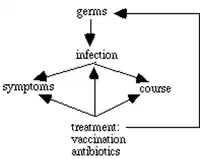
John Snow correctly theorized that the infection was caused by germs, or bacteria that cause disease.
----
Snow’s idea went against understandings of disease at the time. During Snow’s time, most people incorrectly believed disease was caused by miasma, or bad air, not by microorganisms.
----
In the mid-1800s, Snow and other scientists developed germ theory, the theory that certain diseases are caused by bacteria that infect someone’s body.
----
Scientists had known about bacteria since the 1600s, but knowledge of bacteria’s role in disease did not develop until the 1800s.

This 1831 illustration artistically represents an outbreak of cholera according to the incorrect miasma theory. Note the black cloud of poisonous air around the Death figure’s head.
12
Bacteria
French chemist Louis Pasteur was an important figure in germ theory. Pasteur realized that bacteria in contaminated food could cause disease.
----
In the 1860s, he conducted experiments that demonstrated that killing bacteria with heat can prevent disease.
----
Pasteurization: the process of heating food and beverages to kill bacteria (in honor of Pasteur.)

13
Bacteria
Knowledge that bacteria cause some diseases was important in reducing the number of deaths from infectious diseases.
Cities took greater measures to ensure clean drinking water.
Doctors sterilized tools to kill bacteria.
Hospitals became safer as better hygiene reduced the spread of diseases within hospitals.
Scientists used knowledge of bacteria to develop vaccines
14
Cell Theory
During the Industrial Revolution, scientific research led to a greater understanding of cells. Cells are the basic building blocks of life.
----
In 1800’s, scientists developed cell theory, which states:
All organisms are made up of one or more cells.
Cells are the basic unit of life.
All cells come from existing cells.
---
Note that cell theory is different from germ theory, which deals with bacteria’s role in disease.

15
Cell Theory
Scientists built on the discoveries of earlier scholars as they made new discoveries about the movements of celestial bodies.
----
Understanding of cells, too, developed over multiple centuries through the research of multiple scientists.
----
Cell theory helped scientists learn about human health. For example, examining how cells reproduce contributed to scientists’ understanding of how hereditary conditions are passed from parents to children.

16
Video Observation
Watch the video and examine what ALL 4 scientists observed
17
18
Categorize
first saw cell walls under a microscope
said all plants and animals are made of cells
first saw living bacteria under a microscope
said cells can only develop from other cells
Organize these options into the right categories
19
Genetics
From 1854 to 1856, a monk in Austria named Gregor Mendel conducted experiments to research the inheritance of traits.
---
Mendel did not focus on the microscopic mechanisms of life as cell theory scientists did.
----
Mendel was interested in the mathematical probability that a trait would be passed on from a parent to its offspring.
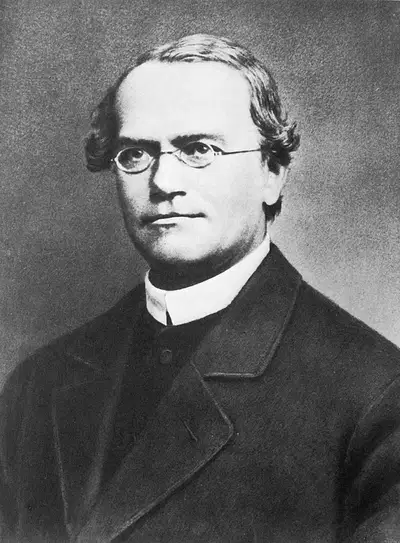
Gregor Mendel
20
Video Question
Which conclusion do Mendel’s findings best support?
21
22
Multiple Choice
Imagine a scientist is applying Mendel’s findings to the study of human biology. Which conclusion do Mendel’s findings best support?
While some bacteria cause disease, others support digestive health.
Coughing and sneezing are sometimes caused by pollen allergies rather than infections.
A child whose parents have good eyesight will likely have good eyesight as well.
23
Genetics
Mendel’s work was important for agriculture. His experiments helped scientists understand the variations that existed in crops.
----
Farmers could select a desired trait, such as a large size, pleasant flavor, or resistance to disease, and intentionally breed crops that had the desired trait.
---
Mendel’s work continues improve crop yields and creating better-tasting food.

24
Natural Selection
In the 1830s, a scientist named Charles Darwin studied nature and described the idea of natural selection.
---
In natural selection, individuals with traits that help them survive live longer, have more offspring, and pass on their traits to the next generation. It is often summarized as “survival of the fittest.”
----
Darwin proposed that species could evolve over time, leading to gradual changes in a species and to the development of new species. The theory of evolution remains an important part of modern biology.

25
Natural Selection
The peppered moth provides an Industrial Revolution-era example of natural selection. Most peppered moths had a pale color. This color helped them blend in with pale trees and prevented predators from seeing them.
----
During the Industrial Revolution, many trees became blackened from factory pollution. Some peppered moths had a darker color, and they were better able to blend in with the darker trees than pale moths were.
-----
While pale moths were more easily found by predators and eaten, the darker moths lived longer, produced more offspring during their lifetimes, and passed on their dark color to their offspring. Over time, the dark moths outnumbered the pale moths.

26
Electricity
Research in electricity brought other scientific advancements during the Industrial Revolution.
----
Nobody invented electricity—electricity exists naturally.
----
During the 1800s, scientists found ways to harness its power.

27
Generating Electricity
In 1831, British scientist Michael Faraday discovered he could create an electric current using magnets and a copper wire.
----
Throughout the century, engineers developed electrical generators and motors.
---
Advancements allowed electricity to be produced on a larger scale and distributed to businesses and homes.

28
Uses of Electricity
One of the early uses for electricity was lighting.
----
American inventor Thomas Edison had a major role in the development of the lightbulb and patented the lightbulb in 1879.
----
Electric lightbulbs joined gaslights as a major method of providing light in the United States.
----
In the late 1800s, electricity was put to heavy commercial use in electric trams and subways in London.

29
Telegraph and Telephone
Electricity also provided new ways to communicate.
----
In the 1830s, American inventor Samuel Morse built the first reliable telegraph machine that could transmit electrical pulses through a wire. He developed a system called Morse code: uses sets of long and short pulses to represent letters and send messages.
----
In the 1860s and 1870s, scientists, including Alexander Graham Bell, learned how to transmit sound through wires and created the first telephones.
----
The telegraph and telephone made communication much faster and easier.

The image shows an 1896 telephone from Sweden
30
Electricity
Developments in electricity brought new opportunities to businesses and new conveniences to consumers.
---
Public transportation helped people get around and provided jobs to people involved in the service.
----
Individuals and companies could communicate more easily with the telegraph and telephone.

31
Summary
In this lesson, you learned:
Germ theory helped scientists understand the sources of diseases and how to prevent diseases.
New knowledge of cells, genetics, and natural selection helped scientists understand how biology and heredity work.
Inventors found ways to use electricity to produce light, power transportation systems, and communicate.
32
Poll
Exit Ticket: Which Science did you like learning about?
Biology (Bacteria and Cells)
Genetics (inheritance & natural s
Physics (Electricity)
Health & Science in the Industrial Revolution
Lesson 7.8
Show answer
Auto Play
Slide 1 / 32
SLIDE
Similar Resources on Wayground

25 questions
2.9 Covalent Bonding
Presentation
•
9th - 12th Grade
24 questions
Spanish American War
Presentation
•
10th - 12th Grade
26 questions
Matter cycles
Presentation
•
9th - 12th Grade
24 questions
Unit Zero lesson 2 cafeteria
Presentation
•
9th - 12th Grade
23 questions
World War I Vocabulary (narrated)
Presentation
•
9th - 12th Grade
27 questions
Principles of the Constitution
Presentation
•
8th - 12th Grade
25 questions
Periodic Table Families and Properties
Presentation
•
9th - 12th Grade
25 questions
Macromolecules
Presentation
•
9th - 12th Grade
Popular Resources on Wayground
10 questions
HCS SCI 03 Summer School Review 4

Quiz
•
3rd Grade
11 questions
HSMS - Standard Response Protocol
Quiz
•
6th - 8th Grade
16 questions
1.1-1.2 Quiz Review
Quiz
•
9th - 12th Grade
12 questions
Exponent Expressions
Quiz
•
6th Grade
20 questions
Adding and Subtracting Integers
Quiz
•
6th - 7th Grade
11 questions
Northeast States
Quiz
•
3rd - 4th Grade
10 questions
Characterization
Quiz
•
3rd - 7th Grade
10 questions
Common Denominators
Quiz
•
5th Grade