

5.4.3

Presentation
•
Science
•
9th Grade
•
Practice Problem
•
Hard

Nicole Rolland
Used 1+ times
FREE Resource
32 Slides • 7 Questions
1

2

3

4

5

6

7

8

9

10

11

12
1. Conjunctiva- 2. cornea- 3.Lacrimal duct 4. Lacrimal gland
13

14

15
16

17
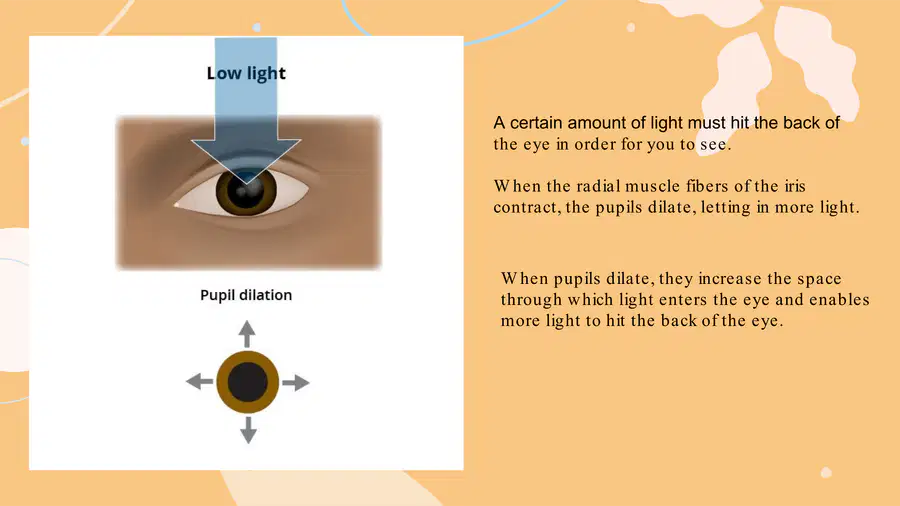
Iris-
Pupil-
Iris regulation in low light: when pupils dilate...
Iris regulation in bright light: when pupils contract...
18

19
Multiple Choice
On a bright sunny day, Stella was doing yardwork. When Stella got thirsty, she went into her house to grab a water bottle from the basement. Which of the following statements describes how Stella‘s eyes most likely responded to moving from a bright environment to a dim environment?
The radial muscles in the iris contracted, causing Stella‘s pupils to dilate.
The radial muscles in the iris contracted, causing Stella‘s pupils to constrict.
The circular muscles in the iris contracted, causing Stella‘s pupils to dilate.
The circular muscles in the iris contracted, causing Stella‘s pupils to constrict.
20

21

22
The Lens
When viewing distant objects, the ciliary muscle_______, which causes the lens to _________.
When viewing close objects, the ciliary muscle _________, which causes the lens to
23

24

25
The Retina
Rods:
Cones:
26

27
Humors of the Eye
Aqueous humor-
Vitreous humor-
28

29
Multiple Choice
Which of the following statements about aqueous humor is correct?
Aqueous humor is a watery fluid located in the vitreous chamber.
Aqueous humor is a watery fluid located in the anterior chamber.
Aqueous humor is a jellylike fluid located in the vitreous chamber.
Aqueous humor is a jellylike fluid located in the anterior chamber.
30

31

32
Multiple Choice
When James had his vision tested, he could read the letters on the Snellen chart easily when the chart was close. However, when James tried to read the letters when the chart was far away, James had difficulty reading many of the letters.
Based on the results of the vision test, is James more likely to be diagnosed with myopia or hyperopia?
hyperopia, or nearsightedness, because distant objects appear blurry with hyperopia
hyperopia, or farsightedness, because near objects appear blurry with hyperopia
myopia, or farsightedness, because near objects appear blurry with myopia
myopia, or nearsightedness, because distant objects appear blurry with myopia
33
Visual Acuity
Myopia-
Hyperopia-
34

35
Hotspot
Identify the lens in the image of the eye below.
36
Reorder
Drag to sort the structures of the eye in order from the front of the eye to the retina.
cornea
anterior chamber
lens
vitreous chamber
37
Multiple Choice
If a person‘s irises were damaged, how might the person‘s eyesight be affected?
The person could not send electrical signals about sight to the brain.
The person would not be able to tell colors apart from one another.
The person‘s eye color would change to a darker color than they were originally.
The person would not be able to regulate the amount of light entering the eye.
38
Categorize
nearsightedness
eye bends light too much
farsightedness
eye does not bend light enough
distant objects appear blurry
nearby objects appear blurry
Sort the statements according to whether the statement describes myopia or hyperopia.
39

Show answer
Auto Play
Slide 1 / 39
SLIDE
Similar Resources on Wayground

34 questions
Mirrors and Lenses
Presentation
•
8th Grade
37 questions
Factors that affect climate
Presentation
•
9th Grade
32 questions
Moon Phases and Tides
Presentation
•
8th Grade
35 questions
The Industrial Revolution
Presentation
•
9th Grade
31 questions
ESS 2.5 Geosphere Interactions
Presentation
•
9th Grade
39 questions
Photosynthesis and Cellular Respiration
Presentation
•
9th Grade
36 questions
Characteristics of Exponential Functions
Presentation
•
9th Grade
34 questions
Lab Safety
Presentation
•
9th Grade
Popular Resources on Wayground
10 questions
Safety Day 2026 – Student Review

Quiz
•
9th Grade
21 questions
Continents and Oceans
Quiz
•
6th Grade
20 questions
Parts of Speech
Quiz
•
5th Grade
16 questions
Subject & Predicate
Quiz
•
5th Grade
25 questions
Multiplication Facts
Quiz
•
5th Grade
12 questions
Map Skills
Quiz
•
3rd Grade
22 questions
Continents and Oceans
Quiz
•
5th Grade
15 questions
Rounding Decimals
Quiz
•
5th Grade
Discover more resources for Science
10 questions
Exploring Chemical and Physical Changes

Interactive video
•
6th - 10th Grade
20 questions
Atomic Structure
Quiz
•
9th Grade
10 questions
Exploring the Electromagnetic Spectrum for Middle School Science
Interactive video
•
6th - 10th Grade
10 questions
Exploring Force and Motion Concepts
Interactive video
•
6th - 10th Grade
10 questions
Exploring Air Masses and Weather Fronts
Interactive video
•
6th - 10th Grade
10 questions
Exploring the States of Matter
Interactive video
•
6th - 10th Grade
10 questions
Exploring Forces: Net Force, Normal Force, Gravity, and Friction
Interactive video
•
6th - 10th Grade
10 questions
Differentiating Thermal Energy and Temperature
Interactive video
•
6th - 10th Grade