

10.3 China and Japan Reject Expansion

Presentation
•
Social Studies
•
9th - 12th Grade
•
Practice Problem
•
Medium

Scott Markowitz
Used 2+ times
FREE Resource
75 Slides • 23 Questions
1

2

3

4

5

6

7

8

9

10

11

12

13

14
Multiple Choice
What role did Zheng He play in Chinese history during the Ming dynasty?
He was an emperor who ruled with an iron fist
He led naval expeditions that expanded Chinese influence
He was a philosopher who promoted Confucianism
He organized the construction of the Great Wall
15
Multiple Choice
What was the result of Zheng He's explorations?
China became a military power in Europe
Diplomatic relations were established with over 16 countries
A war with Japan was initiated
Foreign relations were prohibited
16
Multiple Choice
How did China change following the voyages of Zheng He?
China expanded by conquering its neighbors.
China opened its borders to foreign settlement.
China invited many foreign countries to establish trading outposts.
China closed its borders, fearing barbarian invasions from the north.
17
Multiple Choice
Ming emperors rebuilt and expanded sections of the Great Wall because of the continued threats of __ invasion.
Mongol
European
Japanese
Muslim
18

19

20

21

22
Multiple Choice
What effect did trade have on the Chinese economy during the Ming dynasty?
The economy became completely trade-based
Industry and trade grew, but agriculture was prioritized
The economy collapsed due to corruption
A free trade system with Europe was established
23

24

25

26

27

28

29

30

31
Multiple Choice
Which emperor of the Ming dynasty is known for his agricultural reforms and restoration of Chinese power?
Yonglo
Zheng He
Hongwu
Qianlong
32
Multiple Choice
What impact did Confucianism have on politics and society in China during the Ming dynasty?
Promoted war and territorial expansion
Fostered corruption among officials
Established a meritocratic system for government
Discouraged education and study
33

34

35
Multiple Choice
Why was the Chinese population slow to accept the Manchu Qing emperors?
The Chinese were resistant to rule by foreigners.
The Manchus tried to create a new social structure.
The Manchus failed to keep barbarians from invading the south.
The Chinese feared that their new rulers would move the capital again.
36
Multiple Choice
Which of the following describes the status of women during the Ming Dynasty?
Women were valued as wise political and religious leaders.
Women were able to marry for love and divorce their husbands.
Women were given greater freedom to travel and own businesses.
Women were expected to care for their children and maintain the household.
37
Multiple Choice
How did the Manchus respond to the initial rejection of their government by the Chinese?
They withdrew from China
Implemented democratic reforms
Gained respect from the Chinese through the restoration of prosperity
Established a military government
38
Multiple Select
Which three jobs were available to women during the Ming Dynasty?
farmers
scholars
midwives
court advisors
textile workers
39

40

41

42

43

44

45

46
Multiple Choice
What was Korea's relationship with China during the Qing dynasty?
Korea became a Chinese colony
Korea maintained its independence but adopted many elements of Chinese culture
Korea rebelled against Chinese rule
Korea allied with Japan to resist China
47

48
Multiple Choice
How was life characterized in China during the Ming and Qing dynasties?
A period of constant war
A time of general peace and prosperity
A time of foreign invasions
A period of cultural decline
49

50

51

52

53

54

55

56

57

58

59

60
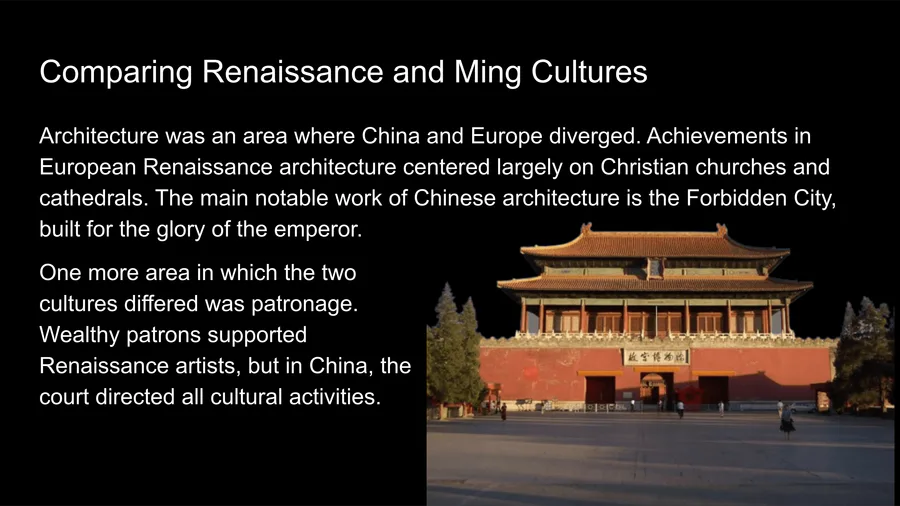
61

62

63

64

65

66

67

68

69

70

71

72

73

74
Multiple Choice
Which of the following daimyo completed the unification of Japan?
Tokugawa Ieyasu
Oda Nobunaga
Toyotomi Hideyoshi
Tokugawa Hidetada
75
Multiple Choice
How did Tokugawa leyasu pacify Japan after years of internal divisions and warfare?
He ruthlessly eliminated all rivals in his government.
He defeated his enemies at the decisive Battle of Edo.
He forced the daimyo and their families to live at the capital city.
He hired Chinese soldiers to keep the peace throughout the country.
76
Multiple Choice
What characteristic best defines Japanese society during the Tokugawa shogunate?
A very fluid social structure
A strong focus on trade and industry
A rigid social hierarchy with the shogun at the top
The elimination of the samurai class
77
Multiple Choice
Which statement characterizes Tokugawa society?
The shogun controlled the government.
Peasants owned more land than the samurai.
Merchants were more respected than warriors.
78
Reorder
Rank the segments of Tokugawa society from the highest to lowest rank in the Japanese social pyramid.
emperor
shogun
daimyo
peasant
merchant
79

80

81

82
Multiple Choice
What type of art and literature flourished in Japan during the Tokugawa shogunate?
Religious literature comparing Christianity, Shinto, and Buddhism
Kabuki theatre and haiku poetry
European-style art and oil painting
Gothic sculpture and architecture
83

84

85

86

87

88

89

90

91

92

93

94

95
Multiple Choice
How did the arrival of the Portuguese in Japan in the 16th century affect the country?
Introduced advanced agriculture
Brought new technologies and weapons
Established a colonial government
Promoted Buddhist religion
96
Multiple Choice
Which development caused the Japanese to become isolationists by the beginning of the 17th century?
the importation of the Portuguese cannon
the adoption of Chinese cultural influences
the continued threats of Mongolian invasion
the growing influence of Christian missionaries
97
Multiple Choice
Which of the following statements best describes Japan's "closed country" policy?
Allowed trade with only European countries
Prohibited Christianity and greatly limited foreign trade
Encouraged European colonization in Japan
Opened Japan to European cultural and religious influence
98
Multiple Choice
Which statement characterizes Japanese commercial policies after 1639?
Japan began a period of economic expansion.
Japan completely isolated itself from foreign contact.
Japan continued to trade with the Netherlands and China.
Japan welcomed Portuguese and Spanish military suppliers.
Show answer
Auto Play
Slide 1 / 98
SLIDE
Similar Resources on Wayground

90 questions
Sentences Lesson
Presentation
•
KG - University
92 questions
ch. 26 Plant Growth and Development
Presentation
•
KG - University
92 questions
Forces Notes Part 2
Presentation
•
9th - 12th Grade
90 questions
IA Review
Presentation
•
9th - 12th Grade
95 questions
Lesson 4 - Adaptation
Presentation
•
9th - 12th Grade
90 questions
Descubre 3 Repaso Vocab 4,5,6
Presentation
•
9th - 12th Grade
90 questions
rage quit lesson
Presentation
•
KG
Popular Resources on Wayground
10 questions
Safety Day 2026 – Student Review

Quiz
•
9th Grade
21 questions
Continents and Oceans
Quiz
•
6th Grade
20 questions
Parts of Speech
Quiz
•
5th Grade
16 questions
Subject & Predicate
Quiz
•
5th Grade
25 questions
Multiplication Facts
Quiz
•
5th Grade
12 questions
Map Skills
Quiz
•
3rd Grade
22 questions
Continents and Oceans
Quiz
•
5th Grade
15 questions
Rounding Decimals
Quiz
•
5th Grade
Discover more resources for Social Studies
10 questions
Exploring the Age of Exploration: Key Events and Figures

Interactive video
•
6th - 10th Grade
9 questions
Exploring Ancient Mesopotamia and Its Civilizations
Interactive video
•
10th Grade
20 questions
Chapter 8 Test "Types of Business Organizations"
Quiz
•
12th Grade
39 questions
Unit 7 Key Terms
Quiz
•
11th Grade - University
10 questions
Debating the Legacy of Christopher Columbus
Interactive video
•
6th - 10th Grade
38 questions
Unit 6 Key Terms
Quiz
•
11th Grade - University
27 questions
World Geography - Q1 9week Test
Quiz
•
9th Grade
22 questions
U3T2 Vocab FAC: Domestic Policy
Quiz
•
10th Grade