

Electromagnetic Spectrum

Presentation
•
Science
•
6th - 8th Grade
•
Practice Problem
•
Easy
Standards-aligned

Boaz Rottet
Used 16+ times
FREE Resource
16 Slides • 3 Questions
1
Electromagnetic Spectrum
In today's lesson, you will learn about the different types of light waves. You will learn:
what the electromagnetic spectrum is;
how to measure and describe waves; and
the types of waves on the electromagnetic spectrum.

2
Our glossary in our notebook defines light as "waves on the electromagnetic spectrum."

3
The electromagnetic spectrum is all types of light. Not just the types that we can see.
I have some fun facts about light in this lesson that we are going to check out!
Visible light is actually a tiny slice of the full spectrum.
It includes:
Radio waves
Microwaves
Infrared
Visible light
Ultraviolet
X-rays
Gamma rays
4
Fun Fact #1
Your body is glowing right now. Humans give off infrared radiation. Thermal cameras can see you in complete darkness

5
Fun Fact #2

Microwaves and Wi-Fi Are Light
6
Fun Fact #3
Gamma Rays Come From Space Explosions


7
Fun Fact #4
Snakes Can See Heat


8
Fun Fact #5
Sunburn Is From Invisible Light

9
Sunlight is important for life on Earth. Plants use energy from sunlight for photosynthesis. The Sun's energy provides warmth for living things. All organisms rely on energy from the Sun, either directly or indirectly.
Think about how sunlight reaches Earth. In a previous lesson, you learned that heat from the Sun travels through space as radiation. Does light travel in a similar manner?

10
The Electromagnetic Spectrum
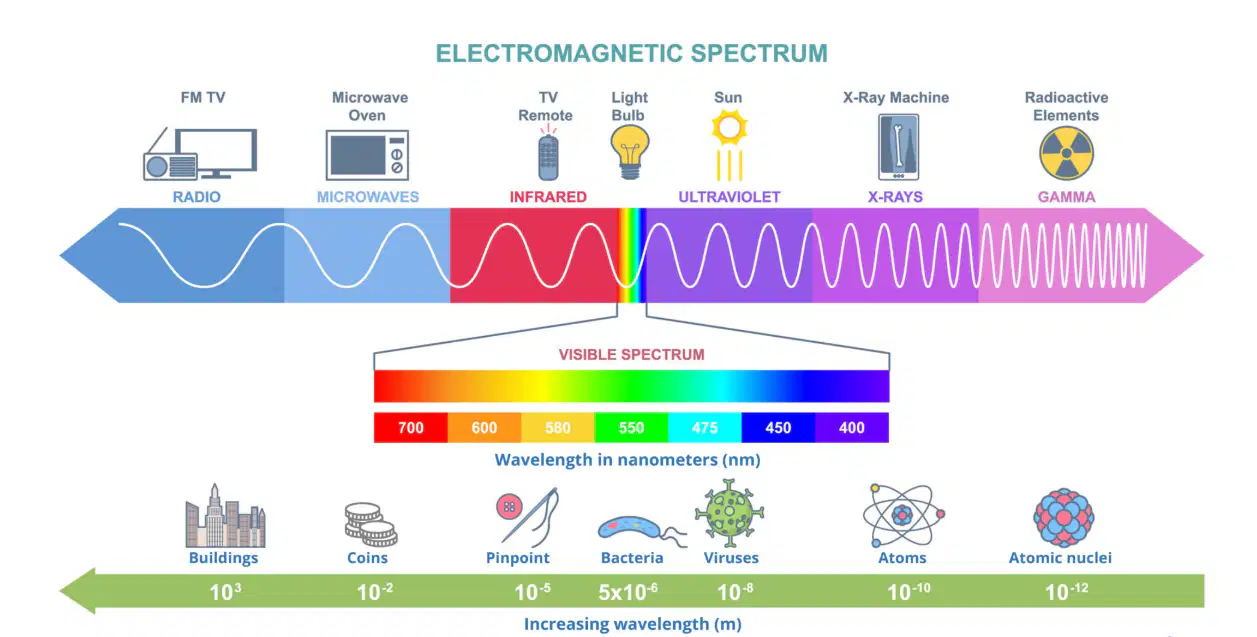
The electromagnetic (EM) spectrum is the range of all of the types of light waves. You can see a very narrow range of light waves using your eyes. The remaining light waves are invisible to humans.
Examine the diagram of the EM spectrum. Seven types of EM waves are listed on the diagram. Note that only a very narrow section includes visible light, or the light that your eyes can see. That portion, called the visible spectrum, is enlarged above the diagram.

EM waves move from one place to another using a process called radiation.
11
Waves
All of the types of light, or EM radiation, travel in waves. A wave is a pattern of motion that transfers energy from one place to another. All EM waves carry energy. The amount of energy that a wave carries depends on its wavelength. A wave's wavelength is the distance from the peak of one wave to the peak of the next.
Why are we able to observe different colors?

12
A wavelength is the length of one wave. There are three main ways to measure wavelength:
from top to top;
from bottom to bottom; and
from midpoint to midpoint.

13
Multiple Choice
The shorter the wave length, the higher the energy.
True
False
14

15


16

17
Multiple Choice
Which type of EM wave has the longest wavelength?
Radio Waves
Gamma Rays
Infrared Rays

19
Draw
Complete the four square. The bottom right space is there if you need more space for your examples.
Electromagnetic Spectrum
In today's lesson, you will learn about the different types of light waves. You will learn:
what the electromagnetic spectrum is;
how to measure and describe waves; and
the types of waves on the electromagnetic spectrum.
Show answer
Auto Play
Slide 1 / 19
SLIDE
Similar Resources on Wayground

14 questions
Atmosphere
Presentation
•
6th - 8th Grade
15 questions
Speed
Presentation
•
6th - 8th Grade
13 questions
MICROSCOPE
Presentation
•
6th - 8th Grade
15 questions
Introduction to Genetics
Presentation
•
6th - 8th Grade
16 questions
Energy Transformation
Presentation
•
6th - 8th Grade
16 questions
Topographic Maps
Presentation
•
6th - 8th Grade
13 questions
Quarter 2 Mini-Lesson: Heat Transfer
Presentation
•
6th - 8th Grade
14 questions
Natural Selection
Presentation
•
6th - 8th Grade
Popular Resources on Wayground
11 questions
Hallway & Bathroom Expectations

Quiz
•
6th - 8th Grade
10 questions
HCS SCI 03 Summer School Assessment 2
Quiz
•
3rd Grade
11 questions
Home Scope
Quiz
•
7th - 8th Grade
12 questions
2026 TAP Technology in the Classroom
Presentation
•
Professional Development
15 questions
HCS SCI 05 Summer School Assessment 2 Review
Quiz
•
5th Grade
15 questions
HCS SCI 04 Summer School Review 2
Quiz
•
4th Grade
59 questions
Geometry Unit 3 Review
Quiz
•
9th - 12th Grade
14 questions
FAST ELA READING SMAPLE TEST MATERIALS

Passage
•
3rd Grade