

IA study guide part 1 Lesson

Presentation
•
Biology
•
9th Grade
•
Practice Problem
•
Hard

Alfred Allen
FREE Resource
32 Slides • 0 Questions
1

IA Study Guide Part 1
Due Tuesday, February 25
Standard 1
2

Standard 1a will have four slides 4.5.6. And 7
Slide 4 is a find and match activity for each of the levels of biological hierarchy.
Remember the first level-individual is the start of roles of life in an area
Slide 5 is understanding spot activity where you have 8 biotic factors and 3 abiotic
factors.
Slide 6 is a fill-in-the-blank terms are in the word bank
Slide 7 is abiotic vs biotic terms
Each slide is worth 5 points equaling 20 points of this study guide
3

Sev1 a
SEV1. Obtain, evaluate, and communicate information to investigate the flow of
energy and cycling of matter within an ecosystem.
a. Develop and use a model to compare and analyze the levels of biological
organization including organisms, populations, communities, ecosystems, and
biosphere.
4


Complete the chart (you may use a picture OR a word for the example)
Level Number
Level of Organization
Example
Definition
Level 1
One single lying thing
Level 2
Population
All the american red
squirrels in a forest
Level 3
Level 4
Ecosystem
The living and nonliving things
interacting in an environment
Level 5
Tropical rainforest
Level 6
Biosphere
All the parts of the world that
contain life
5


An ecosystem is made up of all of
the living (BIOTIC) and non-living
(ABIOTIC) factors.
1. Circle the biotic factors.
2. X-out the abiotic factors.
What type of
ecosystem is
pictured?
_____________
6

9
population
community
ecosystem
biome
biosphere
organism
7

4
Temperature
Air
Sunlight
Water
Rocks
Soil
Trees
Fish
Mushrooms
Bacteria
Parasites
Humans
8

Standard 1b will have four slides 10.11. 12 And 13
Slide 10 is a food web activity where you given a task to predict the outcome of
the web when a couple of the species are removed from it.
Remember what Mr. Allen said about producers influence and how the chain
changes up the trophic levels(primary consumer 2nd trophic level)
Slide 11 is a labeling activity to label the energy pyramid. Can you put the labels in
the right spot?.
Slide 12 is a fill-in-the-blank terms are 10%, heat, and metabolic
Slide 13 is matching with a line the terms to appropriate defnition
Each slide is worth 5 points equaling 20 points of this study guide
9

Sev1 b
SEV1. Obtain, evaluate, and communicate information to investigate the flow of energy
and cycling of matter within an ecosystem.
b. Develop and use a model based on the Laws of Thermodynamics to predict energy
transfers throughout an ecosystem (food chains, food webs, and trophic levels).
(Clarification statement: The first and second law of thermodynamics should be used to
support the model.)
10

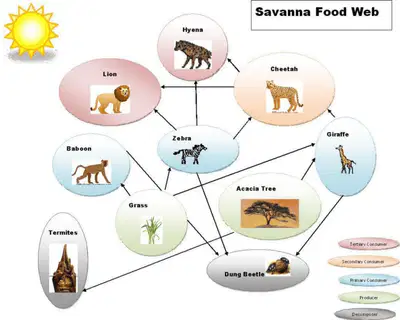
What would happen if the zebras were removed from this ecosystem?
Include at least 3 complete sentences.
TYPE HERE:
11
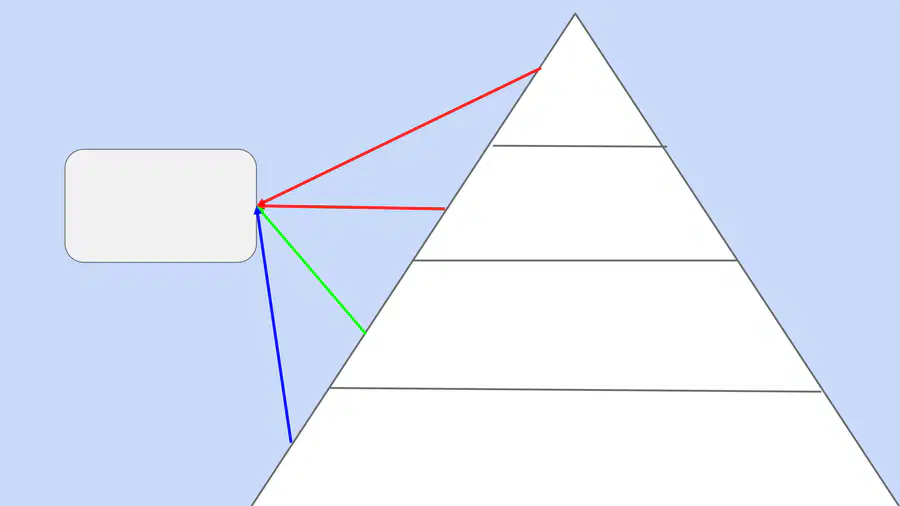





Click and drag each item to the correct space on the energy pyramid
12


Directions: Fill in the blanks to make the sentence correct by typing in
the red boxes. Double click inside the red box to start typing.
13

HERBIVORE
CARNIVORE
OMNIVORE
PRODUCER
CONSUMER
DECOMPOSER
DETRITIVORE
An organism that decomposes organic material - i.e. mushrooms
An organism that can eat both plants and animals
An organism that can only eat plants
An organism that uses photosynthesis to make its own energy
An animal that feeds on dead organic matter
An organism that must eat something else to get its energy
An organism that only eats animals / meat
Draw lines the words
and definitions
14

Standard 1c will have four slides 16.17.and 18
Slide 16 is a find and match activity for the steps in the nitrogen cycle.
Remember the nitrogen in air how is it converted to usable nitrogen for plants.
Slide 17 is a diagram for the carbon cycle.
Slide 18 is the diagram for the hydrological cycle
Each slide is worth 6.6 points equaling 20 points of this study guide
15

Sev1 c
SEV1. Obtain, evaluate, and communicate information to investigate the flow of
energy and cycling of matter within an ecosystem.
c. Analyze and interpret data to construct an argument of the necessity of
biogeochemical cycles (hydrologic, nitrogen, phosphorus, oxygen, and carbon) to
support a sustainable ecosystem.
16

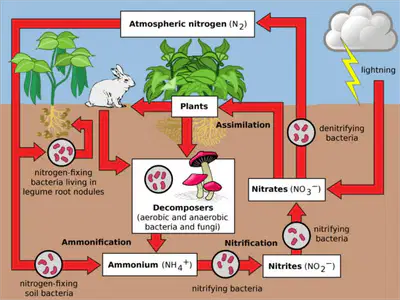
nitrogen
Plants can’t use Nitrogen from the air.
Bacteria in the soil ________ Nitrogen so
plants can use it. This process is called
nitrogen ________. The Nitrogen can now
be absorbed by plants through
their________. Animals (and humans) eat
the plants and absorb the ________.
Animal/human waste and matter is
___________ and Nitrogen is released
back into the environment.
decomposed
fix
roots
Use the words in green to complete the
information about the nitrogen cycle.
fixation
17

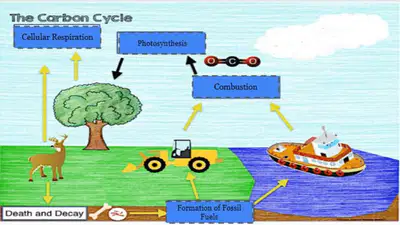
photosynthesis
Carbon enters the atmosphere as
____________.One way carbon gets into
the air is through ______ (burning) of fossil
fuels.
CO2 is absorbed by producers such as
green plants that use it to perform
_______________.
Animals consume plants, thereby,
incorporating carbon into their system.
Animals and plants die, their bodies
___________________ and carbon is
released back into the environment.
CO2
decompose
combustion
Use the words in green to complete the
information about the carbon cycle.
18

EVAPORATION
PERCOLATION
RUNOFF
PRECIPITATION
CONDENSATION
TRANSPIRATION
19

Standard 1d will have four slides 22.23.24. 25, and 26
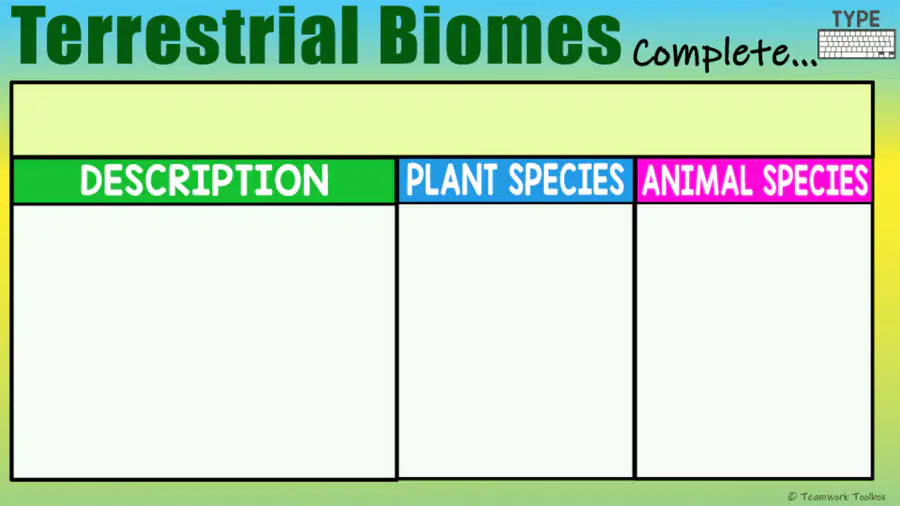
Slide 22-26 is divided into three sections. Each section is to have an animal,
plant and climate patterns(think high/low precipitation)
Each slide is worth 5 points equaling 20 points of this study guide
20

Sev1 d
SEV1. Obtain, evaluate, and communicate information to investigate the flow of
energy and cycling of matter within an ecosystem.
d. Evaluate claims, evidence, and reasoning of the relationship between the
physical factors (e.g., insolation, proximity to coastline, topography) and
organismal adaptations within terrestrial biomes.
21

There are four terrestrial biomes and one aquatic biome
The four biomes will need climate identification with precipitation and temperature
and abiotic factor identity. Plant factors need name of animal/plant and one
adaptation. Tropical rainforest
plant: Euterpe precatoria
Adaptation: they produce a canopy of large leaves supported by a flexible midrib
Animal: Chameleon
Adaptation: hand shaped to grip branches/grasping hands with split digits that allow them to grip
branches and climb trees
22

Type here…
(Include geographic location,
rainfall, temperatures, soil
type)
Type here…
(List the plant
adaptations and
cut and paste
common plant
species)
Type here…
(List the animal
adaptations and
cut and paste
common animal
species)
SAVANNA
17
23

Type here…
(Include geographic location,
rainfall, temperatures, soil
type)
Type here…
(List the plant
adaptations and
cut and paste
common plant
species)
Type here…
(List the animal
adaptations and
cut and paste
common animal
species)
TEMPERATE GRASSLANDS
17
24
Type here…
(Include geographic location,
rainfall, temperatures, soil
type)
Type here…
(List the plant
adaptations and
cut and paste
common plant
species)
Type here…
(List the animal
adaptations and
cut and paste
common animal
species)
TEMPERATE DECIDUOUS FOREST
16
25

Type here…
(Include geographic location,
rainfall, temperatures, soil
type)
Type here…
(List the plant
adaptations and
cut and paste
common plant
species)
Type here…
(List the animal
adaptations and
cut and paste
common animal
species)
TAIGA
14
26

Type here…
(Include geographic location,
rainfall, temperatures, soil
type)
Type here…
(List the plant
adaptations and
cut and paste
common plant
species)
Type here…
(List the animal
adaptations and
cut and paste
common animal
species)
Estuary
14
Aquatic
27

Standard 1e will have four slides 29.30.31, and 32
Slide 29 is fill-in-the-blank assignment with terms on the right.
Slide 30 is the process of eutriphication on an aquatic biome
Slide 31 and 32 use the red box to find the right term for the description
5 points for each slide a total of 20 points for standard 1e.
28

Sev1 e
SEV1. Obtain, evaluate, and communicate information to investigate the flow of
energy and cycling of matter within an ecosystem.
e. Plan and carry out an investigation of how chemical and physical properties
impact aquatic biomes in Georgia. (Clarification statement: Consider the diverse
aq
29

Aquatic ecosystems can be classified by depth, flow,
temperature, and chemistry of the ________. Freshwater
biomes includes flowing-water ecosystems like _________,
as well as standing-water ecosystems like ___________.
_____________ ecosystems have a high salt content like
that of the ocean. ___________ are the most biodiverse
marine ecosystems. _________ are wetlands that form
where rivers meet the ocean - mixing both fresh and
saltwater.
coral reefs
water
rivers & streams
lakes & ponds
marine
estuaries
Drag and drop the words on the right to fill in the blanks
30


31

Drag the Square over the one that does NOT belong with the others.
Marsh
Swamp
Coral Reef
Bog
Below, write at least 1 complete sentence below to explain why is does
NOT belong.
32

Drag the Square over the one that does NOT belong with the others.
Eutrophication
Algae
Phosphorus/Nitrogen
Biodiversity
Below, write at least 1 complete sentence below to explain why is does
NOT belong.
IA Study Guide Part 1
Due Tuesday, February 25
Standard 1
Show answer
Auto Play
Slide 1 / 32
SLIDE
Similar Resources on Wayground

29 questions
Into to DNA Replication
Presentation
•
9th Grade
26 questions
Macromolecules
Presentation
•
9th Grade
27 questions
Biogeochemical Cycles
Presentation
•
9th - 10th Grade
23 questions
Scientific Method
Presentation
•
9th - 10th Grade
24 questions
Scientific Method
Presentation
•
9th - 10th Grade
27 questions
Transcription and Translation Day 1
Presentation
•
9th Grade
27 questions
Unit 1B Macromolecule Review
Presentation
•
9th Grade
26 questions
Biomolecules
Presentation
•
9th Grade
Popular Resources on Wayground
10 questions
Safety Day 2026 – Student Review

Quiz
•
9th Grade
21 questions
Continents and Oceans
Quiz
•
6th Grade
20 questions
Parts of Speech
Quiz
•
5th Grade
16 questions
Subject & Predicate
Quiz
•
5th Grade
25 questions
Multiplication Facts
Quiz
•
5th Grade
12 questions
Map Skills
Quiz
•
3rd Grade
22 questions
Continents and Oceans
Quiz
•
5th Grade
15 questions
Rounding Decimals
Quiz
•
5th Grade
Discover more resources for Biology
20 questions
Cell Transport
Quiz
•
9th - 12th Grade
25 questions
photosynthesis and cellular respiration
Quiz
•
9th Grade
20 questions
Cell Cycle
Quiz
•
9th Grade
8 questions
DNA vs. RNA
Presentation
•
9th - 12th Grade
14 questions
Ecological Succession: Primary and Secondary
Quiz
•
9th Grade
20 questions
Characteristics of Life
Quiz
•
9th - 10th Grade
12 questions
Cell Cycle
Quiz
•
9th Grade
20 questions
Cell Organelles
Quiz
•
9th Grade