
Spectroscopy

Presentation
•
Chemistry
•
9th - 12th Grade
•
Hard

James Gonzalez
FREE Resource
7 Slides • 3 Questions
1

2

3

4

5

6

7

8
Multiple Choice
Infrared spectroscopy is a useful tool for scientists who want to investigate the structure of certain molecules. Which of the following best explains what can occur as the result of a molecule absorbing a photon of infrared radiation?
The energies of infrared photons are in the same range as the energies associated with changes between different electronic energy states in atoms and molecules. Molecules can absorb infrared photons of characteristic wavelengths, thus revealing the energies of electronic transitions within the molecules.
The energies of infrared photons are in the same range as the energies associated with different vibrational states of chemical bonds. Molecules can absorb infrared photons of characteristic wavelengths, thus revealing the types and strengths of different bonds in the molecules.
The energies of infrared photons are in the same range as the energies associated with different rotational states of molecules. Molecules can absorb infrared photons of characteristic wavelengths, thus revealing the energies of transition between different rotational energy states of the molecules.
The energies of infrared photons are in the same range as the total bond energies of bonds within molecules. Chemical bonds can be completely broken as they absorb infrared photons of characteristic wavelengths, thus revealing the energies of the bonds within the molecules.
9
Multiple Choice
Which statement correctly compares what occurs when molecules absorb photons in the microwave region with what occurs when molecules absorb photons in the infrared region?
Microwave photons cause the molecules to increase their rotational energy states, whereas infrared photons cause the molecules to increase their vibrational energy states.
Microwave photons cause electrons in the molecules to increase their electronic energy states, whereas infrared photons cause the molecules to increase their rotational energy states.
Microwave photons cause the molecules to increase their vibrational energy states, whereas infrared photons cause electrons in the molecules to increase their electronic energy states
Microwave photons cause the molecules to increase their rotational energy states, whereas infrared photons cause electrons in the molecules to increase their electronic energy states.
10
Multiple Choice

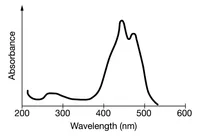
Beta-carotene is an organic compound with an orange color. The diagram above shows the ultraviolet spectrum of beta-carotene. Which of the following statements is true about the absorption bands in the spectrum?
The absorption band between 250 and 320 nm is due to transitions in electronic energy levels, and the absorption band between 380 and 520 nm is due to transitions in molecular vibrational levels.
The absorption band between 250 and 320 nm is due to transitions in molecular vibrational levels, and the absorption band between 380 and 520 nm is due to transitions in molecular rotational levels.
The two main absorption bands are associated with transitions in electronic energy levels. The band in the region corresponding to shorter wavelengths shows a lower absorbance than the band in the region corresponding to longer wavelengths.
The two main absorption bands are associated with transitions in molecular vibrational levels. The band in the region corresponding to shorter wavelengths shows a lower absorbance than the band in the region corresponding to longer wavelengths.
Show answer
Auto Play
Slide 1 / 10
SLIDE
Similar Resources on Wayground

9 questions
Chemistry Unit 01: Scientific Method Notes
Presentation
•
9th - 12th Grade
9 questions
Law of Sines and Law of Cosines Remediation
Presentation
•
9th - 12th Grade
9 questions
Domain 2 Lesson 2
Presentation
•
9th - 12th Grade
6 questions
Hund's Rule
Presentation
•
9th - 12th Grade
8 questions
Synonim of 10 Words
Presentation
•
9th - 12th Grade
7 questions
Binomial Nomenclature
Presentation
•
9th - 12th Grade
8 questions
Pythagorean Theorem
Presentation
•
9th - 12th Grade
11 questions
Molecular Geometry Bond Polarity, Polar or Nonpolar
Presentation
•
9th - 12th Grade
Popular Resources on Wayground
10 questions
How much do you know about our Portrait of an Eagle?

Quiz
•
10th Grade
10 questions
Fast Food Slogans
Quiz
•
6th - 8th Grade
21 questions
Continents and Oceans
Quiz
•
6th Grade
20 questions
Parts of Speech
Quiz
•
5th Grade
16 questions
Subject & Predicate
Quiz
•
5th Grade
25 questions
Multiplication Facts
Quiz
•
5th Grade
12 questions
Map Skills
Quiz
•
3rd Grade
22 questions
Continents and Oceans
Quiz
•
5th Grade
Discover more resources for Chemistry
20 questions
Metric Conversions
Quiz
•
11th Grade
20 questions
electron configurations and orbital notation
Quiz
•
9th - 12th Grade
26 questions
Atomic Structure, Isotopes and Ions
Quiz
•
10th Grade
20 questions
Periodic Trends
Quiz
•
10th Grade
5 questions
Atomic Theory Intro Video

Interactive video
•
10th Grade
20 questions
COUNTING ATOMS
Quiz
•
10th Grade
20 questions
Practice: E-Con, Orbital Notation, Noble Gas Notation
Quiz
•
10th Grade
11 questions
Balancing Chemical Equations
Presentation
•
9th Grade