Search Header Logo
Gene Expression

Gene Expression

Assessment

Presentation

•

Biology

•

9th - 12th Grade

•

Hard

Created by

James Gonzalez

FREE Resource

9 Slides • 43 Questions

1

Open Ended

Review: What is a mutation?

2

Multiple Select

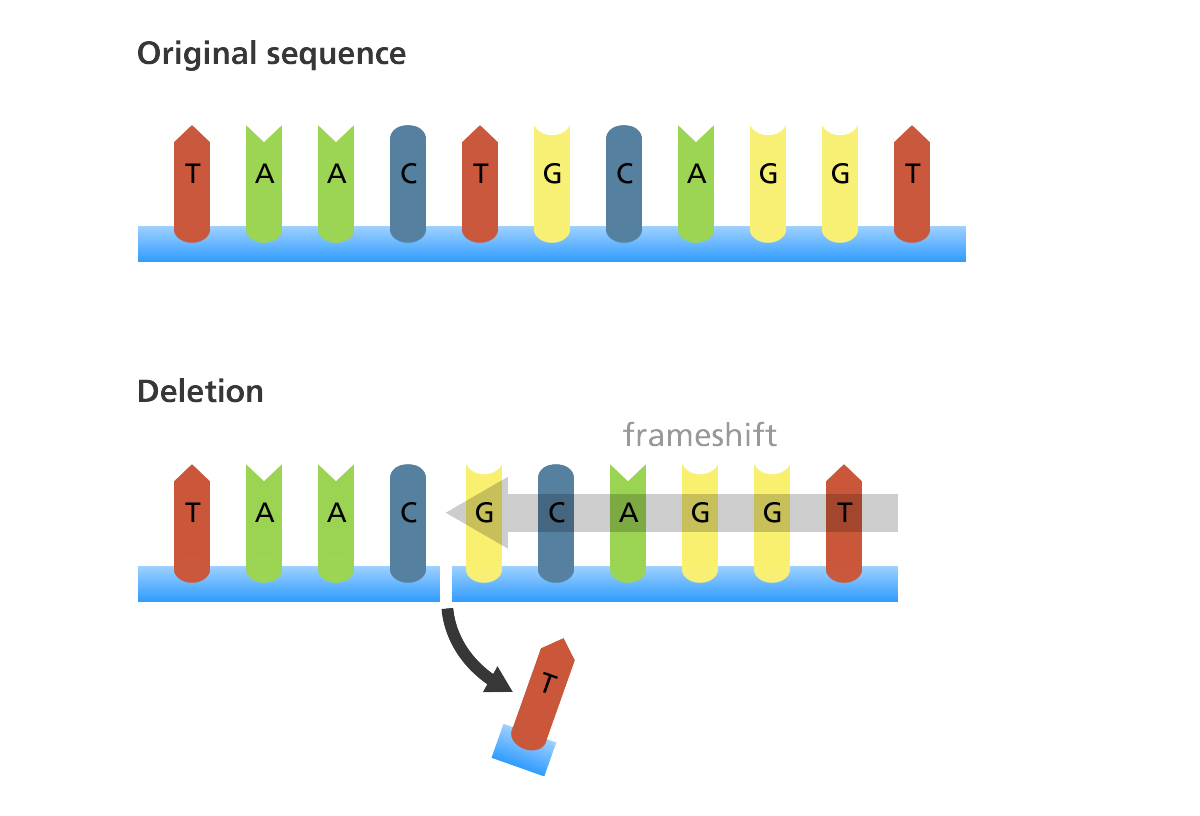
Which of the following would result in a frameshift mutation?

(More than one correct answer)

1

Insertions

2

Substitutions

3

Deletions

3

Multiple Choice

Question image

What type of mutation is this?

1

Substitution/Point

2

Frameshift

4

Multiple Select

What are the two steps in protein synthesis? (Hint: C-->L)

1

translation

2

transcription

3

codon

4

anticodon

5

Multiple Choice

Genes carry our ______.

1

traits

2

jeans

3

codon

4

rna

6

media

7

media

8

media

9

media

10

media

​We can swap the genes of different organisms

  • Scientists created the GloFish by inserting fluorescent genes from jellyfish and sea anemones into the eggs of a tropical fish.

  • The fish was designed to help scientists determine when waterways were contaminated. If they glowed, it meant there were pollutants in the water.

11

media

12

media

13

Multiple Choice

What has DNA?

1

Everything

2

All living things

3

Abiotic factors

4

Rocks

14

media

A Regulated (controlled) process ​by which gene transcription and translation (protein synthesis) are controlled by various (many) factors.

These factors include hormones or environmental fators.​

​

​Gene Expression

​

15

Multiple Choice

What is gene expression?

1

a regulated process

2

an easy process

3

a quick process

4

a slow process

16

media

​Environmentalfactors, in this case temperature, is turning "on" or "off" of certin genes that code for fur color.

​

​Himalayan Rabbit

​

17

Multiple Choice

Question image

The Himalayan rabbit's habitat has cold, snowy winters and mild summers. The body is typically covered in white fur except for the nose, feet, tail, and ears, which are covered in black fur.

A scientist shaved an area of white fur on the back of a Himalayan rabbit and placed an ice pack over the shaved area . The shaved area grew black fur.

Which of these best explains why the hair that grew back where the Ice pack was placed was black and not white?

1

The white hair mutated to black hair as the rabbit's body temperature decreased.

2

The coat color changed from white to black with the age of the rabbit.

3

The genes for black hair were activated by specific temperatures.

4

White hair only grows during certain times of the year.

18

Multiple Choice

CRISPR-Cas9 is a genetic modification technique that edits parts of the genome of an organism . Using this technique scientists can add, remove, or modify sections of the DNA sequence.

How can scientists use this technique to control gene expression?

1

By determining the number of chromosomes in an organism

2

By identifying how closely related one individual is to another

3

By calculating the number of genes different organisms produce

4

By activating or deactivating specific genes

19

Multiple Choice

Explain the role of transcription factors in gene expression regulation.

1

Transcription factors have no role in gene expression regulation.

2

Transcription factors regulate the initiation of transcription by binding to specific DNA sequences.

3

Transcription factors regulate the initiation of translation by binding to specific RNA sequences.

4

Transcription factors are only involved in DNA replication and not gene expression regulation.

20

Multiple Choice

Describe the process of DNA replication and its significance in biology.

1

DNA replication only occurs in non-living organisms.

2

DNA replication is the process of making an identical copy of a DNA molecule. It ensures genetic continuity and allows for the transmission of genetic information from one generation to the next.

3

DNA replication has no significance in biology and is just a random occurrence.

4

DNA replication is the process of creating a completely different DNA molecule.

21

Multiple Choice

What are the key enzymes involved in DNA replication and what are their functions?

1

Protein helicase, Protein polymerase, and Protein ligase

2

ATPase, GTPase, and UTPase

3

DNA helicase, DNA polymerase, and DNA ligase

4

RNA helicase, RNA polymerase, and RNA ligase

22

Multiple Choice

Explain the structure of DNA and its significance in genetic inheritance.

1

The structure of DNA is a single strand, and it is significant in genetic inheritance as it carries oxygen to the cells.

2

The structure of DNA is a square shape, and it is significant in genetic inheritance as it controls the weather.

3

The structure of DNA is a double helix, and it is significant in genetic inheritance as it carries genetic information from one generation to the next.

4

The structure of DNA is a triple helix, and it is significant in genetic inheritance as it determines eye color.

23

Multiple Choice

How does the double helix structure of DNA contribute to its stability and function?

1

The double helix structure has no impact on the stability and function of DNA

2

The double helix structure makes DNA unstable and prone to mutations

3

The double helix structure provides a strong backbone and allows for easy replication and transcription of the genetic code.

4

The double helix structure hinders the process of replication and transcription

24

Multiple Choice

What is the role of RNA polymerase in the process of transcription?

1

It repairs damaged DNA strands

2

It regulates gene expression

3

It synthesizes RNA from a DNA template.

4

It converts RNA into DNA

25

Multiple Choice

Describe the differences between prokaryotic and eukaryotic transcription processes.

1

Prokaryotic transcription occurs in the nucleus, while eukaryotic transcription occurs in the cytoplasm.

2

Prokaryotic transcription does not involve RNA polymerase, while eukaryotic transcription does.

3

Prokaryotic transcription occurs in the cytoplasm, while eukaryotic transcription occurs in the nucleus.

4

Prokaryotic transcription produces introns, while eukaryotic transcription produces exons.

26

Multiple Choice

Explain the process of translation and its role in protein synthesis.

1

Translation is the process of converting DNA to RNA in the nucleus

2

Translation is the process of creating mRNA from tRNA

3

Translation is the process of breaking down proteins into amino acids

4

Translation is the process of decoding the mRNA sequence to build a corresponding amino acid sequence, which forms a protein. It occurs in the ribosomes.

27

Multiple Choice

What is the purpose of electrophoresis in molecular biology and how is it used to analyze DNA fragments?

1

It is used to identify specific genes within a DNA sample

2

It is used to measure the concentration of DNA in a sample

3

It is used to amplify DNA fragments for further analysis

4

It is used to separate DNA fragments based on their size and charge, allowing for analysis of the fragments.

28

Multiple Choice

The lac operon genes only become expressed if:
1
lactose binds to the repressor
2
glucose binds to the repressor
3
lactose binds to the operator
4
the repressor binds to the operator

29

Multiple Choice

The "on/off" switch for an operon is called the
1
promoter
2
repressor
3
operator
4
gene

30

Multiple Choice

what does a promoter do?
1
it allows a gene to be transcribed
2
it creates a DNA segment
3
it is another word for ribosomes
4
it is another word for RNA

31

Multiple Choice

Epigenetics modulates genetic expression:

1

differently in each cell in the body.

2

by altering the genome.

3

in response to only intracellular processes.

4

consistently throughout an individual's life.

32

Multiple Choice

A lack of this nonprotein molecule would result in the inability of the cell to "turn off" genes:

1

Operon

2

Inducer

3

Promoter

4

Repressor

5

Corepressor

33

Multiple Choice

A mutation within the promoter region has occurred. What would potentially happen to transcription rate?

1

Mutated promoters decrease the rate of transcription.

2

Mutated promoters increase the rate of transcription.

3

Mutated promoters can increase or decrease the rate of transcription.

4

Mutated promoters cease transcription of the adjacent gene.

34

Multiple Choice

Attachment of ______ groups to ______ will cause promotion of gene expression due to looser DNA.

1

acetyl, DNA

2

methyl, DNA

3

acetyl, histones

4

methyl, histones

35

Fill in the Blank

The noncoding sequence of DNA located within the promoter where RNA polymerase will bind is called the ________.

36

Multiple Choice

The protein that functions in unwinding DNA strands before replication occurs is called:

1

Topoisomerase

2

Single-strand binding proteins

3

Helicase

4

Ligase

5

Spliceosome

37

Multiple Choice

A type of hereditary pattern exhibited by the coat colors of Labrador retrievers shows a phenotypic ratio of 9:7. This type of pattern is known as:

1

Polygenetic inheritance

2

Multiple alleles

3

Codominance

4

Incomplete dominance

5

Epistasis

38

Multiple Choice

Question image

What type of gene control is shown in this image?

1

processing control

2

transcriptional control

3

post translational control

4

mRNA stability control

39

Multiple Choice

Which RNA bases would pair with TACGAA in transcription
1
AUGCUU
2
ATGCTT
3
GCATCC
4
GCAUCC

40

Multiple Choice

The parts of a gene that do NOT code for amino acids in a protein are called
1
introns
2
exons
3
codons
4
anticodons

41

Multiple Choice

What is the function of the poly-A tail in mRNA?

1

to add modified guanin to the 3' end of the mRNA

2

to indicate the site of translational termination

3

to code for the binding of RNA polymerase to the DNA

4

to help protect the mRNA from degradation and exist longer in the cytoplasm

42

Multiple Choice

Question image
What amino acid sequence will be produced based on the mRNA codon sequence
5'-AUG-UCU-UCG-UUA-UCC-UUG-3'
1
met-ser-leu-ser-leu-ser
2
met-ser-ser-leu-ser-leu
3
met-leu-phe-arg-glu-glu
4
met-glu-arg-arg-glu-leu

43

Multiple Choice

Both eukaryotes and prokaryotes have plasmids. What are plasmids?

1

large extra-chromosomal, double-stranded, linear DNA molecules

2

large extra-chromosomal, double-stranded, circular DNA molecules

3

small extra-chromosomal, double-stranded, circular DNA molecules

4

small extra-chromosomal, double-stranded, linear DNA molecules

44

Multiple Choice

Describe the difference between the synthesis of the leading and lagging strands.

1

directionality: leading = 3' -> 5', lagging = 5' -> 3'

2

synthesis continuity: leading = discontinuous & lagging = continuous

3

directionality: leading = 5' -> 3', lagging = 3' -> 5'

4

synthesis continuity: leading = continuous & lagging = discontinuous

45

Multiple Choice

When a gene does not transcribe unless turned on by activator , it is considered _____ control
1
positive
2
negative

46

Multiple Choice

Alternative RNA splicing involves

1

removing introns and splicing the same exons together

2

removing exons and splicing the same introns together

3

removing introns and splicing different exons together

4

removing exons and splicing different introns together

47

Multiple Choice

Question image

Which of the following polypeptides is coded for by the following

mRNA sequence:

AUG GUU AAA CGA CAA UCC

1

Val, Lys, Phe, Gly, Ser

2

Met Asp, Phe, Ala, Arg

3

Met, Val, Lys, Arg, Gln, Ser

4

Ile, Gln, Lys, Asp, Gln, Ser

48

Multiple Choice

Question image
Identify the mutation in the picture.
1
Deletion
2
Inversion
3
Duplication
4
Translocation

49

Multiple Choice

Question image

Based your answer on the figure: A mutation results in a defective enzyme A. Which of the following would be a consequence of that mutation?

1

an accumulation of A and no production of B and C

2

an accumulation of A and B and no production of C

50

Multiple Choice

A frameshift mutation could result from

1

a base insertion only.

2

either an insertion or a deletion of a base.

3

a base deletion only.

51

Multiple Choice

Question image
Why are insertion and deletion mutations so harmful?
1
They change all of the codons from the mutation on down the line, which changes the amino acid sequence
2
They insert things that an organism doesn't need.
3
They often delete things that organisms need.
4
Insertion and deletions are not any more harmful than substitution mutations.

52

Multiple Choice

Question image

What type of mutation is this?

1

Nonsense mutation

2

Missense mutation

3

Silent mutation

4

Frameshift mutation

Review: What is a mutation?

Show answer

Auto Play

Slide 1 / 52

OPEN ENDED