
The American Revolution: New British taxes

Presentation
•
Social Studies
•
5th Grade
•
Practice Problem
•
Hard

Feri Vahabi
FREE Resource
6 Slides • 14 Questions
1
The American Revolution: New British taxes
By Feri Vahabi
2
Why did the colonists smuggle?
Smuggling was a way for the colonists to trade with anyone they wanted.
British laws known as Navigation Acts said the colonies could only trade
with Great Britain or British colonies. Smugglers ignored these laws and traded with other countries anyway.
Smuggling was also a way for colonial merchants to avoid paying taxes. If
the British tax collectors did not know a product was coming into the
colonies, they had no way to tax it.
3
Multiple Choice
Why did the colonists smuggle goods?
They wanted to trade only with Great Britain.
They wanted to trade with other countries and avoid paying taxes.
They wanted to stop the British from trading.
They did not need the goods from Britain.
4
Multiple Choice
What were the Navigation Acts?
Laws that allowed the colonists to trade freely with other countries.
Laws that limited trade between the colonies and Great Britain.
A set of rules for building ships.
A tax on sugar from the Caribbean.
5
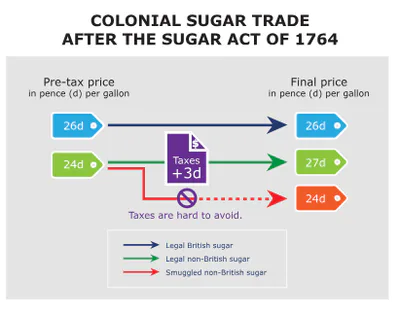
The Sugar Act of 1764 gave British officials more power to enforce taxes on the colonies.
The act was intended to cut down on smuggling in the colonies.
The Sugar Act actually cut sugar taxes in half, but it made those taxes harder to avoid. It sent more British ships to the colonies, and it gave tax officials more power to arrest suspected smugglers.
Smuggling sugar
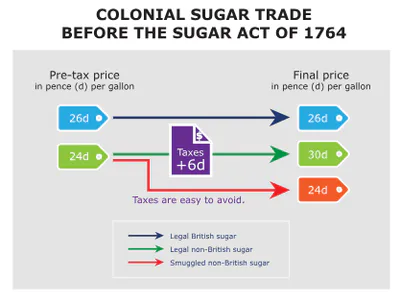
Sugar usually came from British or French plantations in the West Indies, or the Caribbean. The Thirteen
Colonies often bought sugar from the French, because it was cheaper than buying sugar from the British.
Great Britain tried to stop this behavior by placing high taxes on foreign sugar. However, many colonial
merchants avoided the taxes by smuggling.
6
Multiple Choice
Why did the colonists prefer to buy sugar from the French?
It was better quality than British sugar.
It was cheaper than British sugar.
The French had more sugar plantations.
The British did not allow sugar in the colonies.
7
In 1764, the Sugar Act gave British officials new powers to enforce the taxes. Smuggling became more difficult, so tax collections increased. The colonists ended up paying more than they had before.
8
Multiple Choice
What was the purpose of the Sugar Act of 1764?
To stop the colonies from trading with Great Britain.
To reduce sugar production in the Caribbean.
To cut sugar taxes but make them harder to avoid.
To remove all taxes on sugar.
9
Multiple Choice
How did the Sugar Act make smuggling more difficult?
It sent more British ships to the colonies.
It allowed colonists to trade freely.
It gave colonists more rights in court.
It lowered taxes to make smuggling unnecessary.
10
The colonists thought that the Sugar Act ignored their right to a trial by jury.
This was an important right in both Great Britain and the Thirteen Colonies. According to this right, a jury must decide whether a person is guilty of a crime. A jury is a group of people from the same community as the person on trial.
In the Thirteen Colonies, juries rarely found people guilty of smuggling. Most colonists did not think smuggling was wrong, even though it was a crime.
Guilty until proven innocent
Under the Sugar Act, however, juries no longer decided smuggling cases. Instead, smugglers had to
face vice admiralty courts. These courts allowed a single judge, not a jury, to decide cases. In addition, people accused of smuggling were now considered guilty until proven innocent. Beforehand, anyone accused of a crime had been considered innocent until proven guilty.
Judges in vice admiralty courts were colonists selected by British officials. These judges were not as
friendly to smugglers as regular colonists were.
11
Multiple Choice
What was one complaint the colonists had about the Sugar Act?
It ignored their right to a trial by jury.
It forced them to buy only French sugar.
It allowed them to trade with any country.
It increased the price of playing cards.
12
Multiple Choice
How did vice admiralty courts differ from regular colonial courts?
They used juries to decide cases.
They were run by elected colonial leaders.
They had a single judge instead of a jury.
They helped smugglers avoid punishment.
13
Multiple Choice
How were people accused of smuggling treated under the Sugar Act?
Innocent until proven guilty.
Guilty until proven innocent.
Allowed to prove their case before a jury.
Given lower tax rates if found guilty.
14
The Stamp Act of 1765 placed a tax on many paper materials produced or sold in the colonies.
The following list includes just some of the taxed materials:
receipts
newspapers
playing cards
school diplomas
court documents
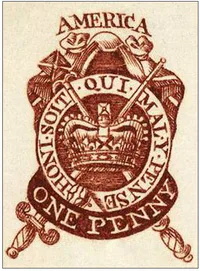
Paper materials now needed a special stamp to be official. People had to pay extra to get that stamp.
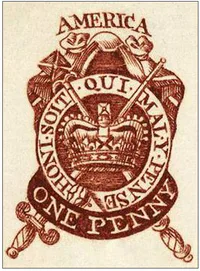
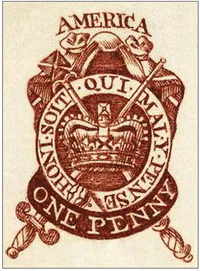
The Stamp Act stamps were not like the sticky stamps we use today on envelopes. They were an ink
pattern pressed onto paper. There were many different stamps, depending on the type of paper product.
This is a stamp that was used on regular newspapers. Every copy of every newspaper needed its own
stamp.
The colonists could get stamps in two ways. They could buy pre-stamped paper, or they could have a British official add a stamp to ordinary paper.
15
Multiple Choice
What was the purpose of the Stamp Act of 1765?
To tax sugar imports.
To place taxes on paper materials.
To allow free trade in the colonies.
To remove taxes on legal documents.
16
Multiple Choice
Which of the following was taxed under the Stamp Act?
Tea and coffee
Sugar and spices
Receipts and newspapers
Farming tools
17
Multiple Choice
What did the Stamp Act require for paper materials?
They had to be sealed in envelopes.
They needed a special stamp to be official.
They had to be signed by the king.
They had to be printed on British paper.
18
Multiple Choice
How were the Stamp Act stamps different from modern stamps?
They were sticky and placed on envelopes.
They were small paper stickers.
They were ink patterns pressed onto paper.
They were only used on letters.
19
Multiple Choice
What was required for every newspaper under the Stamp Act?
A special stamp on each copy.
A British official’s signature.
A seal from the colonial government.
A tax paid by the newspaper owner.
20
Multiple Choice
How could colonists get the required stamps?
They had to print them at home.
They could only buy them from France.
They could buy pre-stamped paper or have a British official stamp it.
They could use any ink stamp they wanted.
The American Revolution: New British taxes
By Feri Vahabi
Show answer
Auto Play
Slide 1 / 20
SLIDE
Similar Resources on Wayground

15 questions
Ancient India Vocabulary
Presentation
•
5th Grade
14 questions
3 Branches of Government
Presentation
•
5th Grade
15 questions
Presidents' Day
Presentation
•
4th - 5th Grade
15 questions
Physical and Political Maps
Presentation
•
4th - 5th Grade
15 questions
European Union
Presentation
•
5th - 6th Grade
16 questions
Review Ancient Egypt
Presentation
•
5th - 6th Grade
15 questions
Week 20 Part 2 Voting Rights
Presentation
•
5th Grade
15 questions
Hemispheres and special lines of latitude and longitude
Presentation
•
4th Grade
Popular Resources on Wayground
10 questions
Main Idea and Supporting Details

Quiz
•
3rd - 6th Grade
20 questions
Math Review
Quiz
•
3rd Grade
14 questions
25-26 SY 8th Grade EOY Benchmark
Quiz
•
8th Grade
15 questions
Fast food
Quiz
•
7th Grade
20 questions
Math Review
Quiz
•
6th Grade
20 questions
Context Clues
Quiz
•
6th Grade
21 questions
EOY Grade 6 Benchmark Assessment - Content Skills
Quiz
•
6th Grade
20 questions
Inferences
Quiz
•
4th Grade