Bonding Quizizz Lesson
Presentation
•
Science
•
11th Grade
•
Practice Problem
•
Easy
+1
Standards-aligned
Katherine Petersen
Used 8+ times
FREE Resource
49 Slides • 30 Questions
1

First,
Polyatomics Practice
2
Labelling
Place the subscript and charge for the sulfate ion.
2
3
-4
-3
-2
4
5
-1
3
Fill in the Blanks
Type answer...
4
Labelling
Place the subscript and charge for the sulfate ion.
-4
-3
4
-2
-1
2
5
3
5
Labelling
Place the subscript and charge for the sulfate ion.
-4
-3
-1
2
-2
3
5
4
6
Fill in the Blanks
Type answer...
7
Make sure to record the following notes in your packet
Regular Chemistry: Pages 4 & 5
Honors Chemistry: Pages 2 & 3
8
9
10
11
12
13
Use the following slides to fill out the table on page 2.
**The answers will be displayed at the end of the questions
14
Labelling
Use the following options to fill out the table shown in the picture.
HOW MANY VALENCE ELECTRONS ARE IN EACH GROUP?
1
6
7
3
2
8
5
4
15
Complete the Lewis Dot Diagrams in the Table
16
Labelling
Use the following options to fill out the table shown in the picture.
How would this element form an ion?
Gain 1 electron
Gain/Lose 0 electrons
Gain 3 electrons
Gain/Lose 4 electrons
Lose 2 electrons
Lose 1 electron
Gain 2 electrons
Lose 3 electrons
17
Labelling
Use the following options to fill out the table shown in the picture.
What charge would ions from these groups form
0
-1
+/-4
-2
+1
-3
+2
+3
18
Labelling
Use the following options to fill out the table shown in the picture.
How would these electrons interact when they form covalent bonds?
Shares 4 electrons
Shares 3 electrons
Shares 2 electrons
Shares 1 electron
Shares 5 electrons
Shares 6 electrons
Shares 0 electrons
Shares 7 electrons
19
Labelling
Use the following options to fill out the table shown in the picture.
How many covalent bonds could this atom form?
Forms 4 covalent bonds
Forms 3 covalent bonds
Forms 6 covalent bonds
Forms 7 covalent bonds
Forms 5 covalent bonds
Forms 0 covalent bonds
Forms 1 covalent bond
Forms 2 covalent bonds
20
21
22
23
Multiple Choice
24
Multiple Choice
The force of attraction between metal atoms and the "sea of electrons" is known as what?
covalent bonding
ionic bonding
polar covalent bonding
metallic bonding
25
Multiple Choice
What is needed for a metallic bond to form?
two nonmetals
a metal and nonmetal
metal atoms
nonmetal atoms
26
Multiple Choice
Metals are used to make electric wires because metals (choose all that apply)
are shiny
have free moving electrons
form a lattice
27
Multiple Choice
True or False: A metallic bond may form between a metal and any other element
True
False
28
29
30
31
32
Multiple Choice
33
Multiple Choice
34
Multiple Choice
35
Multiple Choice
How many valence electrons do MOST atoms need to be stable?
123
8
as many as there are protons
36
Multiple Choice
37
38
39
40
41
42
43
44
45
46
47
48
49
50
51
52
Multiple Choice

53
Multiple Choice
54
Multiple Choice
Each carbon is sharing ____ electrons
1
2
8
4
55
56
57
58
59
60
61
62
63
64
Multiple Choice
Is SiO2 ionic or covalent?
Ionic
Covalent
65
Multiple Choice
What will happen to the electrons when a bond in SiO2 is formed?
electrons will be transferred from one atom to another
electrons will be shared between two atoms
66
Multiple Choice
Which of the following shows the bonds that will form between the Si and O in the picture?
67
Multiple Choice
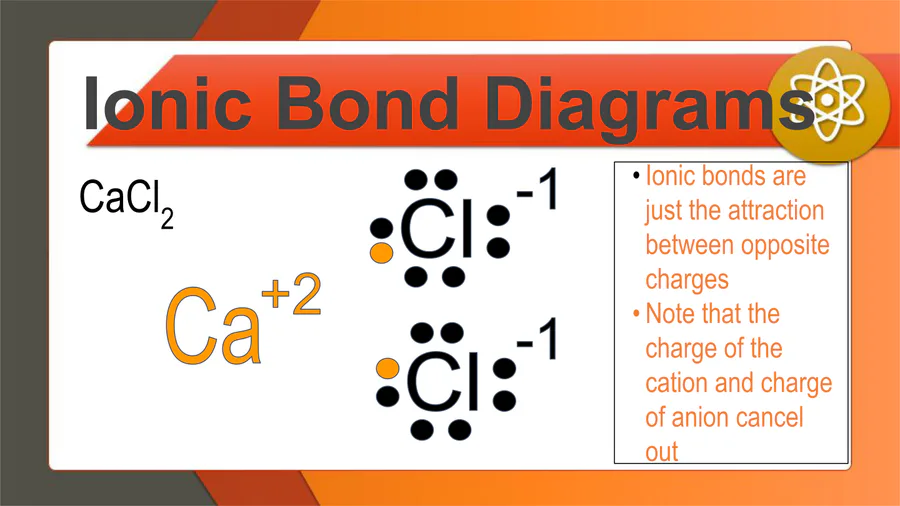
Is CaBr2 ionic or covalent?
Ionic
Covalent
68
Multiple Choice
What will happen to the electrons when a bond in CaBr2 is formed?
electrons will be transferred from one atom to another
electrons will be shared between two atoms
69
Multiple Choice
Which of the following shows the bonds that will form between the Ca and Br in the picture shown?
70
71
72
73
74
75
76
77
78
79
Categorize
High melting points
Solids at room temperature
Disassociates when dissolved in water
When dissolved in water, it can conduct electricity
Can also be called salts
Low melting points
Can be solids, liquids, or gasses at room temperature
Does not disassociate when dissolved in water
When dissolved in water, it does not conduct electricity
Can also be called molecules
Categorize the following properties as properties of ionic or covalent compounds. Make sure to copy this down in your packet.
First,
Polyatomics Practice
Show answer
Auto Play
Slide 1 / 79
SLIDE

Similar Resources on Wayground
75 questions
Evolution
Presentation
•
12th Grade
69 questions
Chapter 2: Chemistry of Life
Presentation
•
10th Grade
78 questions
Relative and absolute dating
Presentation
•
11th Grade
73 questions
Keanekaragaman Hayati di Indonesia
Presentation
•
10th Grade
71 questions
UCSP - Intro to Social Sciences
Presentation
•
11th Grade
74 questions
March 24-28 3D Shapes and Attributes
Presentation
•
KG
73 questions
Making Magma
Presentation
•
11th Grade
71 questions
3. Geologic Processes
Presentation
•
11th Grade
Popular Resources on Wayground
20 questions
"What is the question asking??" Grades 3-5
Quiz
•
1st - 5th Grade
20 questions
“What is the question asking??” Grades 6-8
Quiz
•
6th - 8th Grade
10 questions
Fire Safety Quiz
Quiz
•
12th Grade
20 questions
Equivalent Fractions
Quiz
•
3rd Grade
34 questions
STAAR Review 6th - 8th grade Reading Part 1
Quiz
•
6th - 8th Grade
20 questions
“What is the question asking??” English I-II
Quiz
•
9th - 12th Grade
20 questions
Main Idea and Details
Quiz
•
5th Grade
47 questions
8th Grade Reading STAAR Ultimate Review!
Quiz
•
8th Grade
Discover more resources for Science
5 questions
Evolution (Darwin)
Interactive video
•
9th - 12th Grade
16 questions
Taxonomy and Classification
Quiz
•
6th - 12th Grade
15 questions
Explore Genetics with Punnett Squares and Pedigree Charts
Quiz
•
9th - 12th Grade
20 questions
4.1 Biology STAAR review
Quiz
•
9th - 12th Grade
17 questions
Understand Codominance and Incomplete Dominance
Quiz
•
9th - 12th Grade
28 questions
Biology STAAR Rapid Review
Quiz
•
9th - 12th Grade
20 questions
Population Ecology
Quiz
•
11th Grade
7 questions
Acids and Bases
Presentation
•
9th - 12th Grade