

C2.1 Chemical Signalling (IB Biology)

Presentation
•
Biology
•
12th Grade
•
Easy

Shamara West
Used 8+ times
FREE Resource
49 Slides • 18 Questions
1
By Shamara West
2
OVERVIEW OF UNIT
What is this unit about?
This unit focuses on how cells communicate using chemical signals to coordinate functions in both unicellular and multicellular organisms. You will explore ligand-receptor interactions, signal transduction pathways, and how signaling molecules like hormones, neurotransmitters, cytokines, and calcium ions trigger cellular responses.
It covers various receptor types (transmembrane and intracellular), feedback regulation, and real-world examples such as quorum sensing in bacteria, epinephrine action, and insulin signalling. The unit emphasizes the diversity, specificity, and integration of chemical signals in maintaining homeostasis and coordination across body systems.
3
How do cells interact with each other?
Cells interact with each other by sending and receiving signals.
Signals can be electrical eg. nerve impulse or chemical eg. ligand. Ligands are chemical signaling molecules that bind specifically to a site on another molecule! (You must be able to use the term 'ligand' for the signaling chemical). Write a note on what ligand is.
4
Ligands are made by one cell and bind to receptors in another cell. Receptors are proteins, with binding sites to which the chemical signaling molecule binds. Write notes on what are receptors.
Binding causes changes in receptor which stimulates a response to the signal by the target cell. (Review: B2.1.14 AHL Gated ion channels in neurons. Go read this over!)
For example, acetylcholine is a neurotransmitter substance that functions as a chemical signaling molecule because when it binds to receptors in the cell membrane of postsynaptic neuron it causes the membrane of the neuron to become more permeable to sodium ions resulting in generation of an action potential by the postsynaptic neuron.

5
Despite these similarities, there are numerous differences. Make notes from the table on the following slide!
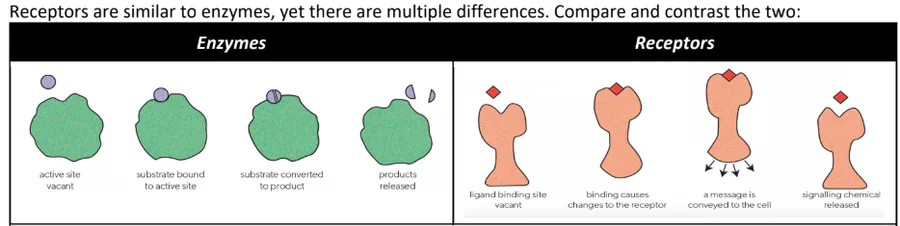
6
Receptor vs Enzymes

7
What is a quorum? What is quorum sensing?
A quorum is a fixed number of individuals needing for a meeting or proceeding to go ahead. (For example, 2/3s of UN security council members are required to be present for a meeting to be facilitated). In the context of biology, quorum is the minimum number of organisms (minimum population size) that needs to be present in order for a certain response to be produced.
Quorum sensing, is a cell to cell communication process used by bacteria (as a group) to respond a certain way based on changes in their population density (number of bacteria present). Write note on what is quorum sensing.
8
Multiple Choice
Which of the following best describes quorum sensing in bacteria?
A. A process where bacteria randomly release toxins to infect a host.
B. A communication method where bacteria detect and respond to their population density.
C. A defense mechanism that helps bacteria escape antibiotics.
D. A process where bacteria use light to generate energy.
9
1. Bacteria Release Signaling Molecules
Each bacterial cell produces and secretes small molecules known as autoinducers (signalling molecule) into the surrounding environment.
Accumulation of Autoinducers
As the bacterial population grows, the concentration of autoinducers increases.
Detection of Threshold Concentration
Once the population reaches a critical density (a “quorum”), the concentration of autoinducers reaches a threshold level, allowing bacteria to detect them.
10
4. Gene Activation and Coordinated Behavior
When autoinducers bind to specific receptors in bacterial cells, they activate genes (promoting transcription) that regulate group behaviors like:
Examples: 1. High density of bacteria on the teeth secrete glue like chemicals on the teeth; bacteria stick to the chemicals in a layer called a biofilm.
Bioluminescence in Vibrio fisceri. Go to pg. 415 of your text; Biology, Course Companion. The syllabus objective requires that you to learn of Quorum Sensing in Bioluminescence in Vibrio fischeri!

11
Replace this with a sub-header that can be in multiple lines.

12
Hormones
Hormones are chemicals produced by ductless glands called endocrine glands; they are released in small amounts into the blood stream (capillaries)
The bloodstream carries the hormone all over the body; hormones have effects only on cells (target) with receptors for them.
Upon binding to their target cells, the hormone regulates the cells' activities by promoting or inhibiting specific processes eg. oestrogen binds to receptors on lining of uterus and restimulate its repair and regrowth during first couple days of the menstrual cycle.
13
Open Ended
Write the names of 3 - 5 other hormones that you know the names of:
14
Match
Match each hormone to its endocine gland that makes it:
insulin
testosterone
FSH (follicle stimulating hormone)
thyroxine
melatonin
pancreas
testis
pituitary gland
thyroid gand
Pineal gland
pancreas
testis
pituitary gland
thyroid gand
Pineal gland
15
Calcium Ions as Signalling Molecules for Muscle Fibres
Are used for cell signalling in both muscle fibres and neurons.
Muscle cells release calcium ions from its sarcoplasmic reticulum when the cells receive nerve impulses.
These calcium ions diffuse out and bind to proteins eg. troponin which moves out the way allowing muscle contraction to occur.
(Troponin would normally be blocking binding sites on muscles to prevent contraction)
16
Calcium ions are essential for neurotransmitter release at the synapse. Here's how it works:
Action potential arrives at the axon terminal of the neuron.
Voltage-gated calcium channels open, allowing Ca²⁺ ions to enter the neuron from the extracellular space.
Calcium triggers vesicle fusion with the presynaptic membrane.
As a result, neurotransmitters are released into the synaptic cleft.
Neurotransmitters bind to receptors on the postsynaptic neuron, continuing the signal.
Calcium is quickly removed from the cytoplasm via pumps and exchangers to reset the neuron
Calcium Ions as a Signalling Molecule for Neurons
17
Neurotransmitters
Neurotransmitters are chemical molecules that allow nerve cells (neurons) to communicate with each other. They are released from vesicles of presynaptic neuron.
They transmit signals across a synapse, 20 - 40nm (the tiny gap between neurons) to send messages throughout the brain and body. Neurotransmitters travel short distances to the postsynaptic neuron (target) and so, convey their signal much more quickly than hormones.

1. Neuron releases neurotransmitters from its axon terminal. 2. Neurotransmitters cross the synapse and bind to receptors on the next neuron. 3. The signal is transmitted, causing an effect like muscle movement, mood changes, or pain perception. 4 Neurotransmitters are either broken down by enzymes or reabsorbed by the original neuron (reuptake).
18
Cytokines
These are small proteins eg. interleukins, interferons that act as signaling chemicals.
They are secreted by a wide range of cells eg. lymphocytes, mast cells, fibroblasts.
Unlike hormones, cytokines are not transported very far so they act either on the cell that produced them or on nearby cells.
They act by binding to receptors in the target cell's cell membrane.
This binding a cascade of signaling inside the target cell which leads to changes in gene expression and cell activity. Cytokines are involved in immune responses such as inflammations.
19
Open Ended

Complete the table by commenting on each feature of each type of signaling chemical.
20


21
Chemical diversity of hormones and neurotransmitters

22
Open Ended
Considering all you have been learning about signaling molecule, Write at least 1 feature of a signaling molecule.
23
Some signalling molecules are transported very short distances and so, have a localized effect.
For example, neurotransmitters are released into the synaptic cleft which is approximately 20 - 40 nm in diameter. The neurotransmitter clearly does not travel far in order to reach the postsynaptic neuron to bind o receptors on it.
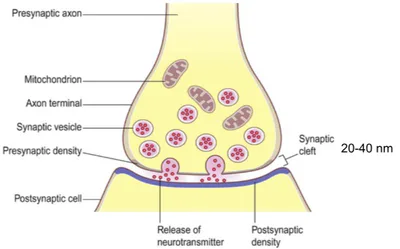
24
Some signalling molecules have a distant effect
Hormones are transported long distances from the cells that secrete them.
Hormones are transported in the bloodstream away from their secreting glands and towards their target cells which could be anywhere in the body.
For example, FSH and LH are made by the pituitary gland of the brain but they affect the ovaries of females and the testis of males.
These target organs are a good distance away from the brain!
25
Hormones have distant effects!
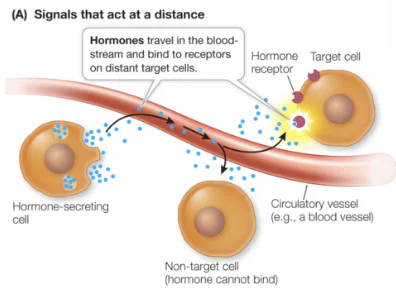
26
Open Ended
True or False: Hormones a close/localized effect:
27
Open Ended
True or False: Neurotransmitters have a far or distant effect.
28

29
Are found in the cytoplasm and/or nucleus.
The signaling chemical eg. steroid hormone for these penetrate into target cell
They are made up of mostly hydrophilic amino acids so they can remain dissolved in the aqueous solutions of the cytoplasm and nucleus.
Intracellular Receptors
These are protein molecules eg. integral proteins embedded in the cell membrane of the target cell.
Signaling molecule eg. peptide hormones for these do not penetrate into cell
These have hydrophobic amino acids on their surface so they attach to the hydrophobic tails of the phospholipids in the membrane's core; but they have hydrophilic amino acids on their sides interacting with the cytoplasm and external solution.
Transmembrane receptors
Signalling chemicals can be divided into two groups, according to whether they enter the target cell or not!
Write notes on the different receptors for signaling molecules.
30
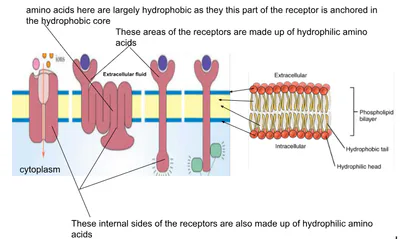
Diagram Showing the Distribution of Hydrophilic and Hydrophobic Amino Acids in Transmembrane Receptors (You ought to be able to describe. Make your notes about distribution of the amino acids)
31

Signaling molecules (peptide) whose receptors are transmembrane do not enter the target cell. However, for intracellular receptors, the (steroid) signaling molecules of these pass through the cell membrane and enter into cell.
Make your notes.
32
Transmembrane vs Intracellular receptors

33
Multiple Choice
Which statement best describes the distribution of hydrophilic and hydrophobic amino acids in transmembrane and intracellular receptors?
Transmembrane receptors have hydrophobic amino acids in their extracellular and intracellular regions;hydrophilic regions embedded in the plasma membrane.
Intracellular receptors have hydrophilic amino acids for lipid liking molecule binding and hydrophobic regions for interacting with the cytoplasm/nucleus.
Transmembrane receptors have hydrophobic regions in the plasma membrane and hydrophilic regions exposed to the extracellular and intracellular environments.
Intracellular receptors are embedded in the plasma membrane, binding hydrophilic signaling molecules with hydrophobic regions exposed to the cytoplasm.
34
Multiple Choice
Which statement correctly describes the interaction of signaling chemicals with transmembrane and intracellular receptors?
Transmembrane receptors bind to signaling chemicals that remain outside the cell, while intracellular receptors interact with chemicals that penetrate the cell membrane
Transmembrane receptors interact with signaling chemicals that penetrate the cell membrane, while intracellular receptors bind to chemicals that remain outside the cell
Both transmembrane and intracellular receptors bind to chemicals that penetrate the cell membrane.
Both transmembrane and intracellular receptors bind to chemicals that remain outside the cell
35
Students should understand that the binding of a signalling chemical to a receptor sets off a sequence of responses within the cell.
Binding of a signalling molecule to a receptor causes a sequence of interactions in the cell, called a signal transduction pathway. Transmembrane and intracellular receptors use different transduction pathways!

Go to pg. 420 in Biology, Course Companion Text. Make your notes!
36
Signal Transduction Offset by Transmembrane Receptors: These receptors are located in the plasma membrane and typically bind to hydrophilic signaling molecules (e.g., peptides, proteins, or neurotransmitters) that cannot cross the lipid bilayer of the cell membrane.
Ligand Binding: The signaling molecule (ligand) binds to the extracellular section of the transmembrane receptor.
Conformational Change: The binding causes a conformational change in the receptor's structure.
Activation of Intracellular Section: The intracellular domain of the receptor is activated, often involving the activation of G-proteins, protein kinases, or second messengers.
37
Signal Amplification: This activation typically triggers a cascade of signaling events inside the cell (e.g., phosphorylation of proteins, increase in second messengers like cAMP)
Cellular Response: The signaling cascade ultimately leads to a cellular response, such as metabolic changes, or ion channel opening

eg. when acetylcholine binds to its receptors on the postsynaptic neuron and gated sodium ion channel proteins open and sodium ions diffuse quickly into the neuron.
38
Signal Transduction Pathway as Offset by Intracellular Receptors
Intracellular receptors are located in the cytoplasm or nucleus and interact with lipophilic signaling molecules (e.g., steroid hormones) that can cross the plasma membrane due to their hydrophobic nature.
Ligand Entry: The signaling molecule (ligand) passes through the plasma membrane due to its lipophilic (lipid loving) nature.
Ligand Binding: The ligand binds to the intracellular receptor, which is usually located in the cytoplasm or nucleus.
Receptor Activation: Ligand binding induces a conformational change in the receptor, activating it.
39
Movement of receptor-ligand complex to nucleus: The activated receptor-ligand complex often moves into the nucleus (if not already there).
Gene Expression Regulation: In the nucleus, the receptor-ligand complex binds to specific DNA sequences (hormone response elements) and regulates gene transcription, leading to changes in protein expression.

40
41
C2.1.8 Transmembrane receptors for neurotransmitters and changes to membrane potential (Use the acetylcholine receptor as an example. Binding to a receptor causes the opening of an ion channel in the receptor that allows positively charged ions to diffuse into the cell. This changes the voltage across the plasma membrane, which may cause other changes).
Neurotransitters are chemical signalling molecules that convey signals between neurons and between neurons and muscle cells.

42
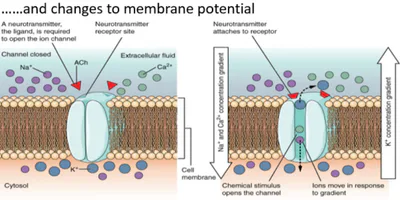
The ligand, in this case the neurotransmitter, acetylcholine (ACh) binds to its transmembrane receptor in the cell membrane of its target cell, musle cell fibre or postsynaptic/receiving neuron. This causes the receptor's shape to change which then causes sodium ion channel protein to open its channel and sodium ions move through via facilitated diffusion into the receiving neuron. This changes the membrane potential of the target cell such that it changes the charge of its cytoplasm from negative to positive charge resulting in generation of a nerve impulse in the postsynaptic neuron. Make your notes!
43
Fill in the Blanks
Acetylcholine is a type of ligand classified as a -----------------------
44
Open Ended
What is a ligand gated receptor?
45
Open Ended
Describe how neurotransmitters eg. ACh causes changes to the membrane potential of a neuron/muscle cell fibre. [4]
46
C2.1.9 Transmembrane receptors that activate G protein (You should understand how G protein-coupled receptors convey a signal into cells. They should appreciate that there are many such receptors in humans).
G protein coupled receptors are a diverse group of transmembrane receptors (in humans) that use a second protein called G protein to convey a signal into the target cell.
The G protein is kept inactive when a molecule of GDP (guanosine diphosphate) binds to it.
ACTIVATION of G PROTEIN
1. Ligand binds to the G protein coupled receptor in target cell's cell
membrane.
47
2. Conformational changes are triggered in the G protein.
3. GDP detaches from the G protein
4. GTP (Guanosine triphosphate) replaces the GDP and the G protein is now activated.
5. The activated G protein detaches from the G coupled receptor and dissociates into its subunits - α, β and γ
6. These subunits cause changes within the cell to bring about the cell's response to the ligand's signal. Makes your notes of 1-6.

In this example, the α subunit of the activated G protein binds to a second messanger (a protein in the cell membrane, for example) and together, they cause opening of ion channel.
48

Diagram showing Activation of G Protein upon Binding of Signaling Molecule to its G protein coupled transmembrane receptor.
Examples of GPCRs are opioid receptors, rhodopsin or adrenergic receptors.
49
Multiple Select
Signal is conveyed into a target cell by which transmembrane receptors
G protein
neurotransmitter
G coupled proteins
50
Multiple Choice
The ligand binding to a transmembrane receptor, deactivates G protein. True or False
True
False
51
Include the roles of a G protein and cyclic AMP (cAMP) as the second messenger.
Epinephrine (adrenaline) binds to G protein-coupled receptors on the surface of target cells, liver or muscle cells).
This binding causes a conformational change in the receptor, which activates a nearby G protein by replacing GDP with GTP on its α-subunit.
The activated G protein then stimulates the enzyme adenylyl cyclase, which converts ATP to cyclic AMP. (cAMP) — the second messenger. As a second messenger, cAMP is an intracellular signaling molecule
52
that has been made by the target cell upon binding of epinephrine (first messenger) to its receptor; its role is to pass on and amplify the signal relayed by epinephrine leading to cellular response by the liver/muscle cells. In other, involvement of a second messenger allows target cell to produce a rapid and amplified response under the effect of small amount of epinephrine.
cAMP activates protein kinase, which then phosphorylates target proteins/enzymes through a cascade of enzyme controlled reactions, triggering various cellular responses, such as: breakdown of glycogen to glucose molecules as in liver or muscle cells.
Make your notes detailing mechanism of epinephrine to include the role of G protein and cAMP.
53

This is the transduction pathway used by liver cells in response to epinephrine resulting in rapid conversion of glycogen to glucose which is released into the the blood.
54
Open Ended

Put into words the mechanism of action of epinephrine as a signaling molecule. Refer to diagram.
55
C2.1.11 Transmembrane receptors with tyrosine kinase activity
What is Kinase? Its an enzyme that catalyzes the phosphorylation of molecules by adding the phosphate group from ATP to this molecule.
For example, tyrosine kinase catalyzes the phosphorylation of the amino acid, tyrosine in protein molecules.
Kinases are inactively bound to transmembrane receptors. When a ligand binds to the receptors, kinase enzyme become active and phosphorylate molecules which trigger a series of reactions.
56
Transmembrane receptors with tyrosine kinase activity are used in blood glucose regulation involving the hormone, insulin. Insulin lowers blood glucose!
1. Insulin binds to the insulin transmembrane receptor (the tails of these are the
tyrosine kinase enzymes) in its target cell eg. liver cells.
2.There's a structural change in the receptors causing both enzymes to form a
dimer (a molecule made up of 2 smaller molecules - so both enzymes joining
forms a dimer)
3. Dimer becomes phosphorylated. Phosphorylation leads to responses/reactions.
4. For example, glucose transporters (channel proteins for glucose) are inserted in
the cell's membrane so the liver cell absorbs lots of glucose from the blood.
57
Diagram Showing Transmembrane receptors with Tyrosine Kinase Activity.
Make your notes by using the info on slide 56 (previous) to annotate this diagram.

58
Match
Match the mode of action caused by the ligand and a respective transmembrane receptor
Ligand (ACh) and transmembrane receptor
Ligand and G protein couple transmembrane receptor
Ligand and Epinephrine(adrenaline) receptors
Ligand and receptor with tyrosine kinase activity
Changes membrane potential of neuron/mus
Activation of G protein
Activated G protein and cAMP activation
Phosphorylation of molecules
Changes membrane potential of neuron/mus
Activation of G protein
Activated G protein and cAMP activation
Phosphorylation of molecules
59
60
C2.1.12 Intracellular receptors that affect gene expression

61
bind to transmembrane receptors in plasma membrane in target cells.
activates G protein; results in cAMP production; results in cascade of reactions
(cascade of reactions) mediated by a second messenger (inside the cell), cAMP;
this results in phosphorylation of molecules; activation of enzymes eg. tyrosine kinase;
Peptide Hormones
pass through the plasma membrane (of target cells);
bind to (intracellular receptor) receptor proteins in the cytoplasm OR form a receptor–hormone complex;
(receptor–hormone complex) enters the nucleus;
promotes the transcription of specific genes;
Steroid Hormones
62
C2.1.13 Effects of the Hormones - Oestradiol and Progesterone on Target Cells
Both hormones are involved in reproduction!

63
C2.1.14 Regulation of cell signalling pathway by positive and negative feedback
Regulation of chemical signaling is essential for maintaining homeostasis and ensuring that cellular processes function correctly. Regulation is important for key reasons such as: preventing overstimulation, ensures precise timing of responses, allows for adaptations to changes in the environment , allows for proper growth and development etc etc. Regulation of signalling pathway is achieved by feedback mechanisms eg. positive feedback and negative feedback.
Feedback is a regulatory process where the output or result of a system influences its own activity.
64
The output of a system reduces or suppresses its own activity. The cell signalling responses lead to making of end product; when it is increased to sufficient level it shuts of the signalling pathway leading to its own decreased production.
Negative
A process in which the output enhances or amplifies its own activity, leading to an increase in the end product. Cell signalling process produces an end product that amplifies cell signalling leading to more end product.
Positive
65
Open Ended
Go to pg. 427 in the Biology, Course Companion text and use the information to describe negative feedback regulation using the effect of testosterone as an example.
66
Open Ended
Go to pg. 426 in the Biology, Course Companion text and use the information to describe positive feedback regulation using the effect of signalling molecule inositol triphosphate (IP3) as an example.
67
By Shamara West
Show answer
Auto Play
Slide 1 / 67
SLIDE
Similar Resources on Wayground

61 questions
Photosynthesis part 2
Presentation
•
11th Grade
61 questions
Tok Natural Sciences Activity
Presentation
•
12th Grade
60 questions
Introduction to the Bats 2025
Presentation
•
12th Grade
60 questions
Cells and Cell Processes
Presentation
•
10th - 12th Grade
63 questions
Law of Supply
Presentation
•
12th Grade
65 questions
Formation of the Universe
Presentation
•
12th Grade
64 questions
Metabolism Chapter Review
Presentation
•
11th - 12th Grade
64 questions
EPF: Module 15 Presentation Budgeting 101
Presentation
•
12th Grade
Popular Resources on Wayground
10 questions
Safety Day 2026 – Student Review

Quiz
•
9th Grade
21 questions
Continents and Oceans
Quiz
•
6th Grade
20 questions
Parts of Speech
Quiz
•
5th Grade
16 questions
Subject & Predicate
Quiz
•
5th Grade
25 questions
Multiplication Facts
Quiz
•
5th Grade
12 questions
Map Skills
Quiz
•
3rd Grade
22 questions
Continents and Oceans
Quiz
•
5th Grade
15 questions
Rounding Decimals
Quiz
•
5th Grade
Discover more resources for Biology
20 questions
Cell Transport
Quiz
•
9th - 12th Grade
8 questions
DNA vs. RNA
Presentation
•
9th - 12th Grade
16 questions
Epithelial tissues
Quiz
•
11th - 12th Grade
15 questions
DNA Structure and Replication
Quiz
•
9th - 12th Grade
20 questions
Ecological Succession Review
Quiz
•
9th - 12th Grade
3 questions
Enzymes & Energy
Quiz
•
9th - 12th Grade
38 questions
Mitosis & Meiosis
Quiz
•
9th - 12th Grade
37 questions
DNA/RNA practice part 2
Quiz
•
9th - 12th Grade