
Unit 4 DBQ day 2

Presentation
•
History
•
9th - 12th Grade
•
Practice Problem
•
Medium

Isiah Jones
Used 3+ times
FREE Resource
9 Slides • 9 Questions
1
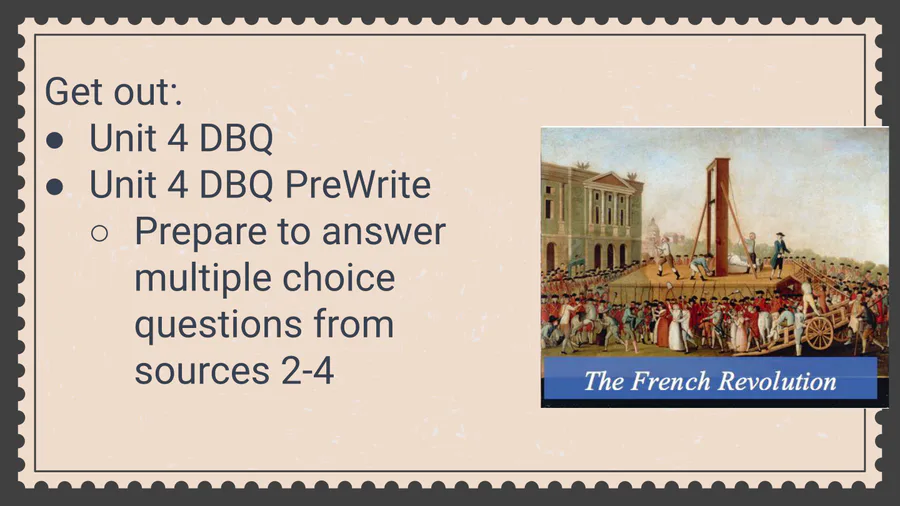
2
Multiple Choice
📌 Document 2: John Armitage’s History of Brazil (1836)
Question 1:
What was one of the major causes of revolutionary sentiment in Brazil, according to Armitage?
a) A desire to join the United States as a new state
b) Heavy taxation and economic hardship
c) An immediate push for democracy by all social classes
d) A strong alliance between Indigenous groups and European elites
3
Multiple Choice
📌 Document 2: John Armitage’s History of Brazil (1836)
Question 2:
What does the document suggest about the role of race in the independence movement in Brazil?
a) Only white inhabitants had political power, while people of color had little influence
b) Mixed-race individuals had full political rights and economic opportunities
c) Indigenous groups led the independence movement
d) Slavery had already been abolished before revolutionary ideas took hold
4
Multiple Choice
📌 Document 3: "The Female Patriots" by Hannah Griffitts (1768)
Question 3:
How does Hannah Griffitts challenge traditional gender roles in her poem?
a) By calling on women to physically fight in the revolution
b) By urging women to participate in boycotts and economic resistance
c) By encouraging women to stay silent and let men handle political matters
d) By asking the British government for more representation for women
5
Multiple Choice
📌 Document 3: "The Female Patriots" by Hannah Griffitts (1768)
Question 4:
What revolutionary strategy does Griffitts advocate in her poem?
a) Violent rebellion against British authorities
b) Forming secret political societies
c) Economic resistance, such as refusing to buy taxed goods
d) Negotiating peacefully with the British government
6
Multiple Choice
📌 Document 4: John Locke’s Second Treatise of Civil Government (1690)
Question 5:
According to Locke, what is the source of legitimate political power?
a) Divine right of kings
b) The consent of the governed
c) Military force and conquest
d) The wealth and status of the ruling class
7
Multiple Choice
📌 Document 4: John Locke’s Second Treatise of Civil Government (1690)
Question 6:
Which of the following best explains how Locke’s ideas influenced political revolutions?
a) His ideas were rejected by revolutionaries as too radical
b) His belief in absolute monarchy inspired new forms of government
c) His philosophy of natural rights and consent of the governed justified resistance to oppressive rule
d) His support for religious authority strengthened the power of kings
8

9
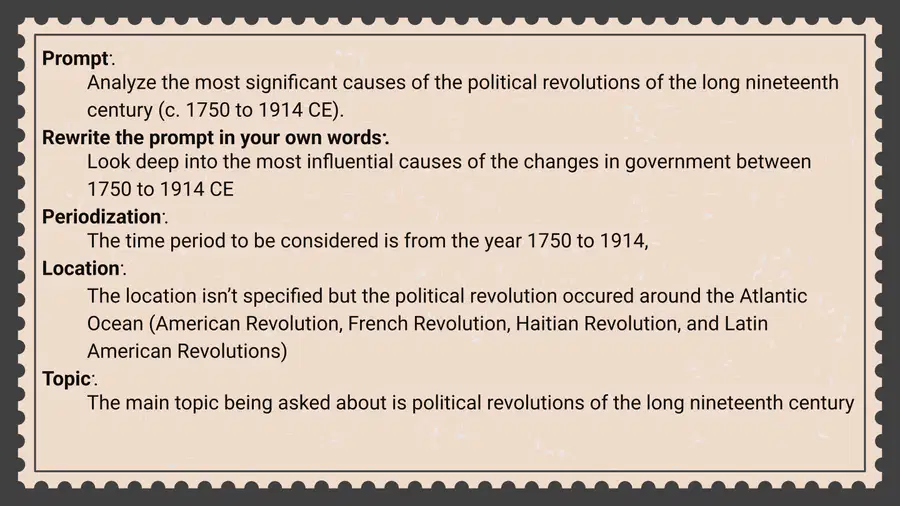
10
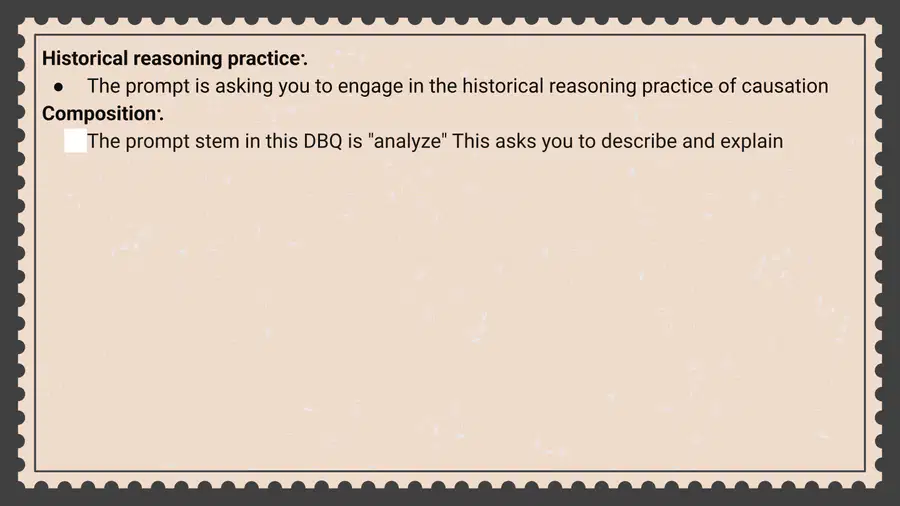
11
12
13
Multiple Choice
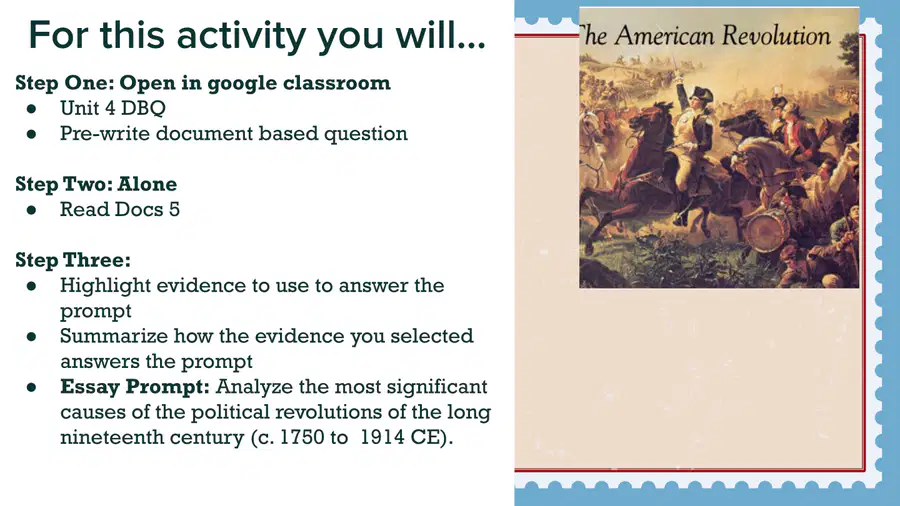
1. Based on Document 5 (The Code Noir), which of the following was a key cause of unrest among enslaved populations in the French colonies?
a) Enslaved people were allowed to own and sell property.
b) Enslaved people were heavily restricted and denied basic freedoms.
c) Enslaved people could meet freely to discuss their rights.
d) Enslaved people were able to vote under French colonial rule.
14
Open Ended
Write down the specific evidence you will use from the in response to the prompt. Remember to add quotes when needed.
15
Open Ended
summarize the evidence to answer the prompt
16
17
Exit Ticket
Thesis statement: topic, opinion, reasons
submit in google classroom
18

Show answer
Auto Play
Slide 1 / 18
SLIDE
Similar Resources on Wayground

14 questions
Evaluating Thesis Statements
Presentation
•
9th - 12th Grade
12 questions
Standard Deviation
Presentation
•
9th - 12th Grade
13 questions
The Space Race
Presentation
•
9th - 12th Grade
16 questions
The Holocaust
Presentation
•
8th - 12th Grade
13 questions
5 Themes of Geography
Presentation
•
9th - 12th Grade
12 questions
Molar Conversions
Presentation
•
9th - 12th Grade
14 questions
Trapezoids and Kites
Presentation
•
9th - 12th Grade
12 questions
Graphing Linear Inequalities Review
Presentation
•
9th - 12th Grade
Popular Resources on Wayground
5 questions
A Home on the Shore

Quiz
•
3rd Grade
28 questions
US History Regents Review
Quiz
•
11th Grade
6 questions
A Horse Tale
Quiz
•
3rd Grade
20 questions
Math Review
Quiz
•
3rd Grade
10 questions
Juneteenth History and Significance

Interactive video
•
5th - 8th Grade
20 questions
Dividing Fractions
Quiz
•
5th Grade
55 questions
A Long Walk to Water Final Review
Quiz
•
6th - 8th Grade
10 questions
Equation Word Problems
Quiz
•
7th Grade