
AKS 4c

Presentation
•
Chemistry
•
9th - 12th Grade
•
Easy
Standards-aligned

Marissa Brown
Used 1+ times
FREE Resource
10 Slides • 24 Questions
1
AKS 4C - Advantages and Disadvantages of Nuclear Chemistry
By Marissa Brown
2
Fission vs Fusion

3

4

A nuclear reaction is a process in which two nuclei, or a nucleus and an external subatomic particle, collide to produce one or more new nuclides.
Thus, a nuclear reaction must cause a transformation of at least one nuclide to another.
Fission and Fusion are two common types of Nuclear reactions
Nuclear Reaction
5

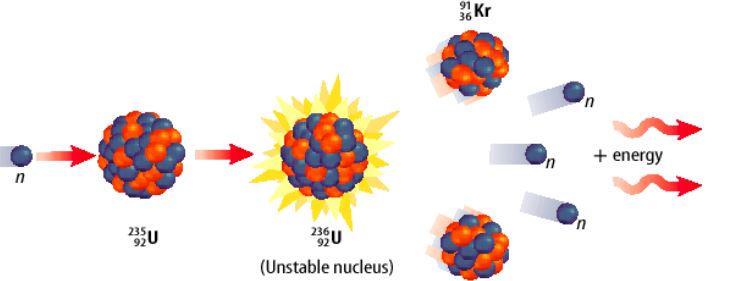
Nuclear fission occurs when a Large nucleus such as Uranium-235 is bombarded (hit) by an external sub-atomic particle, a neutron, causing it to become more unstable (Ur-236)
The unstable nucleus then splits to produce:
two smaller, more stable nuclei such as Ba and Kr;
3 neutrons that can then bombard more large atoms causing a chain reaction;
large amount of energy.
the mass of products is less than the mass of starting atom as some of the mass is converted into the energy produced.
23592U + n = 23692U (unstable)
followed by
23692U = 14456Ba + 89 36Kr + 3n + energy
Nuclear Fission-splitting of nucleus
6
A domino effect is created by this chain reaction that if not controlled, will go on indefinitely or until no more Uranium atoms are available.

7
Fission is used in:
Nuclear power plants as it produces much more energy than fossil fuels.
A small amount of reactants will yield much more energy than a thousand times more fossil fuels.
Used in atomic bombs and nuclear weapons.
Some text here about the topic of discussion.
Uses of Fission reactions
8
It creates harmful radioactive waste products that must be stored for a long time before it decays.
It is not a renewable energy source.
. It creates harmful waste products.
Can be dangerous and explosive if out of control.
High start up cost to control the process
Can cause mass destruction
Disadvantages
It can provide cheap energy resources for the planet.
It is a reliable source of energy.
Takes little energy to split two atoms in a fission reaction
It provides high concentrations of energy.
Advantages
Advantages and Disadvantages of Nuclear Fission
9

Nuclear Fusion occurs when two small nuclei such as H-2 and H-3, join to form a larger nucleus of greater mass, He-4.
This process requires extremely high temperatures and pressure and so naturally occurs in the sun and stars where these conditions are met.
The mass of the larger nuclei formed is less than the sum of the starting nuclei as some of the mass is converted to energy.
Produces more energy than fission.
Does not involve chain reactions.
2 1Deuterium + 3 1Tritium = 42He + 10n + energy
Nuclear Fusion- the joining of nuclei
10
Like fission, also produces radioactive waste. (most not affecting us on Earth as shielded in atmosphere).
No technology available to produce the extreme temperatures required for the process.
3. Energy produces inaccessible to man directly.
Disadvantages
Produces much more energy than fusion with little material.
Safer and cheaper method of producing energy with less radioactive waste
Advantages
Advantages and disadvantages of Nuclear Fussion
11
Draw
Put A Beside those relating to fission and B beside those for fusion.
12
Multiple Choice
Which reaction represents fission?
13
Multiple Choice
Which reaction represents fusion?
14
Multiple Choice

Which type of reaction does the diagram illustrate?
Fission
Fusion
Alpha Decay
Beta Decay
15
Multiple Choice
16
Multiple Choice
17
Multiple Choice
Nuclear fission is where...
two smaller atom nuclei fuse into one larger atom nucleus
two larger atom nuclei fuse into one smaller atom nucleus
one larger atom nucleus decays and breaks into two or more smaller atom nuclei
one smaller atom nucleus decays and breaks into two or more larger atom nuclei
18
Multiple Choice
Nuclear fusion
19
Multiple Select
What are some disadvantages to using nuclear fission? (pick two)
Releases harmful radiation
Able to produce a lot of power in a short amount of time
Fuel can be dangerous to work with
Low cost to operate
20
Multiple Select
Advantages of Nuclear power include:
Creates a lot of energy
Safer than coal (in the U.S.)
Involves harmful radioactive elements
Produces radioactive waste that must be stored
21
Multiple Select
Disadvantages of Nuclear power include:
Creates a lot of energy
Safer than coal (in the U.S.)
Involves harmful radioactive elements
Produces radioactive waste that must be stored
22
Multiple Choice
Two nuclei with low masses are combined to form one nucleus of larger mass is called what?
Nuclear fission
Nuclear fusion
Nuclear half-life
Half-life
23
Multiple Choice
24
Multiple Choice
25
Multiple Choice
26
Multiple Choice
27
Multiple Choice
28
Multiple Choice
29
Multiple Choice
30
Multiple Choice
31
Multiple Select
What are some advantages to using nuclear fusion? (pick two)
Almost no waste
requires larger amounts of energy to use
Nearly unlimited fuel source
Expensive
32
Multiple Select
What are some disadvantages to using nuclear fusion? (pick two)
Almost no waste
requires larger amounts of energy to use
Nearly unlimited fuel source
Expensive
33
Multiple Select
What are some advantages to using nuclear fission? (pick two)
Releases harmful radiation
Able to produce a lot of power in a short amount of time
Fuel can be dangerous to work with
Low cost to operate
34
Multiple Select
What are some disadvantages to using nuclear fission? (pick two)
Releases harmful radiation
Able to produce a lot of power in a short amount of time
Fuel can be dangerous to work with
Low cost to operate
AKS 4C - Advantages and Disadvantages of Nuclear Chemistry
By Marissa Brown
Show answer
Auto Play
Slide 1 / 34
SLIDE
Similar Resources on Wayground

28 questions
Food Chains and Webs
Presentation
•
9th - 12th Grade
30 questions
Atomic Theory History
Presentation
•
9th - 12th Grade
24 questions
Nuclear Decay
Presentation
•
9th - 12th Grade
24 questions
Gas Laws Lesson - Part 1
Presentation
•
9th - 12th Grade
25 questions
Heat & Heat Transfer
Presentation
•
9th - 12th Grade
27 questions
Introduction to Stoichiometry Day 1
Presentation
•
9th - 12th Grade
30 questions
Chem04 Quantum Shells, Subshells, Orbitals
Presentation
•
9th - 12th Grade
27 questions
Bonding Day 1 - Bonding Basics
Presentation
•
9th - 12th Grade
Popular Resources on Wayground
19 questions
Naming Polygons

Quiz
•
3rd Grade
10 questions
Prime Factorization
Quiz
•
6th Grade
20 questions
Math Review
Quiz
•
3rd Grade
15 questions
Fast food
Quiz
•
7th Grade
20 questions
Main Idea and Details
Quiz
•
5th Grade
20 questions
Context Clues
Quiz
•
6th Grade
20 questions
Inferences
Quiz
•
4th Grade
19 questions
Classifying Quadrilaterals
Quiz
•
3rd Grade
Discover more resources for Chemistry
34 questions
Unit 11 Acids and Bases Test Review
Quiz
•
10th Grade
20 questions
Types of Chemical Reactions
Quiz
•
9th - 12th Grade
120 questions
2nd Semester Final Review
Quiz
•
11th Grade
25 questions
Unit 12 Thermochemistry Review
Quiz
•
10th Grade
22 questions
Solubility Curve Practice
Quiz
•
10th Grade
25 questions
Solutions Test Review
Quiz
•
10th Grade
12 questions
IP PreAP: Fission and Fusion Reactions
Quiz
•
10th - 12th Grade
22 questions
Unit 8- Chemical Reactions
Quiz
•
10th Grade