

week 7: perception + attention

Presentation
•
Other
•
University
•
Hard

Liza Kim
Used 5+ times
FREE Resource
2 Slides • 11 Questions
1
By Liza Kim
2
Multiple Select
How is the Hermann Grid an example of lateral inhibition? Select all that apply then submit your answer.
It shows how on-center/off-surround receptive fields work.
Gray spots appear at the intersections because light in the surround makes it look darker.
Lateral inhibition increases sensitivity to dim light rather than contrast.
Lateral inhibition enhances contrast by inhibiting neighboring neurons.
3
Multiple Choice
Why do the dark spots in the Hermann Grid illusion disappear when you look directly at them?
Smaller receptive fields in the fovea reduce lateral inhibition.
The brain ignores peripheral stimuli when focusing on a single point.
Larger receptive fields in the fovea increase lateral inhibition at the intersections.
The visual system adapts to the pattern over time, causing the dark spots to fade.
4

5
Multiple Choice
What is the key difference between simple and complex cells?
Simple cells detect brightness, while complex cells detect corners.
Simple cells detect edges regardless of location, while complex cells detect edges at specific locations.
Simple cells detect edges at specific locations, while complex cells detect edges regardless of location.
Simple cells detect patterns, while complex cells detect objects.
6
Multiple Choice
How does sustained attention depend on selective attention?
Selective attention relies on sustained attention to filter stimuli.
Sustained attention maintains focus on what selective attention has identified as important.
Sustained attention and selective attention work independently.
Selective attention always happens involuntarily, while sustained attention requires effort.
7
Multiple Choice
What hypothesis on selective attention would be supported if a dog shifts focus from a nearby squirrel to their owner's voice after hearing their name?
Selective attention occurs at the earliest stages of sensory processing.
Attention is driven mostly by environmental cues.
The dog is relying on pre-attentive feature detection to isolate the sound of their name.
Selective attention occurs in later stages of sensory processing.
8
Multiple Choice
What is the difference between integrated search and simple search?
Integrated search happens automatically, while simple search uses focused attention to search item by item.
Integrated search requires combining 2 or more features, while simple search requires detecting only 1 feature.
Integrated search requires detecting only 1 feature, while simple search requires integrating 2 or more features.
Both require combining 2 or more features, but simple search is faster.
9
Multiple Select
Which of the following are examples of integrated search? Select all that apply then submit your answer.
Scanning through the lecture slides for information on a specific concept.
Looking for a specific term in the textbook’s glossary.
Finding text that is both bolded and underlined among other text that is either only bolded or underlined.
Finding highlighted text in the textbook.
10
Multiple Choice
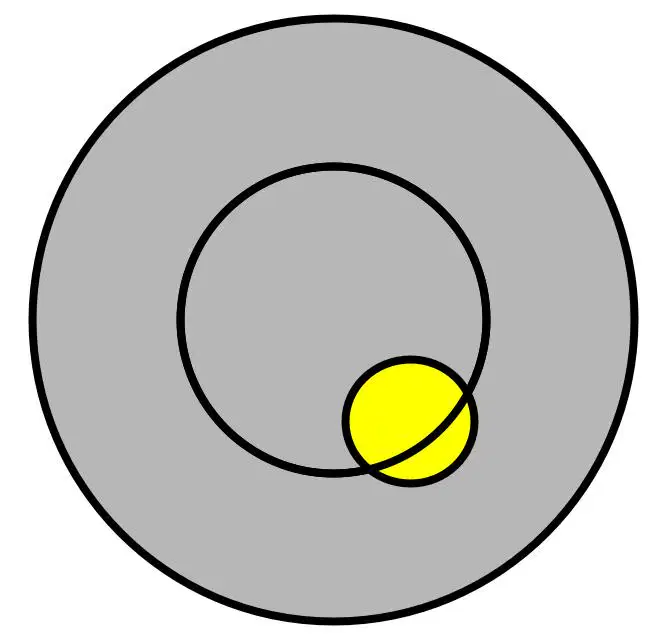
The image shows a spot of light covering more of the center than the surround portion of a contrast detector. How would the on-center/off-surround and off-center/on-surround cells respond?
The on-center cell would increase firing, and the off-center cell would decrease firing.
The on-center cell would decrease firing, and the off-center cell would increase firing.
Both would increase firing.
Both would show weak or no response.
11
Multiple Choice
As you move past a table, what would your hypercomplex cells detect?
The color of the table.
The corner of the table.
The overall shape of the table.
The texture of the table’s surface.
12
Multiple Choice
What was the main purpose of discussing the Hermann Grid, Waterfall Illusion, and Thatcher Effect in class?
To demonstrate how the eyes detect color and brightness.
To show that motion and contrast are processed independently.
To explain why visual processing happens in the retina, not the brain.
To show that the brain creates a model of the world that doesn’t always match reality.
13
Fill in the Blanks
In the visual system, smaller receptive fields are located in the
Type answer...
By Liza Kim
Show answer
Auto Play
Slide 1 / 13
SLIDE
Similar Resources on Wayground

10 questions
Burns
Presentation
•
University
10 questions
ORDER OF THE ADJECTIVES
Presentation
•
University
11 questions
Robotics
Presentation
•
University
11 questions
TOEIC Preparation
Presentation
•
University
10 questions
Team Building
Presentation
•
University
10 questions
Generalidades de Contabilidad de costos
Presentation
•
University
10 questions
How well does Lamarcus Know his big sister Kamiyah
Presentation
•
KG
9 questions
Week 8
Presentation
•
University
Popular Resources on Wayground
10 questions
Safety Day 2026 – Student Review

Quiz
•
9th Grade
21 questions
Continents and Oceans
Quiz
•
6th Grade
20 questions
Parts of Speech
Quiz
•
5th Grade
16 questions
Subject & Predicate
Quiz
•
5th Grade
25 questions
Multiplication Facts
Quiz
•
5th Grade
12 questions
Map Skills
Quiz
•
3rd Grade
22 questions
Continents and Oceans
Quiz
•
5th Grade
15 questions
Rounding Decimals
Quiz
•
5th Grade
Discover more resources for Other
20 questions
Disney Trivia
Quiz
•
University
10 questions
Spanish Greetings and Goodbyes!
Presentation
•
6th Grade - University
20 questions
Physical or Chemical Change/Phases
Quiz
•
8th Grade - University
39 questions
Unit 7 Key Terms
Quiz
•
11th Grade - University
25 questions
SER and Subject Pronouns
Quiz
•
8th Grade - University
38 questions
Unit 6 Key Terms
Quiz
•
11th Grade - University
19 questions
Key Concepts in Buddhism
Quiz
•
University
0 questions
Cell Domain Basic Review (Biology)
Quiz
•
University