

Ample Reserves (Quizizz)

Presentation
•
•
Hard

Karen Yancy
Used 4+ times
FREE Resource
49 Slides • 30 Questions
1

2

3

4

5

6

7

8
Fill in the Blanks
9
Fill in the Blanks
10
Fill in the Blanks
11

12

13
Multiple Choice
When the interest on reserve balances rate (IORB) is higher than the FFR, banks can
Lend at the IORB and borrow at the FFR, earning a profit on the difference
Lend at the FFR and borrow at the IORB, earning a profit on the difference
Borrow at the FFR and deposit at the IORB, earning a profit on the difference
Borrow at the IORB and deposit at the FFR, earning a profit on the difference
14

15
Multiple Choice
Because banks can deposit as many funds as they want in their reserve balance account at the Fed, if the interest on reserve balance rate (IORB) is higher than the FFR, then arbitrage will ensure that
The IORB rate falls to the FFR as banks seek to profit on the difference
The IORB rate falls while the FFR rises as banks seek to earn a profit on the difference
The FFR rises to the IORB rate as banks seek to profit from the difference
The IORB rate rises while the FFR falls as banks seek to earn a profit on the difference
16

17

18

19

20
Multiple Choice
What is the primary objective of an ample reserves policy?
Maximizing short-term profitability
Ensuring liquidity and financial stability
Minimizing tax liabilities
Accelerating capital expenditure
21

22
Multiple Choice
How can an ample monetary reserves policy help a country during times of economic crisis?
By stimulating consumer spending
By reducing government debt
By providing liquidity and stability to the financial system
By increasing taxes
23

24
Multiple Choice
If aggregate demand is growing faster than long-run aggregate supply, the Federal Reserve is most likely to
Increase the IORB
Increase bond prices
Increase income taxes
Decrease the discount rate
Decrease the RRR
25

26
Multiple Choice
If a banking system has ample reserves, which of the following is an action taken by the central bank that would cause a decrease in the cyclical rate of unemployment in the short run?
An increase in the RRR
An increase in the policy rate
An increase in the discount rate
A decrease in interest on reserves
A decrease in the personal income tax rates
27

28
Multiple Choice
The purchase of bonds by a central bank will have the greatest effect on real gross domestic product if which of the following situations exists in the economy?
The banking system has ample reserves,the RR is high, and the interest rate has a large effect on investment spending
The banking system has ample reserves,the RRR ishigh, and the interest rate has a small effect on investment spending
The banking system has limited reserves,the required reserve ratio is low, and the interest rate has a large effect on investment spending
The banking system has limited reserves,the RRR is low, and the MPC is low
The banking system has ample reserves,the MPC is high, and the interest rate has a small effect on investment spending
29

30
Multiple Choice
To reduce inflation, the central bank would be most likely to
Decrease the reserve requirement
Decrease the income tax rates
Buy government securities
Increase the supply of money
Increase its administered rates
31

32
Multiple Choice
For which of the following sets of unemployment and inflation rates will a central bank be most reluctant to decrease its administered interest rates? (unemployment rate/inflation rate)
U 10%; interest rate 2%
U 10%; interest rate 5%
U 10%; interest rate 10%
U 5%; interest rate 5%
U 5%; interest rate 10%
33

34
Multiple Choice
If the interest rate on short-term government bonds declined as a result of policy actions by a central bank, the central bank must have
Decreased its administered interest rates
Decreased the amount of currency in circulation
Sold government bonds to commercial banks
Increased the supply of bonds
Increased the discount rate on loans to commercial banks
35

36
Multiple Choice
An increase in administered interest rates will most likely change the nominal interest rate and aggregate demand in which of the following ways in the short run? [nominal interest rate (nir)/aggregate demand (AD)]
nir increase AD decrease
nir increase AD increase
nir increase AD not change
nir decrease AD decrease
nir decrease AD increase
37

38
Multiple Choice
Which of the following accurately describes the difference between how open market operations are used in a banking system with limited reserves compared to a banking system with ample reserves?
In a banking system with limited reserves, open market operations are used to maintain sufficient reserves, whereas in a banking system with ample reserves, open market operations are used to indirectly influence the nominal interest rate by changing the money supply.
In a banking system with limited reserves, open market operations are used to indirectly influence the nominal interest rate by changing the money supply, whereas in a banking system with ample reserves, open market operations are used to maintain sufficient reserves.
In a banking system with limited reserves, open market operations are used to directly adjust the nominal interest rate, whereas in a banking system with ample reserves, open market operations are used to indirectly influence the nominal interest rate by changing the money supply.
In a banking system with limited reserves, open market operations are used to indirectly influence the nominal interest rate by changing the money supply, whereas in a banking system with ample reserves, open market operations are used to directly adjust the nominal interest rate.
In a banking system with limited reserves, open market operations are a non-operational monetary policy tool, whereas in a banking system with ample reserves, open market operations are an operational monetary policy tool.
39

40

41

42

43
Draw
Assume that the economy of country Zen is in long run macroeconomic equilibrium.
a) Draw a correctly labeled graph of the aggregate demand, short-run aggregate supply, and long-run aggregate supply curves, and show each of the following.
The current equilibrium real output and price level, labeled Y1 and PL1 respectively
The full-employment output, labeled Yf
b) On your graph in part a, show the short run effect of an increase in consumer confidence. Label the new equilibrium real output Y2 and the new equilibrium price level PL2
44

45

46
Open Ended
c. Assume that the banking system in Zen has ample reserves. Suppose that the central bank’s goal is to maintain a stable price level at PL1. Based on the change in the price level shown in part b, identify one specific monetary policy action the central bank would take to achieve its goal.
47

48
Open Ended
d. Based on the monetary policy action identified in part c, will real output increase, decrease, or stay the same in the short run? Explain.
49

50

51

52
Draw
Assume that the economy of Eichland is operating below full employment. Draw a correctly labeled graph of long-run aggregate supply, short-run aggregate supply, and aggregate demand, and show each of the following.
Current equilibrium output and price level, labeled as Y1 and PL1
Full-employment output, labeled as Yf
53

54
Open Ended
b. Assume the banking system in Eichland has ample reserves and that the central bank targets a new policy rate to reach full employment. Should the central bank increase or decrease its administered interest rates?
55

56

57
Draw
c. Given the central bank action you identified in part (b), draw a correctly labeled graph of the reserve market and show the effect on the policy rate.
58

59

60
Open Ended
d. The policy makers pursue a fiscal policy rather than the monetary policy in part (b). Assume that the marginal propensity to consume is 0.8 and the value of the recessionary gap is $300 billion.
If the government changes its spending without changing taxes to eliminate the recessionary gap, calculate the minimum required change in government spending. Show your work.
61
Open Ended
d. The policy makers pursue a fiscal policy rather than the monetary policy in part (b). Assume that the marginal propensity to consume is 0.8 and the value of the recessionary gap is $300 billion.
If the government changes taxes without changing government spending to eliminate the recessionary gap, will the minimum required change in taxes be greater than, smaller than, or equal to the minimum required change in government spending in part (d)(i) ? Explain.
62

63
Open Ended
e. Assume the government lowers income tax rates to eliminate the recessionary gap. Will each of the following increase, decrease, or stay the same?
Aggregate demand. Explain.
Long-run aggregate supply. Explain.
64

65

66

67
Draw
Assume that the country of Zeetoland is in short-run equilibrium. The expected inflation rate is 4 percent, the actual rate of unemployment is 5 percent, the natural rate of unemployment is 6 percent, and the equilibrium real interest rate is 3 percent. Draw a correctly labeled graph of the AD, SRAS, and LRAS curves for Zeetoland, and show each of the following: the current equilibrium real output and price level, labeled Y1 and PL1 respectively, the full employment output labeled Yf.
68

69
Open Ended
b. Assume no policy action is taken to address the output gap in Zeetoland. Explain how the economy will adjust to full employment in the long run.
70

71
Open Ended
c. Assume instead that the central bank is concerned about the buildup of inflationary pressures in Zeetoland and is considering taking action to fight inflation. Assuming the banking system in Zeetoland has ample reserves, identify one monetary policy action the central bank would likely take.
72

73
Open Ended
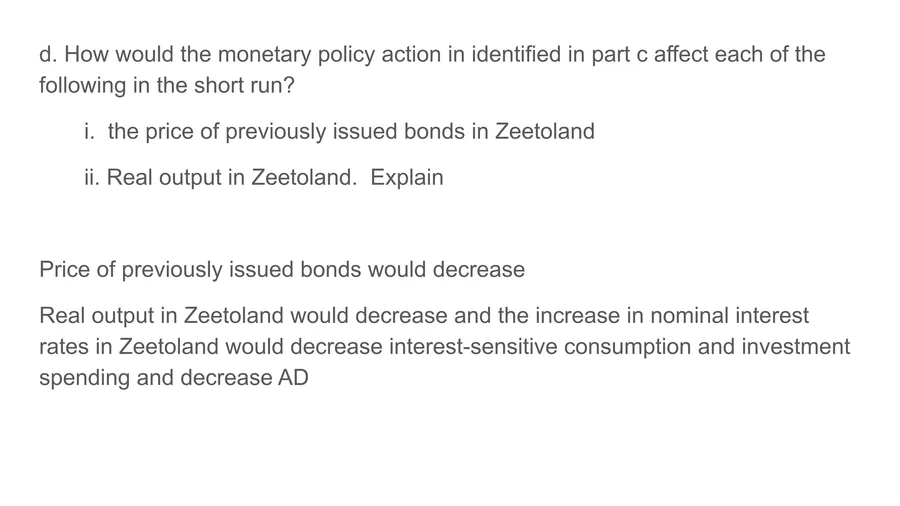
d. How would the monetary policy action in identified in part c affect each of the following in the short run?
i. the price of previously issued bonds in Zeetoland
ii. Real output in Zeetoland. Explain
74
75

76
Draw
e. Draw a correctly labeled graph of the foreign exchange market for Zeetoland’s currency, the zeet, and show the effect of the monetary policy action identified in part c on the demand and the exchange rate for the zeet.
77

78
Open Ended
f. Based on the change in the value of the zeet shown in part e, what happen to Zeetoland’s exports? Explain.
79

Show answer
Auto Play
Slide 1 / 79
SLIDE
Similar Resources on Wayground

75 questions
4th Grade: Review One
Presentation
•
4th Grade
74 questions
Intro to Binary Numbers
Presentation
•
6th - 8th Grade
70 questions
Unit 4 level 3
Presentation
•
University
78 questions
Part 2 EOC Review
Presentation
•
10th Grade
74 questions
04 Unit: Mexican National Era
Presentation
•
7th Grade
74 questions
Middle East Environmental Issues
Presentation
•
7th Grade
76 questions
Grade 9 General Reading Revision Tri 1
Presentation
•
9th Grade
75 questions
Motion Gr 7
Presentation
•
7th Grade
Popular Resources on Wayground
10 questions
Safety Day 2026 – Student Review

Quiz
•
9th Grade
21 questions
Continents and Oceans
Quiz
•
6th Grade
20 questions
Parts of Speech
Quiz
•
5th Grade
16 questions
Subject & Predicate
Quiz
•
5th Grade
25 questions
Multiplication Facts
Quiz
•
5th Grade
12 questions
Map Skills
Quiz
•
3rd Grade
22 questions
Continents and Oceans
Quiz
•
5th Grade
15 questions
Rounding Decimals
Quiz
•
5th Grade
Discover more resources for
10 questions
Safety Day 2026 – Student Review
Quiz
•
9th Grade
21 questions
Continents and Oceans
Quiz
•
6th Grade
20 questions
Parts of Speech
Quiz
•
5th Grade
16 questions
Subject & Predicate
Quiz
•
5th Grade
25 questions
Multiplication Facts
Quiz
•
5th Grade
12 questions
Map Skills
Quiz
•
3rd Grade
22 questions
Continents and Oceans
Quiz
•
5th Grade
15 questions
Rounding Decimals
Quiz
•
5th Grade