
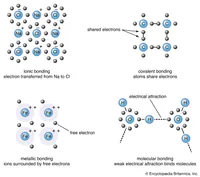
Chemical Bonds

Presentation
•
Science
•
7th Grade
•
Practice Problem
•
Hard

Boaz Rottet
Used 3+ times
FREE Resource
19 Slides • 2 Questions
1
Chemical Bonds
Learners can:
use Lewis structures to model valence electrons
identify the number and type of atoms present in a chemical formula

2
So........ we have been learning about chemical reactions where atoms bond with each other.
Why do you think atoms like to bond with each other?

3
4
5
The periodic table arranges elements according to their properties. The chart consists of:
rows called periods; and
columns called groups.
Elements in the same period or the same group have common characteristics.

6

7

8
9
Valence Electrons
An atom contains protons, neutrons, and electrons. The protons and neutrons are located in the solid nucleus in the center of the atom. The electrons orbit the nucleus in the space called the electron cloud. Electrons travel around the nucleus in layers called energy levels. A valence electron is an electron in the outermost energy level of an atom.

10

How many valence electrons do each of these elements have?


11
The periodic table is arranged so that elements with similar properties are in the same column. One of those properties is the number of valence electrons in an atom of an element. The elements in a column all have the same number of valence electrons.
Valence electrons are the electrons in the outside energy level of an atom. The number of valence electrons in an atom of an element is related to its group number.
Groups 1 and 2 have the same number of valence electrons as the group number.
Groups 13 through 18 have a number of valence electrons equal to the group number minus 10.

13
Atoms satisfy the octet rule by either gaining or losing electrons to make a complete outer shell.
If the number of valence electrons is less than 4, the element will typically lose electrons.
If the number of valence electrons is greater than 4, the element will typically gain electrons.
Atoms that gain or lose electrons form ions, or atoms with a positive or negative charge.
What would fluorine and lithium like to do with their valence electrons? Gain or lose?


14
A Lewis structure, or a Lewis diagram, is a model that shows the valence electrons surrounding the symbol for an element. Lewis structures are useful models because they help show why and how elements form chemical bonds.
To draw a Lewis model, follow these steps.
Write the symbol of the element.
Find the number of valence electrons using the group number.
Place dots to represent valence electrons. Place 1 dot on each side of the symbol (above, right, below, and left) until no valence electrons remain.
If there are more than 4 valence electrons, create pairs with the remaining dots.
15

16

17

18

19
Draw
Draw a Lewis Dot Structure for Sulfur!
20
The diagram below shows six ways to draw a Lewis diagram for sulfur. Each of the diagrams is a correct model. Note that each diagram contains 2 pairs of valence electrons and 2 single valence electrons.

21
Multiple Choice
Which of the following are valid Lewis structures for nitrogen?
Chemical Bonds
Learners can:
use Lewis structures to model valence electrons
identify the number and type of atoms present in a chemical formula
Show answer
Auto Play
Slide 1 / 21
SLIDE
Similar Resources on Wayground

17 questions
3.2 - Atomic Structure
Presentation
•
7th Grade
15 questions
Physical Chemical Changes
Presentation
•
7th Grade
18 questions
Asexual vs Sexual
Presentation
•
7th Grade
17 questions
Human Circulatory System
Presentation
•
7th Grade
15 questions
Heredity review
Presentation
•
7th Grade
16 questions
Theories vs Laws
Presentation
•
7th - 8th Grade
17 questions
Watershed Vocab
Presentation
•
7th Grade
17 questions
Physical and Chemical Properties
Presentation
•
7th Grade
Popular Resources on Wayground
20 questions
"What is the question asking??" Grades 3-5

Quiz
•
1st - 5th Grade
20 questions
“What is the question asking??” Grades 6-8
Quiz
•
6th - 8th Grade
10 questions
Fire Safety Quiz
Quiz
•
12th Grade
20 questions
Equivalent Fractions
Quiz
•
3rd Grade
34 questions
STAAR Review 6th - 8th grade Reading Part 1
Quiz
•
6th - 8th Grade
20 questions
“What is the question asking??” English I-II
Quiz
•
9th - 12th Grade
20 questions
Main Idea and Details
Quiz
•
5th Grade
47 questions
8th Grade Reading STAAR Ultimate Review!
Quiz
•
8th Grade
Discover more resources for Science
19 questions
Introduction to Properties of Waves
Presentation
•
6th - 8th Grade
16 questions
Interactions within Ecosystems
Presentation
•
6th - 8th Grade
20 questions
genetics, punnett squares, heredity
Quiz
•
7th Grade
16 questions
Photosynthesis and Cellular Respiration Review
Quiz
•
7th Grade
20 questions
Abiotic & Biotic Factors
Quiz
•
7th Grade
18 questions
Conduction Convection Radiation
Quiz
•
7th Grade
20 questions
Asexual/Sexual Reproduction
Quiz
•
7th Grade
5 questions
Natural Selection

Interactive video
•
7th Grade