Search Header Logo
Real Numbers

Real Numbers

Assessment

Presentation

Mathematics

Professional Development

Hard

Created by

Joseph Anderson

FREE Resource

10 Slides • 20 Questions

1

The Properties of Real Numbers

by Dr. Luis Bello
Slide image

2


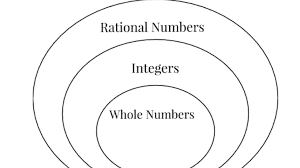
We have already described numbers as counting numbers, whole numbers, and integers. Do you remember what the difference is among these types of numbers?


3

Do you remember what the difference is among these types of numbers?

counting numbers 1,2,3,4…


whole numbers 0,1,2,3,4…


integers …−3,−2,−1,0,1,2,3,4…

4

Multiple Choice

An example of a whole number is:

1

4/9

2

-9

3

5.2

4

17

5

Multiple Select

Classify the number (choose all that apply): -20

1

positive number

2

whole number

3

integer

4

rational number

6

Multiple Choice

Question image

What is the best classification for this number? (how far down can you push this into the Venn Diagram)

10

1

none of these

2

whole

3

integer

4

rational

7

Multiple Choice

Question image

What is the best classification for this number? (how far down can you push this into the Venn Diagram)

-4

1

none of these

2

whole

3

integer

4

rational

8

Rational Numbers


A rational number is a number that can be written in the form p/q


where p

and q

are integers

and qo.

9

All fractions, both positive and negative, are rational numbers.

A few examples are:


4/5, −7/8, 13/4, and −20/3


10

Slide image

11

Multiple Choice

Is 100/36 a rational number?

1

Yes

2

No

12

Multiple Choice

Is 0 a rational number?

1

Yes

2

No

13

Multiple Choice

Is ⅔ a rational number?

1

Yes

2

No

14

Multiple Choice

Is 7\sqrt{7}  a rational number?

1

Yes

2

No

15

Irrational numbers

Are there any decimals that do not stop or repeat?


The number π (the Greek letter pi, pronounced ‘pie’), which is very important in describing circles, has a decimal form that does not stop or repeat.


π=3.141592654.......


A decimal that does not stop and does not repeat cannot be written as the ratio of integers. We call this kind of number an irrational number.

16

Slide image

17

Multiple Select

Identify the rational numbers. (Select all that apply)

1

4\sqrt{4}

2

π\pi

3

3.53.5

4

2\sqrt{2}

5

23\frac{2}{3}

18

Multiple Choice

Is the following number rational or irrational?

-17.5

1

Rational

2

Irrational

19

Multiple Choice

Is the following number rational or irrational?

√25

1

Rational

2

Irrational

20

Multiple Choice

Which number is a rational number?

1

1/4

2

π

3

√3

21

Multiple Choice

Which number is irrational?

1

9.6

2

√45

3

3/8

4

3.4 x 10 ⁵

22

Multiple Choice

Is -32 a rational number?

1

Yes

2

No

23

Slide image

24

Multiple Choice

12 + 7 = 7 + 12 
What property is this? 
1
Commutative Property of Addition
2
Commutative Property of Multiplication
3
Distributive Property
4
Identity Property of Addition

25

Multiple Choice

Commutative Property of Multiplication
1
8 + 2 = 2 + 8
2
7 x 1 = 7
3
7 + 0 = 7
4
7 x 6 = 6 x 7

26

Multiple Choice

Name the property showed by the following statement.
(3 x 3)5 = 5(3 x 3)
1
Commutative Property
2
Associative Property
3
Distributive Property
4
Multiplication Property of One (Identity)

27

Slide image

28

Multiple Choice

Which of these illustrates the Associative Property of Multiplication?
1
4x(5x6)=(4x5)x6
2
6+(9+1)=(6x9)+1)
3
4 x (56) = (45) x 6
4
5 + 0 = 0 + 5

29

Multiple Choice

Which is an example of Associative Property of Addition?
1
(12+3)+8=12x(3x8)
2
12x(3x8)=(12x3)x8
3
(12+8)+3=12+(8+3)
4
12 + 18 = 18 + 12

30

Multiple Choice

(30 + 20) + 60 = 30 + (20 + 60)

1

Associative Property of Addition

2

Associative Property of Multiplication

3

Commutative Property of Addition

4

Commutative Property of Multiplication

The Properties of Real Numbers

by Dr. Luis Bello

Slide image

Show answer

Auto Play

Slide 1 / 30

SLIDE