Surface Water
Presentation
•
Science
•
6th - 8th Grade
•
Hard

Joseph Anderson
FREE Resource
30 Slides • 34 Questions
1
Surface Water
Lesson 2
Pg 372-378
2
Multiple Choice
3
Multiple Choice
Water above Earth's surface is called
tributary
surface water
watershed
groundwater
4
Multiple Choice
5
Multiple Choice
Look closely at the map of the watershed below. If water enters the watershed at the top of the mountain where the arrow is pointing, at which point will it stop draining?
Point A
Point B
Point C
Point D
6
Multiple Choice
Where are you most likely to find a watershed?
In a lake
On a mountain top
At the bottom of a valley
Everywhere
7
Multiple Choice
What definition BEST describes a watershed?
An area where water infiltrates the soil
An area where aquatic plants and animals thrive
An area where snow melts and changes into liquid water
An area that collects precipitation and drains it to the lowest point
8
Please read pages 372-375 that
focuses on rivers and watersheds.
9
Pg 372
10
Pg 372
11
Pg 373
12
Pg 373
13
Pg 374
14
Pg 374
15
Pg 375
16
Pg 375
17
Multiple Choice
Which of the following models BEST represents how water flows in a watershed?
A
B
C
D
18
Multiple Choice
Which statement about water pollution is TRUE?
Pollution only affects surface water.
Pollution cannot be dissolved in water.
Pollution affects both surface and groundwater.
Pollution cannot travel through soil to groundwater.
19
Multiple Choice
Runoffs recharge lakes and streams.
True
False
20
Multiple Choice
Rapid growth of algae in a pond is often the result of -
loss of habitat due to commercial building.
flooding that causes water levels to rise.
excess nutrients from fertilizer runoff.
clogged river tributaries entering a lake.
21
Multiple Choice
The picture shown is an example of______
runoff
point source water pollution
nonpoint source water pollution
ground water
22
Multiple Choice
How were the great lakes formed?
They are the remains of the bathwater of dinosaurs.
They were formed due to cracks in the earth.
They were formed from the remains of glaciers from the last ice age.
They were formed as a result of global warming.
23
Multiple Select
How are lakes and ponds formed?
Glaciers carving a basin
Earthquakes or volcanoes
Twisting rivers or oxbow lakes
All of the above
24
Multiple Choice
What is the difference between lakes and ponds?
Lakes are bigger and deeper than ponds
Ponds are bigger and deeper than lakes
Lakes have more plants and animals than ponds
Ponds have more plants and animals than lakes
25
Multiple Select
What is the main source of water for lakes and ponds?
Rainwater
Underground aquifers
Rivers and streams
All of the above
26
Please read pages 376-379 that
focuses on lakes & ponds.
27
Pg 376
28
Pg 377
29
Pg 377
30
Pg 378
31
Pg 378
32
Pg 379
33
Pg 379
34
Multiple Select
What is the role of plankton in lakes and ponds?
They are microscopic plants that produce food and oxygen
They are tiny creatures that eat algae
They are food for larger animals
All of the above
35
Multiple Select
How does pollution affect lakes and ponds?
Pesticides from crops can contaminate the water
Fertilizers from lawns can cause excessive plant growth
Air pollution can lead to acid rain
All of the above
36
Ground Water
Lesson 3
380-385
37
Please read pages 380-385 that
focuses on groundwater.
38
Multiple Choice
In the diagram, letter A best represents:
Runoff
Watershed
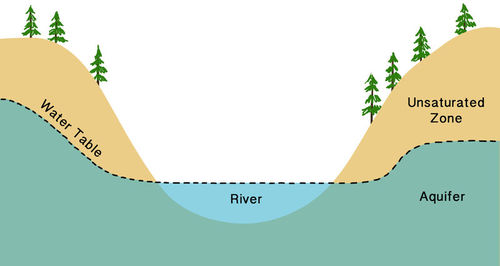
Water Table
Confining Layer
39
Multiple Choice
During the process of infiltration, water seeps through the ground and into an aquifer. Which of the following terms best describes this process?
Recharge
Discharge
Depletion
Surcharge
40
Multiple Choice
41
Multiple Choice
Aquifer – a permeable rock layer than can hold or transport water
True
False
42
Multiple Choice
If a well is over-pumped... what could happen?
there will be more groundwater
less groundwater + aquifers will dry out
the water table does not change
43
Multiple Choice
All bodies of fresh water, salt water, ice, and snow that are found above ground
Groundwater
Surface water
Runoff
Swimming pool
44
Pg 380
45
Pg 380
46
Pg 381
47
Pg 382
48
Pg 382
49
Pg 382
50
Pg 383
51
Pg 383
52
Pg 384-385
53
Pg 385
54
Multiple Choice
Which of the following implies the same thing as the word "aquifer"?
zone of saturation
zone of aeration
zone of soil moisture
zone of twilight
55
Multiple Choice
The top of an aquifer is known as:
the water table.
an artesian well.
the hydraulic gradient.
a geyser.
56
Multiple Choice
The two factors that influence the curved route of infiltrated water flow underground are:
gravity and hydraulic pressure.
gravity and electromagnetism.
the Coriolis Effect and the prevailing winds.
permeability and non-permeability.
57
Multiple Choice
How would the porosity of the poorly sorted sediment compare to the well sorted sediment?
It would be greater in the poorly sorted sediment
It would be less in the poorly sorted sediment
It would be the same in both
58
Multiple Choice
What is the best definition of a water table?
The level to which a river rises when it floods
The boundary between the land and the ocean
The top of the saturated zone in an aquifer
The bottom of the saturated zone in an aquifer
The top of the unsaturated zone in an aquifer
59
Multiple Choice
What would cause the water table to lower?
High rates of evaporation and transpiration
Low rates of evaporation and transpiration
Increasing amounts of runoff
A heavy rainstorm with a lot of precipitation
60
Multiple Choice
What is infiltration?
The process by which water sinks into the ground
The zone where there are still air spaces left between the particles.
The process by which water vapor turns into liquid water and forms fog or clouds.
The process by which water does not sink into the ground, but rather travels along the surface.
61
Multiple Choice
Which soil would have the greatest permeability rate after a rainstorm?
sand (0.02 cm)
silt (0.002 cm)
clay (0.0002 cm)
62
Multiple Choice
These containers have the same volume of beads which are representing soil particles. What is the relative porosity and permeability of each?
The container on the left has the higher permeability and porosity
The container on the right has the higher permeability and porosity
The container on the left has the higher permeability, but they both have the same porosity
The container on the right has the higher permeability, but they both have the same porosity
63
Multiple Choice
Which surface would have the most runoff from it after a rainstorm?
64
Multiple Choice
Which surface would be impermeable?
Surface Water
Lesson 2
Pg 372-378
Show answer
Auto Play
Slide 1 / 64
SLIDE

Similar Resources on Wayground
58 questions
Phase Change @Home Lesson 2 Slides
Presentation
•
6th - 8th Grade
56 questions
Properties of Minerals Guided Lesson
Presentation
•
6th - 8th Grade
56 questions
LEGO My Element!
Presentation
•
6th - 8th Grade
61 questions
Matter Unit Powerpoint Review
Presentation
•
6th - 8th Grade
58 questions
Mitosis vs Meiosis
Presentation
•
7th Grade
59 questions
8th-T3 L1: Movement in Space
Presentation
•
6th - 8th Grade
61 questions
Plate Motion @Home Lesson 13 Slides
Presentation
•
6th - 8th Grade
60 questions
Heredity Lesson
Presentation
•
6th - 8th Grade
Popular Resources on Wayground
15 questions
Grade 3 Simulation Assessment 1
Quiz
•
3rd Grade
22 questions
HCS Grade 4 Simulation Assessment_1 2526sy
Quiz
•
4th Grade
16 questions
Grade 3 Simulation Assessment 2
Quiz
•
3rd Grade
19 questions
HCS Grade 5 Simulation Assessment_1 2526sy
Quiz
•
5th Grade
17 questions
HCS Grade 4 Simulation Assessment_2 2526sy
Quiz
•
4th Grade
20 questions
Equivalent Fractions
Quiz
•
3rd Grade
24 questions
HCS Grade 5 Simulation Assessment_2 2526sy
Quiz
•
5th Grade
20 questions
Math Review
Quiz
•
3rd Grade
Discover more resources for Science
20 questions
8th Grade Science STAAR Review
Quiz
•
8th Grade
16 questions
Interactions within Ecosystems
Presentation
•
6th - 8th Grade
20 questions
Earth Day
Quiz
•
3rd - 12th Grade
20 questions
Rocks and The Rock Cycle
Quiz
•
6th Grade
20 questions
genetics, punnett squares, heredity
Quiz
•
7th Grade
16 questions
Photosynthesis and Cellular Respiration Review
Quiz
•
7th Grade
20 questions
Abiotic & Biotic Factors
Quiz
•
7th Grade
52 questions
iLearn Science Review
Quiz
•
6th Grade