

Ecological Succession and Biodiversity

Presentation
•
Biology
•
9th - 12th Grade
•
Hard

Joseph Anderson
FREE Resource
17 Slides • 16 Questions
1

2

The members of a species that live in a
specific ecosystem are known as a
population
Buffalo
population
Rabbit
population
Grass
population
3

The group of populations that live in an area and
interact together form a _____________.
community
Prairie
Community
4

An ecosystem includes all of the biotic (living) and
abiotic (non-living) factors.
Prairie
Community
5

Levels
of
Organization
Organism (Species)
6

The role (job) that each species has in an ecosystem is
known as its ______. This includes where the species
lives, what it eats and what it provides to the rest of
the community.
niche
Photo by Donar Reiskoffer
Photo by Snežana Trifunović
7

Time
Most environments are not static; they change over time.
Ecological succession is the natural, gradual change in the
types of species (community) that live in an ecosystem over
time.
8


1.Primary Succession
• Defined: Establishment and development of an
ecosystem in an uninhabited environment
• Starts with bare rock
9

1. New lifeless land is still created today. The
formation of this land is often the result of
____________ eruptions and receding
___________.
volcanic
glaciers
10


Pioneer Species
2. Pioneer species: First organisms to inhabit new land
– Moss and lichen (which is fungi and algae in a symbiotic
relationship) grow on bare rock
– Dead matter and crumbling rock → first layer of soil.
11


The Process Continues
3. Seeds grow in the new soil.
4. Small flowers & shrubs build up more
organic matter
5. Small animals and insects inhabit land
12


The Process Continues
6. As plants and animals die, the soil gets more
nutrients and is able to support larger plant life
7. Animals use the trees as a habitat
13


The Process Continues
8. Large trees take root, compete with smaller trees
9. Large animals inhabit new forests
14

Time
Succession ends once a climax community is established. A
climax community is a stable group of plants and animals in the
ecosystem.
Because it starts from bare rock, primary succession can take
hundreds to thousands of years to reach a climax community.
Barren rock
Lichens and mosses
(Pioneer species)
Annuals
Grasses and Ferns
(Perennials)
Shrubs and
Bushes
Softwoods
Hardwoods
15


Secondary Succession
• Defined: Rebuilding an ecosystem after a natural
disaster
– Includes forest fires, floods, and deforestation
16


Secondary Succession
• Secondary succession follows most of the same
major steps of primary succession; however, it
occurs at a much faster rate
• This is because in secondary succession, the soil
already exists, so plants can immediately start
growing
17


Secondary Succession
• Secondary succession usually only takes decades to
occur, and the climax community can be achieve in
as little as 50 years
18
Multiple Choice
In which of these places can one observe primary succession?
tropical rain forest
abandoned field recently
burned forest
recently created volcanic island
19
Multiple Choice
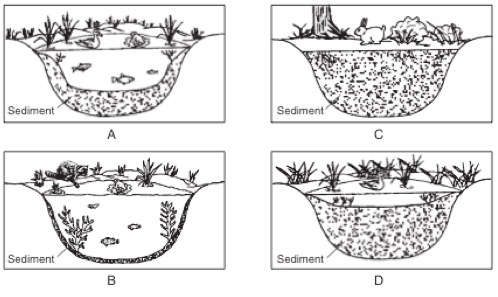
A, B, C, D
D, C, B, A
B, A, D, C
C, D, A, B
20
Multiple Choice
Lichens → Shrubs → Grasses → Trees
Lichens → tree → shrubs→Grasses
Grasses → Lichens → Shrubs → Trees
Lichens → Grasses → Shrubs → Trees
21
Multiple Choice

Secondary Succession
Primary succession
Utter and complete destruction! RAWR!
Climax Communities
22
Multiple Choice

Climax communities
Secondary succession
Primary succession
Pioneer species
23
Multiple Choice

Climax communities
Secondary succession
Lichen
Pioneer species
24
Multiple Choice

Primary Succession
Secondary Succession
Climate Community
Pioneer Species
25
Multiple Choice
primary succession
secondary succession
both types of succession
26
Multiple Choice
primary succession
secondary succession
both types of succession
27
Multiple Choice
ecological succession
climax community
secondary succession
pioneer speciles
28
Multiple Choice
ecological succession
primary succession
secondary succession
pioneer speciles
29
Multiple Choice
ecological succession
primary succession
secondary succession
pioneer speciles
30
Multiple Choice
ecological succession
primary succession
secondary succession
pioneer speciles
31
Reorder

Reorder the following (1 is earliest stage)
Bare Rock
Lichen
Herbs
Shrubs
Oaks
32
Multiple Choice

Bushes and Shrubs
Oak trees
Mossess and Lichens
A rose Bush
33
Multiple Choice
Rocky material left behind by a retreating glacier forms what is called a moraine. When primary succession occurs the moraine, which life-forms will help create the soil by breaking down bare rock?
Insects
Lichens
Grasses
Deciduous trees
Show answer
Auto Play
Slide 1 / 33
SLIDE
Similar Resources on Wayground

25 questions
Unit 6 Origin of Life - DAY 3
Presentation
•
9th - 12th Grade
28 questions
Evolution and Fossil Record
Presentation
•
9th - 12th Grade
28 questions
Evidence for Evolution: Fossil and Biological
Presentation
•
9th - 12th Grade
28 questions
Evolution Fossil
Presentation
•
9th - 12th Grade
29 questions
Classification & Dichotomous Keys
Presentation
•
9th - 12th Grade
25 questions
Semicolons
Presentation
•
9th - 12th Grade
26 questions
Creature Quiz- Birds of Prey
Presentation
•
9th - 12th Grade
26 questions
Darwin's Theory of Evolution
Presentation
•
9th - 12th Grade
Popular Resources on Wayground
5 questions
A Home on the Shore

Quiz
•
3rd Grade
28 questions
US History Regents Review
Quiz
•
11th Grade
6 questions
A Horse Tale
Quiz
•
3rd Grade
20 questions
Math Review
Quiz
•
3rd Grade
10 questions
Juneteenth History and Significance

Interactive video
•
5th - 8th Grade
20 questions
Dividing Fractions
Quiz
•
5th Grade
55 questions
A Long Walk to Water Final Review
Quiz
•
6th - 8th Grade
10 questions
Equation Word Problems
Quiz
•
7th Grade