Search Header Logo
  1. Resource Library
  2. Science
  3. Units And Measurement
  4. Triple Beam Balance
  5. Triple Beam Balance
Triple Beam Balance

Triple Beam Balance

Assessment

Presentation

•

Science

•

8th Grade

•

Hard

Created by

Joseph Anderson

FREE Resource

6 Slides • 22 Questions

1

Scientific Information

  • Observation vs Inference

    • Observation → a fact that is determined by using your 5 senses

      • Example: A dog measures 14 inches tall

      • You can never observe feelings - you can only infer them

    • Inference → what you think based on your observations - it can also be a prediction about the future

      • Example: It is going to rain

    • Scientific Method - An organized way of solving a problem

      • There are about 7 Steps: 

1. Problem - usually in the form of a question that you want to solve

2. Hypothesis - an educated guess based on research and knowledge

3. Design Experiment 

4. Conduct an Experiment - make and record your observations!

5. Analyze Results - use graphs and charts

6. Conclusion - what did you determine?

7. Share your results


media

2

Open Ended

Make an observation about the globe.

3

Open Ended

Make an inference about the globe.

4


Add each number the beam is pointing to.

50 + 100 + 5 = 155 grams

How do I measure mass?

  • The measure of matter inside an object (M&M → Mass & Matter)

    • Measured using a triple beam balance - Usually in grams (g)

Mass

Measurement
media

5

Fill in the Blanks

media image

What is the mass of the object being displayed by this triple beam balance?

6

Fill in the Blanks

media image

What is the mass of the object being displayed by this triple beam balance?

7

Multiple Choice

Question image
What is the mass on this triple beam?
1

221.5g

2

222.5g

3

20g

8

Multiple Choice

Question image

What is the mass of this object?

1

328 grams

2

300.2.8 grams

3

333 grams

4

302.8 grams

9

Volume

The measure of the amount of space an object takes up 

  • Measured using a graduated cylinder - Usually in (mL)

    • In a regular solid, can be measured as volume = length x width x height

    • To find the volume of an irregular shaped object you must use the dunk method!


10

media
​Volume of a Regular Solid

11

media
​The Dunk Method

Volume = 78 mL - 58 mL 

Volume = 20 mL


12

Multiple Choice

What is volume?

1

how heavy it is

2

how much space it takes up

3

how much matter is in the object

4

the shape of the object

13

Multiple Choice

What units is volume measured in?

1

grams

2

degrees

3

milliliters or cm3

4

pounds

14

Multiple Choice

Question image

Which equation would help you find the volume?

1

5-4=1 mL

2

5.6-4.8=0.8 mL

3

4-5=1 mL

4

5+4=9 mL

15

Multiple Choice

Question image

What is the volume of the rock?

1

50 mL

2

75 mL

3

25 mL

4

125 mL

16

Multiple Choice

Question image
Identify the volume of water.
1

22 mL

2

25 mL

3

15 mL

4

25 g

17

Multiple Choice

Question image

What is the volume of the chalk?

1

9 mL

2

19 mL

3

10 mL

4

20 mL

18

Multiple Choice

Question image

What is the volume of this prism?

1

20 ft3

2

8 ft3

3

40 ft3

4

11 ft3

19

Multiple Choice

Question image

What is the volume of this prism?

1

24 cm3

2

240 cm3

3

60 cm3

4

20 cm3

20

media
media

Density →

How tightly packed the molecules are in an object.

Formula: density = mass/volume
d=m/V - Usually g/cm3

●Doesn’t change when you cut or break an
object

●Decreases when you increase the volume -
you can do this by heating it up!

●Increases when you decrease the volume -
you can do this by applying pressure!

●More dense sinks - less dense rises (heat
rises!) “Denser Downer”

21

Multiple Choice

Frank has a paper clip. It has a mass of 9g and a volume of 3cm3. What is its density?
1

3 g/cm3

2

1/3 g/cm3

3

27 g/cm3

4

39 g/cm3

22

Multiple Choice

What is the density of water?
1

0 g/ml

2

1 g/ml

3

10 g/ml

4

100 g/ml

23

Multiple Choice

Question image
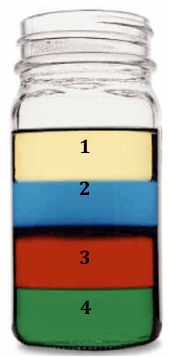
Put the liquids in order from most dense to least dense?
1

4, 3, 2, 1

2

1, 2, 3, 4

3

3, 4, 2, 1, 

4

4, 3, 1, 2

24

Multiple Choice

Question image
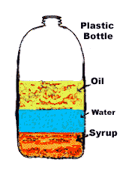
Which liquid is the least dense?
1

oil

2

water

3

syrup 

4

plastic bottle

25

Multiple Choice

What is the formula for density?
1

density = mass x volume

2

density = mass / volume

3

density = mass + volume

4

density = mass - volume

26

Multiple Choice

Why do some substances float on water?
1

they are warmer than water

2

they are cooler than water

3

they are more dense than water

4

they are less dense than water

27

Multiple Choice

Why does ice float?
1

Liquid water is less dense than solid water.

2

Solid water is less dense than liquid water.

3

Gaseous water is less dense than solid water.

4

Liquid water is less dense than gaseous water.

28

Multiple Choice

Question image
Look at this image.  Which object has the LOWEST density in water? How? 
1

The Ping Pong Ball because it floats to the top 

2

The bolt because it has sunk to the bottom

3

The soda cap because it is not just full of air like the Ping Pong ball

pattern-tertiary

Scientific Information

  • Observation vs Inference

    • Observation → a fact that is determined by using your 5 senses

      • Example: A dog measures 14 inches tall

      • You can never observe feelings - you can only infer them

    • Inference → what you think based on your observations - it can also be a prediction about the future

      • Example: It is going to rain

    • Scientific Method - An organized way of solving a problem

      • There are about 7 Steps: 

1. Problem - usually in the form of a question that you want to solve

2. Hypothesis - an educated guess based on research and knowledge

3. Design Experiment 

4. Conduct an Experiment - make and record your observations!

5. Analyze Results - use graphs and charts

6. Conclusion - what did you determine?

7. Share your results


media

Show answer

Auto Play

Slide 1 / 28

SLIDE