
Search Header Logo
Organisms

Organisms

Assessment

Presentation

Science

7th Grade

Hard

Created by

Joseph Anderson

FREE Resource

8 Slides • 22 Questions

1

Organisms and their Environment Review

Slide image

2

Biodiversity

  • The number and variety of organism in an environment

  • The more biodiversity the more stable the ecosystem is.

3

Multiple Choice

What is Biodiversity

1

The number of organism in an ecosystem

2

The variety of organism in an ecosystem

3

The number and variety of organisms in an ecosystem

4

None of these

4

An ecosystem that is not sustainable can break down when a natural disaster occurs.


Slide image

5

Biodiversity and Sustainability

  • variety of species allows more organisms to adapt to changes

  • genetic variation makes it more likely that some individuals will survive a disease outbreak.

  • species with different adaptations makes it more likely that some will survive an ecological disaster.

  • a variety of herbivore species that eat producers helps ensure prey for predators in the ecosystem.

Slide image

6

Multiple Select

Tropical rain forests have the greatest biodiversity of any type of land ecosystem. How does biodiversity contribute to the sustainability of an ecosystem? Choose all that apply.

1

The presence of more species with different adaptations makes it more likely that some organisms will survive an ecological disaster.

2

Greater genetic variation within species makes it more likely that some individuals

will survive a disease outbreak.

3

there are fewer species to be affected by environmental stresses

4

The presence of a variety of herbivore species that can feed on a large number of different producer species helps ensure abundant prey for predators in the ecoosystem.

7

Multiple Choice

An ecosystem that is not sustainable can break down when a natural disaster occurs. This can lead to organisms in the ecosystem either leaving the area or dying off. Increased biodiversity results in a more sustainable ecosystem because —

1

a greater number of plant species means that there is less barren land

2

a greater variety of species present allows more organisms to adapt after changes

occur

3

the transition area between two ecosystems is narrower

4

there are fewer species to be affected by environmental stresses

8

Multiple Choice

Ecologists have shown that —

1

higher animal to plants ratios provides the most stable environment

2

having multiple keystone species is important to ecological stability

3

higher biodiversity in an ecosystem provides better stability

4

ocean ecosystems are far more stable than terrestrial ecosystems

9

Multiple Choice

Question image

Based on these observations in the table, which ecosystem is likely to be the least sustainable?

1

Ecosystem 1, because it has the fewest species

2

Ecosystem 2, because it includes both aquatic and terrestrial species

3

Ecosystem 3, because it has few predators

4

Ecosystem 4, because it supports many animals

10

Multiple Choice

Question image

Which ecosystem would be more likely to survive if a disease killed the grasses?

1

The forest ecosystem, because most of the animals can eat other organisms

2

The grassland ecosystem, because several predators compete for food

3

The forest ecosystem, because it has three top predators

4

The grassland ecosystem, because it has many herbivores

11


  • Primary succession starts with bare rock or sand.

  • Secondary succession: Starts after a natural distaster (established soil)

  • pioneer species modify the area and allow larger and more complex organisms to appear (lichens and mosses)

  • Succession will start with less biodiversity and end with more biodiversity ( climax community)

Slide image

12

Multiple Choice

Question image

Ecological succession is the —

1

process of change to an ecological community over time

2

passing down of advantageous traits to offspring

3

an organism's ability to survive an environmental change

4

the creation of a new species within an ecosystem

13

Multiple Choice

Frederick is studying how ecological succession will change a freshly-plowed piece of land. Which data table represents what Frederick is most likely to record about the plant life in each stage of ecological succession?

1
2
3
4

14

Multiple Select

Check all the examples of primary succession

1

A forest rebuilds after a forest fire

2

New island is created from hot spot in the ocean

3

A tornado completely destroyed a crop of corn.

4

a glacier retreated exposing the bedrock.

15

Multiple Choice

Some student take care of a vegetable garden. When it is time to plant in the spring, the students leave part of the garden empty in order to observe ecological succession. Which of these will most likely occur first?

1

Development of topsoil

2

Growth of weeds and grasses

3

Growth of trees and shrubs

4

Development of a stream

16

Multiple Select

Check all the examples of secondary succession.

1

A forest is completely destroyed in a fire

2

A new island is created by a hotspot in the ocean

3

A tornado completely destroyed a crop of corn

4

a glacier retreats exposing the bed rock.

17

Multiple Choice

Which organisms are common pioneer species?

1

Conifer trees and tall grasses with roots that loosen the soil

2

Mosses and lichens that can grow on rocky surfaces

3

Grasses and weeds that arrive as seeds carried by the wind and then germinate

in rich soil

4

Vines and shrubs that help prevent the erosion of shallow soil

18

Multiple Choice

Weeds are plants that grow in areas where they are unwanted. Often they spread aggressively and damage garden plants by competing with them for sunlight, water, and nutrients. The growth of weeds is the first stage of ecological succession, which acts to —

1

restructure a habitat and allow only the most hardy plants to survive.

2

clear-cut a habitat and allow only the smallest plants to survive.`

3

bring water to a habitat and allow only the most water-loving plants to survive.

4

drain water from a habitat and allow only the most fibrous plants to survive.

19

Multiple Choice

Both primary and secondary succession begin with pioneer species that —

1

modify the area and allow larger and more complex organisms to appear

2

A change the area and make it safer from predatory organisms

3

invade the area so that new organisms cannot be established

4

use up all the existing resources and prevent establishment of non-native organisms

20

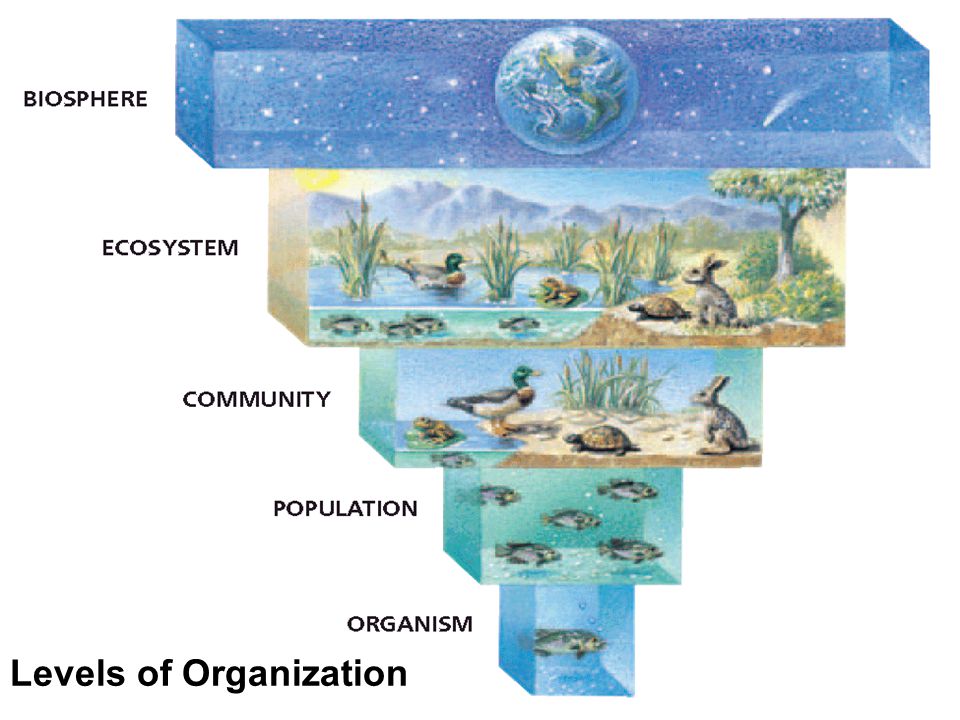
Ecological Levels of Organization

  • organism: one of a species:

  • population: more than one of the same species

  • community: more that one type of species living in an area

  • ecosystem: interaction between abiotic and biotic factors.

  • biome: large region that share similar climate and living organisms
Slide image

21

Multiple Choice

Question image

Which level of organization does this group of rabbits best represent?

1

A population

2

A community

3

An ecosystem

4

An organism

22

Multiple Choice

Question image

Which level of organization does the interaction of the tropical fish with the living tube sponge best represent?

1

community

2

population

3

ecosystem

4

organism

23

Classification

  • There are 3 domains: Archaea, Bacteria, and Eukarya

  • There are 6 Kingdoms: Archaebacteria, Eubacteria, Protista, Fungi, Plantae, and Animalia.

  • All organisms with eukaryotic cells fall in the domain Eukarya.

  • Kingdoms Protista, Fungi, Plantae, and Animalia are under the Eukarya domain.

  • Organism are classified by the characteristics that have...

Slide image

24

Multiple Choice

Which of the following is NOT a reason why scientists classify organisms?

1

So that scientists all over the world can talk about organisms with a common

language

2

So that scientists can organize all the different types of organisms to study them

better

3

So that scientists can more easily identify new organisms that are discovered

4

So that scientists can tell the order in which the organisms were discovered

25

Multiple Choice

The domains of living organisms are —

1

Archaea, Euryarchaeota, and Eukarya, and they are the broadest level of

taxonomic organization.

2

Flustrina, Archaea, and Bryozoa, and they are the second-lowest level of taxonomic organization.

3

Prokarya, Bryozoa, and Bacteria, and they are the lowest level of taxonomic organization.

4

Archaea, Bacteria, and Eukarya, and they are the broadest level of taxonomic

organization.

26

Multiple Choice

Question image

Are these two vastly different organisms classified in the same domain or kingdom?

1

They are classified into the same domain, but they are in different kingdoms.

2

hey are classified into different domains, but they are the same kingdom.

3

They are classified into the same domain and same kingdom.

4

They are classified into different domains and kingdoms.

27

Multiple Choice

There are several million different types of organisms on Earth. Which of the following is the best way to organize them?

1

By the name of the person who discovered them

2

By features or characteristics they share

3

Chronologically by date of discovery

4

Numerically by their age

28

Biomes

  • Large regions that share similar climate and living organism

  • Organism have special adaptations to survive in their particular biome

  • The rainforest is the most productive biome since has the most biodiversity

Slide image

29

Multiple Choice

Question image

A desert environment is home to many lizards, small

mammals, and cacti and other plants with short roots.

1

dry and sandy, allowing small animals to burrow and hide from the Sun while allowing plants with short roots to reach and hold onto water.

2

wet and hard, allowing small animals to rest and stay cool on the wet soil while allowing plants with short root systems to push through the hard soil to soak up water.

3

cold and wet, allowing small animals to remain cool when it rains while allowing plants with short root systems to easily push through sandy soil to soak up water.

4

dry and hard, allowing small animals to lay on the hard soil to get sunlight while allowing plants with short roots to sit on top of the soil and hold onto water.

30

Multiple Choice

The picture below shows manatees, an herbaceous aquatic mammal, traveling along the saltwater estuary of Biscayne Bay in Florida.

How does this saltwater estuary support populations of manatee?

1

It provides shallow water for easy access to oxygen at the water's surface.

2

It provides cold water to keep the manatees cool.

3

It provides heavy currents for fast swimming.

4

It provides several rocks for the manatees to hide from prey that they want to

eat.

Organisms and their Environment Review

Slide image

Show answer

Auto Play

Slide 1 / 30

SLIDE

