Planetary Motion
Presentation
•
Physics
•
8th - 10th Grade
•
Hard

Joseph Anderson
FREE Resource
10 Slides • 20 Questions
1
Planetary Motion
2
The Moon, the planets, the Sun, and the stars all rotate around the Earth (which stays still), with uniform circular motion.
Geocentric Model
3
The Moon, the planets, the Earth, and the stars all rotate around the Sun (which stays still), with uniform circular motion.
Heliocentric Model
4
Multiple Choice
Heliocentric model is Earth-centered.
True
False
5
Multiple Choice
Geocentric model Earth-centered.
True
False
6
Fill in the Blank
The earth is at the center according to _______ model.
7
Fill in the Blank
The Sun is at the center according to _______ model.
8
Kepler's Laws of Planetary Motion
9
The planets move around the Sun in elliptical orbits.
Kepler's First Law
10
A line running from the sun to the planet sweeps out equal areas of the ellipse in equal times.
Kepler's Second Law
11
The squares of the orbital periods of the planets are directly proportional to the cubes of the semi-major axes of their orbits.
Kepler's Third Law
12
13
Multiple Choice
According to Kepler's Model planets travel in ____ orbits.
elliptical
circular
14
Multiple Choice
The closer a planet is to the sun the ____ distance is covered in the same time.
more
less
same
15
Multiple Choice
The closer an orbiting object is to the sun, the _____ it travels.
faster
slower
16
17
Multiple Choice
Which force is required to maintain a body in uniform circular motion?
Muscular force
Gravity force
Centripetal force
Friction force
18
Multiple Choice
Which of the following is the correct definition of centripetal force?
The force that acts away from the centre of the circle when an object is moving on a circular path, is known as centripetal force.
The force that acts between two masses separated from each other by a certain distance, is termed as the centripetal force.
The force that acts between two static charges separated from each other by a distance is termed as the centripetal force.
The force that acts towards the center of the circle when an object is moving on a circular path, is known as centripetal force.
19
Multiple Choice
Which of the following changes when a body performs uniform circular motion?
Mass
Speed
Kinetic energy
Direction
20
Multiple Choice
When a girl rotates a stone tied to a string by swirling the string what force does her hand exert on the string?
Centrifugal
Centripetal
21
Multiple Select
What are the changes in a uniform circular motion?
velocity changes
direction changes
speed changes
mass changes
acceleration changes
22
Multiple Choice
What is centrifugal force?
The force that acts away from the centre of the circle when an object is moving on a circular path, is known as centrifugal force.
The force that acts between two masses separated from each other by a certain distance, is termed as the centrifugal force.
The force that acts between two static charges separated from each other by a distance is termed as the centrifugal force.
The force that acts towards the center of the circle when an object is moving on a circular path, is known as centrifugal force.
23
Multiple Choice
What is the difference between centripetal and centrifugal forces?
Centripetal is towards center while centrifugal is away from the center.
Centrifugal is towards center while centripetal is away from the center.
24
Multiple Choice
Which of the following terms means "center fleeing"?
centrifugal
centripetal
25
Multiple Choice
26
Multiple Choice
What is the relationship between centripetal force and the mass of an object?
direct
inverse
27
Multiple Choice
28
Multiple Choice
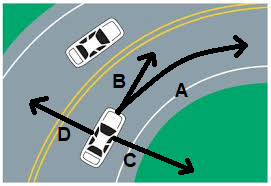
A car is rounding a bend as shown in the diagram. Which arrow correctly shows the direction of the cars velocity?
A
B
C
D
29
Multiple Choice
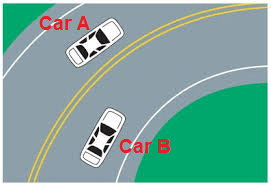
If car A and car B are both traveling at the same speed, which will require a higher centripetal force?
Car A
Car B
They have the same centripetal force
30
Thank You
Planetary Motion
Show answer
Auto Play
Slide 1 / 30
SLIDE

Similar Resources on Wayground
21 questions
1-2 Multiplying a Polynomial by a Monomial
Lesson
•
8th - 10th Grade
26 questions
Transition Words and Phrases (HLA)
Lesson
•
8th - 10th Grade
22 questions
Motion Acceleration
Lesson
•
7th - 11th Grade
23 questions
Solving Literal Equations
Lesson
•
8th - 10th Grade
24 questions
relations and functions
Lesson
•
8th - 10th Grade
24 questions
Types of Slope
Lesson
•
8th - 10th Grade
21 questions
Slope Review
Lesson
•
8th - 10th Grade
21 questions
Preterito con verbos de -car, -gar, zar
Lesson
•
8th - 10th Grade
Popular Resources on Wayground
15 questions
Fractions on a Number Line
Quiz
•
3rd Grade
14 questions
Boundaries & Healthy Relationships
Lesson
•
6th - 8th Grade
13 questions
SMS Cafeteria Expectations Quiz
Quiz
•
6th - 8th Grade
20 questions
Equivalent Fractions
Quiz
•
3rd Grade
25 questions
Multiplication Facts
Quiz
•
5th Grade
12 questions
SMS Restroom Expectations Quiz
Quiz
•
6th - 8th Grade
20 questions
Main Idea and Details
Quiz
•
5th Grade
10 questions
Pi Day Trivia!
Quiz
•
6th - 9th Grade
Discover more resources for Physics
10 questions
Exit Check 5.1 - Forms of Energy
Quiz
•
9th Grade
20 questions
Electricity!
Quiz
•
8th - 9th Grade
20 questions
Calculating Speed, Distance, Time
Quiz
•
8th Grade
20 questions
FORCE AND MOTION
Quiz
•
8th Grade
18 questions
Newton's Laws of Motion
Quiz
•
8th Grade
10 questions
Exploring the Phenomenon of Static Electricity
Interactive video
•
9th - 12th Grade
14 questions
Bill Nye Waves
Interactive video
•
9th - 12th Grade