Search Header Logo
Kinetics

Kinetics

Assessment

Presentation

Science

10th - 12th Grade

Hard

Created by

Joseph Anderson

FREE Resource

18 Slides • 18 Questions

1

AP Chemical Kinetics Review

By Andrew Baldwin

2

media

3

media

4

media

5

media

6

media

7

media

8

Multiple Choice

What is the rate of reaction?
1
How fast a reaction is 
2
How big a reaction is
3
How loud a reaction is
4
How much gas a reaction produces

9

media

10

media

11

media

12

media

13

media

14

media

15

media

16

media

17

media

18

media

19

Multiple Choice

What criteria must be met for reactant collisions to result in a successful product?

1

The reactants must collide with each other

2

The reactants must collide with enough energy and be in the right positions

3

The reactants must have enough energy to form the activated complex

20

Multiple Choice

Increase in temperature of the reactants can do one of the following
1
Slow collision frequency
2
Allow less effective collision between the particles
3
Neutralise the reaction
4
increase collision between the particles thus increasing the rate.

21

Multiple Choice

Why does a higher temperature increase the rate of a reaction?
1
it increases both the frequency and energy of particle collisions
2
it only increases the frequency of particle collisions
3
it only increases the energy of particle collisions
4
it reduces the activation energy of the reaction

22

Multiple Choice

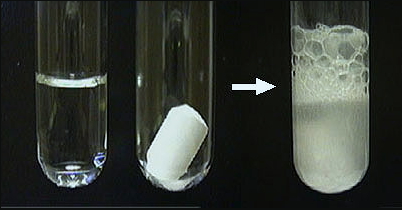
Question image

How could we make this reaction happen more quickly?

1

Decrease the concentration of the acid

2

crush the chalk to increase the surface area

3

Put the test tube in an ice bath

23

Multiple Choice

When surface area is decreased the rate of reaction...

1

Decreases, because there are LESS possible sites for correct collisions

2

Increases, because there are LESS possible sites for correct collisions

3

Decreases, because there are MORE possible sites for correct collisions

4

Increases, because there are MORE possible sites for correct collisions

24

Multiple Choice

How does a catalyst work in speeding up a reaction?

1

By lowering the activation energy or reaction

2

by giving them more energy

3

by making them more available

25

Multiple Choice

Question image
The following graph shows two different reaction pathways for the same overall reaction at the same temperature. Which pathway is slower and why?
1
Red, because the activation energy is larger
2
Blue, because the activation energy is lower
3
both reaction progress at the same rate

26

Multiple Choice

Question image
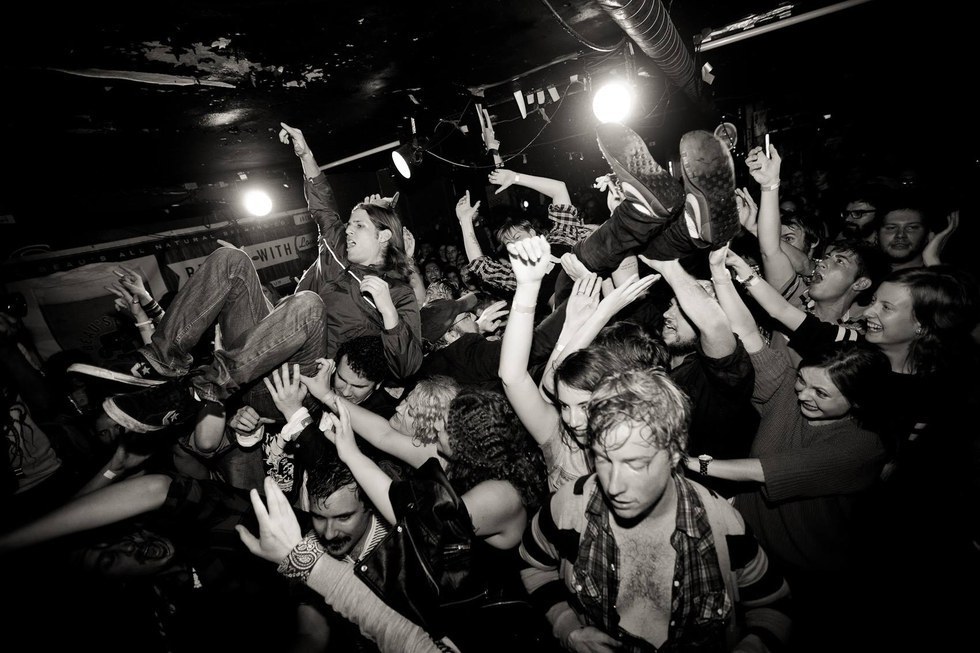
You add more bodies into a "mosh pit" to hope for more collisions.  You have increased-
1
temperature
2
concentration
3
pressure
4
catalyst

27

media

28

Multiple Choice

Question image
1
A. is most exothermic
2
B. is most exothermic
3
C. is most exothermic
4
D. is most exothermic

29

Multiple Choice

Consider the following rate law: Rate = k[A]n[B]m
How are the exponents n and m determined?
1
by using balanced chemical equation
2
By using the subscripts for the formulas
3
By educated guess
4
By experiment 

30

Multiple Choice

For 2A + B → 2C, the rate of production of C has been found to be 12 M/s. During that reaction, the rate of reaction was?
1
12 M/s
2
24 M/s
3
6 M/s
4
Cannot tell without more data

31

Multiple Choice

Question image
The reaction of (CH3)3CBr with hydroxide ion proceeds:
(CH3)3CBr(aq) + OH-(aq) → (CH3)3COH(aq) + Br-(aq)
What will the initial rate (in mol/L*s) be in Experiment 4?
1
0.003
2
0.006
3
0.009
4
0.018

32

Multiple Choice

Question image
1
rate = k[CO]2[O2]2
2
rate = k[CO]2[O2]
3
rate = k[CO][O2]2
4
rate = k[CO][O2]1/2

33

Multiple Choice

If you quadruple the concentration and the rate quadruples, what order is this reaction?

1

zero

2

first

3

second

34

Multiple Choice

Question image

The particles under the purple curve (middle) have an average Kinetic Energy that is proportional to of 500K

1

True

2

False

35

Multiple Choice

___________ are produced in one step and used up in a later step and __________________ are present and unchanged in the reactants and the products

1

intermediates, catalysts

2

catalysts, intermediates

36

Multiple Choice

If a “reaction profile” has a taller ‘hill’ (or activation energy) then the reaction is ____________________?

1

Faster

2

Slower

AP Chemical Kinetics Review

By Andrew Baldwin

Show answer

Auto Play

Slide 1 / 36

SLIDE