Volcanoes and Plate Tectonics
Presentation
•
Science
•
5th - 9th Grade
•
Hard

Joseph Anderson
FREE Resource
13 Slides • 18 Questions
1
Plate Tectonics & Volcanoes
​
2
Pangea & Plate Tectonics
All of the continents formed one major landmass called Pangaea.
Scientists have determined this using the fossils found on different continents of the same species, mountain formations, and similar climate signs.
3
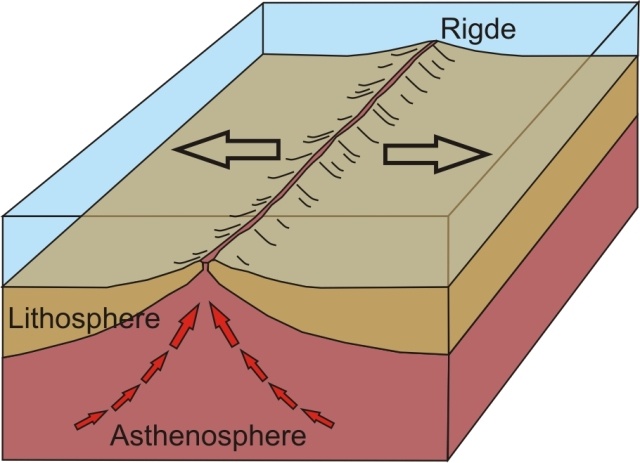
Sea Floor Spreading
Cracks along the ocean floor allow magma to come up and cool.
The cooling magma forms a new crust.
The old crust breaks and the two parts move away from one another.
Oceanic crust is newer than continental crust.
4
Why is the Earth the same size?
New crust is being formed every day at mid-ocean ridges.
However, the old crust is dense and heavy so it sinks in subduction zones or trenches (deepest parts of the oceans).
The old crust is melted back into magma and the process begins again.
5
Multiple Choice
Oceans plates sink back into the mantle at _______________ zones, keeping the crust the same size.
Mid-ocean ridges
Subduction (trenches
Transforming
6
Multiple Choice
_____________________ are undersea that are the deepest part of the ocean.
Divergent trenches
Ocean trenches
Transform trenches
Mid-ocean trenches
7
Multiple Choice
______________________ continually adds materials to the ocean floor creating ocean floor.
Sea-floor spreading
Ocean trenches
Divergent mid-ocean ridges
Convergent mid-ocean ridges
8
Multiple Choice
What evidence supports that the continents were one giant land mass?
Rock formation, weather, fossils
Mountain formation, fossils, climate
Land features, fossils, climate
Valleys, Ocean trenches, climate
9
Plate Tectonic Theory
Earth's lithosphere (crust and upper mantle) is moving around on plates.
The plates move in different directions and at different speeds.
Some plates have whole continents, and some have only oceanic crust.
10
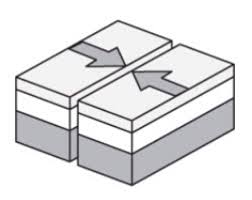
Plate Boundaries: Convergent
Convergent boundaries form where two plates COLLIDE or HIT.
3 things can happen at a convergent boundary.
1. Continent-Continent: the plates buckle and thicken forming mountains.
2. Continent-Oceanic: the oceanic crust subducts (sinks) because it is denser (heavier), volcanic mountains can be found here.
3. Oceanic-Oceanic: the oceanic crust that is denser (heavier) will subducts (sinks), volcanic islands can be found here.
11
12
Multiple Choice
The edges of plates are called....
convection
boundaries
subduction
13
Multiple Choice
When one plate forces it's way under another plate.
convection
boundary
subduction
14
Multiple Choice
What geological feature would an oceanic-continental convergent boundary create?
volcanic mountains
mountains
volcanic islands
15
Multiple Choice
What geological feature would an continental-continental convergent boundary create?
volcanic mountains
mountains
volcanic islands
16
Multiple Choice
What geological feature would an oceanic-oceanic convergent boundary create?
volcanic mountains
mountains
volcanic islands
17
Plate Boundaries: Divergent
Divergent Boundaries move away from one another.
Think of DIVIDE or SPLIT
This is common along mid-ocean ridges where the crust is thinner allowing for magma to rise.
On land, this occurs in rift valleys, when two continents move away from one another.
18
19
20
Plate Boundaries: Transform
When two plates move past each other horizontally, it is a transform boundary.
The plates don't slide smoothly and scrape on one another.
This is the common cause of earthquakes.
21
22
Multiple Choice
Name the boundary
convergent boundary
divergent boundary
transform boundary
sergent boundary
23
Multiple Choice
What kind of plate boundary is shown here?
divergent
convergent
transform
24
Multiple Choice
A subduction zone is formed...
when one tectonic plate sinks below another
at every type of convergent plate boundary
at every type of divergent plate boundary
at transform boundaries
25
Multiple Choice
What geologic feature/event would you most likely to find at a convergent boundary between two pieces of continental crust?
Volcano
Mountain
Rift
Island Arc
26
Multiple Choice
What geologic feature/event would you most likely to find at a divergent boundary between two pieces of oceanic crust?
Rift Valley
Mid-Ocean Ridge
Island Arc
Flat land
27
Multiple Choice
What geologic feature/event you be most likely to find at a transform boundary?
Earthquakes
Volcanoes
Mountains
Rift Valleys
28
Multiple Choice
The diagram shows a landform on Earth. How did the movement of Earth’s plates form the landform?
Two oceanic plates slid past each other.
Two continental plates collided.
One continental plate slid past an oceanic plate.
29
Multiple Choice
What kind of plate boundary is shown here?
divergent
convergent
transform
30
Multiple Choice
What kind of plate boundary is shown here?
divergent
convergent
transform
subducting
31
What are Volcanoes?
A volcano is any place where gas, ash, or melted rocks come out of the ground.
They can be found everywhere on Earth- in the ocean or on land.
Magma is less dense so it rises to the surface and escapes through vents or openings.
Magma on land is called lava.
Plate Tectonics & Volcanoes
​
Show answer
Auto Play
Slide 1 / 31
SLIDE

Similar Resources on Wayground
22 questions
Healthy Habits
Lesson
•
5th - 8th Grade
25 questions
Australia's Physical Features
Lesson
•
4th - 10th Grade
20 questions
Healthy Lifestyles
Lesson
•
4th - 9th Grade
24 questions
Amplify Unit 4 rock transformations review
Lesson
•
6th - 8th Grade
24 questions
Continental Drift Review
Lesson
•
6th - 8th Grade
28 questions
Wave Behavior
Lesson
•
6th - 9th Grade
20 questions
Brain Pop Plate Tectonics
Lesson
•
4th - 9th Grade
24 questions
Earth's Interior
Lesson
•
5th - 8th Grade
Popular Resources on Wayground
15 questions
Fractions on a Number Line
Quiz
•
3rd Grade
14 questions
Boundaries & Healthy Relationships
Lesson
•
6th - 8th Grade
13 questions
SMS Cafeteria Expectations Quiz
Quiz
•
6th - 8th Grade
20 questions
Equivalent Fractions
Quiz
•
3rd Grade
25 questions
Multiplication Facts
Quiz
•
5th Grade
12 questions
SMS Restroom Expectations Quiz
Quiz
•
6th - 8th Grade
20 questions
Main Idea and Details
Quiz
•
5th Grade
10 questions
Pi Day Trivia!
Quiz
•
6th - 9th Grade
Discover more resources for Science
20 questions
Rocks and The Rock Cycle
Quiz
•
6th Grade
20 questions
Food Chains and Food Webs Review
Quiz
•
5th Grade
20 questions
Cell Organelles and Functions
Quiz
•
6th - 8th Grade
10 questions
Exploring the Layers of the Earth
Interactive video
•
6th - 10th Grade
21 questions
Solar System Review
Quiz
•
5th Grade
21 questions
Waves and Wave Properties
Quiz
•
6th - 8th Grade
20 questions
Newton's Laws of Motion
Quiz
•
8th Grade
16 questions
Photosynthesis and Cellular Respiration Review
Quiz
•
7th Grade