
Diversity in Living Organisms
Presentation
•
Science
•
8th Grade
•
Hard

Joseph Anderson
FREE Resource
7 Slides • 42 Questions
1
Geologic Time Scale
A Calendar of Earth's History
Spans 4.6 billion years
2
Natural Selection
Nature selects those with desirable traits, and those survive and reproduce. Over time, the desirable trait becomes the most common because it has been past down generation after generation.
3
Evidence to support the Theory of Evolution
Remember several observations provide evidence for evolution including; natural selection, artfacts in the fossil record, DNA similarties in organisms, embryology, and similarities in anatomy (body structure)
4
Embryology
Rsearching embryos has led to the observation that many organisms start out very similar in their early development.
5
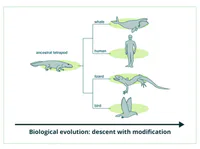
Similar Body Structures
Organisms with similar body structures indicate a common ancestor.
Similar body structures that species have inherited from a common ancestor are called Homologous Structures.
6
The Fossil Record
Almost all fossils found are of extinct animals. Scientist have been able to study Earth's history from these fossils. They have been able to piece together what the past may have been like, and that these ancient remains are ancestors to organisms living today.
7
DNA
DNA, or chemical codes are the instructions, or recipes, for all living things. DNA exists in the cells of all organisms.
Fossilized remains of extinct organisms still contain traces of DNA which can be extracted, duplicated, and compared to the DNA of living organisms.
Comparing ancient DNA to DNA of current species shows scientists how different species are related to each other through their common ancestors.
8
Multiple Choice
Vocab check:
The theory that organisms have slowly changed over time...
fossil record
relative dating
evolution
adaptation
9
Multiple Choice
10
Multiple Choice
11
Multiple Choice
12
Multiple Choice
13
Multiple Choice
14
Multiple Choice
15
Multiple Choice
16
Multiple Choice
17
Multiple Choice
18
Multiple Choice
The variety of organisms that live on the Earth is called_____________.
19
Multiple Choice
20
Multiple Choice
21
Multiple Choice
What is the process in which populations CHANGE gradually over time?
evolution
species
variation
competition
22
Multiple Choice
What do you call similar structures that related species have inherited from a common ancestor?
Natural Selection
Analogous Structure
Vestigial Structure
Homologous Structure
23
Multiple Choice
Millions of fossils that scientists have collected which tells us the history of
the Earth and all living things on it.
scientific theory
fossil record
vestigial structure
natural selection
24
Multiple Choice
Body parts that are structurally similar in related species ant that provide evidence for a common ancestor.
petrified fossil
homologous structure
variation
vestigial structure
25
Multiple Choice
Ancient whales once walked on the Earth more than 45 million years ago.
The remnants of their pelvic, hip, and leg bones still exist in today's cetaceous
mammals (dolphins, whales, porpoises). These structures are called the _________
inherited from ancient walking whales.
homologous structures
petrified fossil
vestigial structures
preserved remains
26
Multiple Choice
Which would be an example of a homologous structure?
a bird beak and a dog mouth
a hippo leg and a whale fin
a dolphin fin and whale fin
a bird wing and a butterfly wing
27
Multiple Select
Which are examples of vestigial structures? Select all that apply!
human appendix
whale pelvis
tail bone
28
Multiple Choice
29
Multiple Choice
30
Multiple Choice
31
Multiple Choice
32
Multiple Choice
33
Multiple Choice
34
Multiple Choice
35
Multiple Choice
36
Multiple Choice
Which rock layer contains the oldest fossil?
A
B
C
D
37
Multiple Choice
Which rock layer contain fossils of the most evolved organism?
A
B
C
D
38
Multiple Choice
The evidence in this diagram supports _______________.
Common Ancestry
Diversity
Heredity
Metamorphosis
39
Multiple Choice
An organ that was used by an ancestor but now serves no current function is described as ______(ex: appendix)
Antiquated
Vascular
Vestigial
Obsolete
40
Multiple Choice
An organism in its earliest stage of life is known as a(n) __________.
baby
whippersnapper
Embryo
infant
41
Multiple Choice
A geologist identifies the identical index fossils in rock layers from 2 different areas. What can be concluded?
The two rock layers were deposited at approximately the same time.
The fossil organism evolved independently in the 2 separate layers
The deposition rate of the 2 layers was identical
42
Multiple Choice
Which best explains why mammals became dominant after the mass extinction of dinosaurs?
They had traits that allowed them to adapt and change to the environment.
They were bigger than dinosaurs.
They were able to hibernate for a long time.
They ate different foods than dinosaurs.
43
Multiple Choice
If a bat, an alligator, and a bird evolved from a common ancestor, what can be concluded?
They have similar anatomical structures
They live in the same part of the world
They are in the same biological classification
44
Multiple Choice
Which evidence supports the idea that life on Earth has continually evolved?
evidence from layers of tree rings
evidence from rock layers, fossils, and ice cores
evidence gathered from melting glaciers
evidence that the climate has changed over the past 100 years
45
Multiple Choice
Which would most likely increase the genetic variation in a population of organisms?
increase in diseases
decrease in diseases
increase in mutations
decrease in mutations
46
Multiple Choice
Which is the best evidence for evolution?
new rock layers containing fossils of simple organisms
new rock layers containing fossils unlike existing organisms
old rock layers containing fossils unlike existing organisms
old rock layers containing fossils of complex organisms
47
Multiple Choice
Which demonstrates how genetic variation may result from a change in the environment where an animal lives?
A salmon swims faster as it enters colder waters.
A snake increases its body temperature because it moves on top of a rock in direct sunlight.
A beetle stands out to predators because it moves among plants that have colors different than its own.
An arctic fox changes its color over time because it migrates to an area with a different climate.
48
Multiple Choice
Why do peppered moths tend to be the same color as the trees on which they live?
The coloring goes along with tasting like the tree.
It keeps the moth the same temperature as the tree.
It makes the moths faster than the birds
It makes the moths harder to see.
49
Multiple Choice
All of these finches have different shaped beaks. They are an adaptation to gain access to different types of
Water
Food
Shelter
Geologic Time Scale
A Calendar of Earth's History
Spans 4.6 billion years
Show answer
Auto Play
Slide 1 / 49
SLIDE

Similar Resources on Wayground
40 questions
ÔN TẬP CUỐI KÌ 1 ĐỊA LÍ NĂM 2024
Lesson
•
7th Grade
45 questions
Human impacts and Global warming
Lesson
•
8th Grade
44 questions
4/12 - Blitz - Physics
Lesson
•
8th Grade
48 questions
Magnets
Lesson
•
8th Grade
42 questions
Andrew Jackson
Lesson
•
8th Grade
44 questions
Physical Properties of Stars
Lesson
•
8th Grade
42 questions
1-Chemistry Basics Lesson
Lesson
•
8th Grade
45 questions
Characteristics of Stars
Lesson
•
8th Grade
Popular Resources on Wayground
10 questions
5.P.1.3 Distance/Time Graphs
Quiz
•
5th Grade
10 questions
Fire Drill
Quiz
•
2nd - 5th Grade
20 questions
Equivalent Fractions
Quiz
•
3rd Grade
15 questions
Hargrett House Quiz: Community & Service
Quiz
•
5th Grade
20 questions
Main Idea and Details
Quiz
•
5th Grade
20 questions
Context Clues
Quiz
•
6th Grade
20 questions
Inferences
Quiz
•
4th Grade
15 questions
Equivalent Fractions
Quiz
•
4th Grade
Discover more resources for Science
20 questions
Recognizing Violence and Being an Upstander
Quiz
•
8th Grade
19 questions
Introduction to Properties of Waves
Lesson
•
6th - 8th Grade
16 questions
Interactions within Ecosystems
Lesson
•
6th - 8th Grade
10 questions
Exploring the Layers of the Earth
Interactive video
•
6th - 10th Grade
20 questions
Newton's Laws of Motion
Quiz
•
8th Grade
46 questions
8th Science STAAR Review
Quiz
•
8th Grade
10 questions
Exploring the Dynamics of Ocean Currents
Interactive video
•
6th - 10th Grade
23 questions
Newton's 3 Laws of Motion
Quiz
•
8th Grade